The Gold Fund
A couple of weeks ago I got a telephone call from David, another ex-pat, whose mother was visiting him in Bishkek for the first time. He wanted to discuss where he could take her, what he could show her, … and, as I work in tourism, he thought I would be a good person to brainstorm some possibilities: … which of the nearby valleys were worth a visit?, was it too early to plan a trip to Lake Issyk Kul?, what shows or concerts were being being performed in town at that time?, were there any exhibitions?, and so on. We discussed various suggestions – the theaters, the parks, the museums – including the Historical Museum.
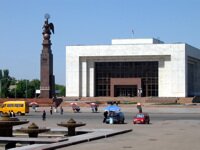
Now, the Historical Museum is located in the large marble clad “cube” in Bishkek’s main square – Ala Too Square, (which has recently undergone a major renovation). In front of the museum stands the statue of “Erkindik”. Erkindik is Kyrgyz for Freedom - or Liberty - and hence the monument is known as Bishkek’s Statue of Liberty. To the right is a large flagpole which flies an enormous Kyrgyz flag – some thirty square meters of flapping crimson and yellow – and attended by two sentries mounting a ceremonial guard. Once in a while the “changing of the guard” gives a fantastic “photo opportunity” as the replacement sentries goose-step their way to the foot of the flagpole
It is listed in most of the guide books to Kyrgyzstan as an interesting place to visit, mainly because it still has large hagiographic displays from the Soviet period depicting scenes from the life of Vladimir Illych Lenin. (It used to be called the Lenin Museum.) You can’t miss him … as soon as you enter the museum there is a large statue of him striding forth above the wide marble staircase in front of you.
I thought that Mum was probably of that age group that would remember the Soviet Union, rather than the Russian Federation, and would probably be interested to see that period of history through a different perspective. When he said, “Yes, of course we’ll do the Historical Museum”, it was almost as if he was dismissive about it … after all Historical Museums are all very similar throughout the world, and although I have fond memories of the guided tour around the one in Tirana, (Albania), I must admit that perhaps it didn’t sound like a scintillating and inspiring suggestion. So I added, almost as an afterthought, “… and see if it is possible to see the “Gold Fund”.”
“What’s that?”, he asked.
A good question … let me try and explain:
The museum has a lot more to offer than just Lenin. The spacious exhibition halls have displays showing the history of the region dating from ancient times, about the culture and handicrafts of the nomadic Kyrgyz and some interesting painted ceilings. Like most museums, however, it has a lot more artifacts than it has the space to display. Much material is kept in store and the public rarely get the opportunity to see it unless some special exhibition is organized. For a long time the Gold Fund was relegated
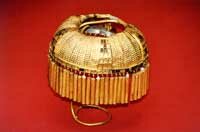
I had heard about the Gold Fund almost as soon as I arrived in Bishkek, some fourteen years ago. The central items of the collection were discovered by accident the Shamsy valley, about sixty kilometers to the East of Bishkek, when a tractor driver ploughing a field dug up some up some ancient Scythian artifacts, including a golden face mask, a headdress and other jewellery. There were rumours that the horde had, like so many other valuable archaeological discoveries, been crated up and shipped off to Moscow or St. Petersburg, (Leningrad), but that wasn’t so. They were safely ensconced in the museum’s strong room and brought out only for special occasions or for some photographer to “snap” for some publication.
Some years later, an official at the Ministry of Culture invited me to a meeting at the Historical Museum and I got my chance to see it. I wasn’t told what I was going to see – I was just told to follow her. We descended into the bowels of the museum, away from the display cabinets to small rooms filled with Dexion shelving and cardboard boxes holding goodness knows what. I signed the record book thinking, “What have I let myself in for?”, and was led past a thick metal door into a small room containing shelving and a large table. One by one, cardboard boxes were taken down from the shelves and opened … and my eyes popped out of my head as they settled on ancient crafted objects.
They started by showing me some small items – archaeological finds made of bronze, some adorned with precious of semi-precious stones. My initial reaction was, basically, blasé … “OK, interesting, but nothing special … The British Museum has plenty of stuff like this …”, but as more and more boxes were opened, I became more interested. It helped that my hosts were able to tell me stories about the discovery of each object, which was as interesting as what the object was, and what it was made of.
I was asked if I thought tourists would be interested to see these exhibits? It was obviously a rhetorical question – Yes, of course they would – but not in the strong room. It was too deep in the building and unwelcoming, and too small – only about four or five visitors could be accommodated at once, with difficulty. However, putting the objects on permanent display was not a viable option – security required a special room and display cabinets, but the Ministry didn’t have the funds available to make it possible.
This is when the Americans enter the story. A special grant paid for the necessary construction work and last year the Gold Fund became a part of the permanent exhibition – albeit for a separate supplementary fee.
When I heard that the Gold Fund was now open for viewing, I tried to arrange a visit to it for my staff. I say “tried” because we failed to get in … first of all the exhibition is not open every day, and then we happened to hit “Lunchtime” … and on that day – there was a visiting delegation and so so lunch was an “extended lunch”, and although we hung around for about an hour, the key holder still hadn’t returned so I said, “Enough, I’m going back to the office!”
Hence, I said to David, “… see if it is possible to see the “Gold Fund”.”
About a week ago, when David called me once again, (about something else), I asked him how his mother’s visit went. “Great,” he said, “and thank you for the suggestion about the Gold Fund – that was really great. She really enjoyed that.”
That whetted my appetite once again. Maybe it was worth another go to try and see it.
Now, it just so happened that on Monday I was walking walking past the Museum and I remembered the conversation, so I decided to call in and ask about the Gold Fund. Now, the museum is closed on Mondays, but the door was open and so I went in. The place was deserted – well, after all, it was technically closed. I walked about looking for someone to ask, and a woman came charging up to me saying: “We’re closed. We’re closed.”
“Yes, I know,”, I replied, “but I wanted to ask about the Gold Fund.”
“Yes, yes. Tomorrow,” she said, “but not now. We’re closed.” Remembering the last time, I asked about lunch – maybe it would be better to come in the morning. “Yes, yes, anytime after ten.”
So, Tuesday, I gathered a small group, (including the three “baseball kids”: Maxim, Andrei and Sveta – see A Baseball Match), and off we marched to the museum. When we arrived I began to get a bad feeling in the pit of my stomach – the girls on the cash desk didn’t seem to know anything and the key holder wasn’t anywhere to be found – history seemed to be repeating itself. This time, however, we only had to wait about ten minutes, and had we been doing a tour round the museum, (but we had all done that before, anyway), then I am sure everything would have been ready for us when we arrived back at the main hall.
We paid the fee and she led us downstairs to a strong room. Not the same one I had been to before – but still downstairs. It was bigger than the previous one and the objects were in display cabinets rather than in cardboard boxes on Dexion shelving. I think I preferred seeing the objects unwrapped, rather than displayed behind glass – but you can’t have everything. I was just glad to see the objects on display at last.
It’s a fairly small exhibit. As well as the Shamsy Horde, the exhibits included artifacts discovered during the construction of the Toktogul Reservoir, a variety of ancient coins and ingots and a couple of ancient Buddhist sculptures. I found the fine craftsmanship fascinating.
All in all, the visit took about half an hour, or about an hour and a half together the walk to and from the office and the ten minute wait for the key to be found. It made a pleasant break from the daily routine.


 Bishkek