Better late than never …
Rasporyazheniye
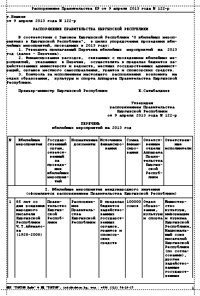
With an impeccable sense of timing, on April 9th the Kyrgyz Government issued a Rasporyazheniye, (an order), approving a list of some 19 anniversaries to be officially commemorated in 2013: the birthdays of eighteen famous people and one institution. It approves and sets a budget, (a modest budget to be sure), to run various events and competitions.
I hope you will excuse my sarcasm when I refer to ” an impeccable sense of timing”, but it strikes me as odd that at least five of the anniversaries had already passed (… and, when I say “at least”, that is because I can’t find the actual date for five of the anniversaries), but I suppose it is a case of “better late than never”.
For the record: it was worse two years ago when the equivalent list for 2011 was authorised only on 1st June … but last year was much better, with the list being authorized before the end of January … so this year’s tardiness is very much a case of backsliding.
I hope you will also excuse my apparent sarcasm in referring to “eighteen famous people ” … as most people outside Kyrgyzstan’s borders may not recognize most of them – and trying to find out who they all were has proved difficult … in some cases the only information I could find was in Kyrgyz – so I’ll have to get someone to read it to me – and for a couple I couldn’t find any information at all. I suppose that shouldn’t be too surprising, after all, these are deemed to be national commemorations and the characters are presumably important in the history and cultural life of the people of Kyrgyzstan.
I presume, however, that this might change as the anniversaries approach and the Kyrgyz media start to pay attention to the various activities that are organized to commemorate the occasion … I have already seen a number of articles, for example about Panfilov and Manuilova.
- the 120th anniversary of the birth of the soldier and Hero of the Soviet Union, Ivan Vasilievich Panfilov, (1st January, 1893 [... actually, because Russia was then on the Julian Calendar, he was actually born on 20th December 1892 ... but we'll let that pass for now ... it was, after all January 1st in the rest of the world] - 18th November, 1941)
- the 110th anniversary of the birth of the composer Vladimir Alexandrovich Vlasov, (7th January, 1903 [... actually, because Russia was then on the Julian Calendar, he was actually born on 25th December 1902 ... but we'll let that pass for now ... it was, after all January 7th in the rest of the world]- 1986). Vlasov was actually born in Moscow, where he graduated from the Conservatory, taught music, (notably the theory of music and violin), as well as composing and performing. He arrived in Kyrgyzstan in 1936 and was to make made an impact on the creative life of the Republic, being a friend of Maldybaev and his fellow Muscovite Feret, who were known collectively as “the trio”. Their first collaborative effort was the musical drama Altyn Kyz – Golden Girl – which was followed by a host of other works. He also wrote a lot of pieces on his own. His range included symphonic and chamber music as well as well as ballet.
- the 80th anniversary of the establishment of the Kyrgyz National Agrarian University named in honour of Konstantin Skryabinm (officially, 0n 1st February, 1933). Originally established as a separate university faculty specializing in Agricultural Science, (the first students studied Veterinarian Sciences), in 1943 it transferred to the Academy of Sciences of the USSR. This was just one of the many reorganizations and transformations that the institution has undergone since it was founded, that have resulted in it being the oldest and most diversified. After the Second World War, specialist departments or faculties in Irrigation, Agricultural Mechanization, Economics, Engineering and Technological Innovation … there are now seven separate faculties … oh, and a teaching farm. Currently there are 7000 students, (in its eighty years there have been over 50000 graduates), studying 32 different specialties.
- the 80th anniversary of the birth of the poet Esengul Ibraeva, (16th March, 1934 – 2005). Ibraev was born into a farming family in the Naryn region and studied in the State Teachers’ College in Naryn, graduating in Journalism and Philology. She worked in several posts working with young people within the region and on luiterary magazines. His first collection of poems, “My Little Brother” was published in 1954 and several individual poems were published in Russia, Poland and East Germany as well as here in Kyrgyzstan.
- the 100th anniversary of the birth of the author, poet, dramatist and translator Raikan Shukurbekov, (1st April, 1913 – 23rd May, 1964). Born into a herder’s family in the Talas region, he lost his parents at an early age and was brought up in an orphanage where he learned to read and write. In 1928 he was moved to Bishkek, (or Frunze, as it was then called), and later graduated from the Kyrgyz Teacher Training College. After that he began working at the Kyrgyz Drama Theater. He began writing and a couple of his stories based on the events of 1916 were published – one in 1929 and another in 1936. His first play was staged in 1934. During the Second World War, (or Great Patriotic War, as it is known here), he went to the front but was wounded and returned home as an invalid, some of his poems written at the time were later published to great acclaim. He continued his writing and also translated a number of classics from world literature, (by authors such as Chekov, Gorky, Schiller and Moliere), into Kyrgyz,
The ten anniversaries where I could discover a specific date were:
- the 80th anniversary of the birth of the politician and statesman Absanat Masalievish Masaliev, (10th April, 1933 – 31st July, 2004) … the next day after the order was approved! .. I have already written a postcard about Masaliev so I won’t add anything here.
- the 90th anniversary of the birth of the conductor Asankhan Dzhumahmatov, (16th June, 1923 – 21st July, 2008). Born in the village of Issyk Ata, his father was arrested and exiled to Siberia he was relocated along with his mother and brother to the Ukraine where he began to study music. He returned to Kyrgyzstan and started studying to be a teacher whilst simultaneously working in the Opera and Ballet Theater. He spent some time in Moscow and was repatriated at the outbreak of hostilities, in 1941, when the Germans invaded. He volunteered and signed up for the Red Army, participating in the Battle for Stalingrad where he was severely wounded. After fighting in the Great Patriotic War, Dzumahmatov attended the Moscow Conservatory and at the same time worked in the Theater. He became the Principal conductor at the Kyrgyz Opera and Ballet Theater, where he was instrumental in bringing many classics into the reservoir, as well as the State Orchestra of Folk Instruments. He was instrumental in creating the orchestra for Kyrgyz state Television and Radio and also a Chamber Orchestra. He had a wide repertoire that covered the genres of classical, traditional and even pop music. He orchestrated over fifty classical instrumental pieces.
- the 130th Anniversary of the birth of the Manaschi, Moldobasan Musulmankul, (20th June, 1883 – 16th June, 1961). Born in the village of Ak Terek in the Talin district of Naryn, both his father and older brother were gifted manaschi in their own right. He exhibited his own talent at an early age and was already a famous performer by the time he was seventeen – eventually becoming one of the most famous manashi of his day, combining the clear recitation of the verbal content with movement – “the motion of his hands as if he had some magical instrument presenting the picture” – and dynamic facial expressions, portrayiong both “pride and dignity”. A copy of two hundred thousand lines of his version of the epic are kept in the collection of the Academy of Sciences. He wasn’t only, however, a manaschi but was involved in several aspects of developing Kyrgyz culture. When the Philharmonia opened its doors in the 1930′s, he was one of the first performers to be featured in their programme – but he didn’t just reserve his appearances for the large stage – he also traveled around the villages and jailoo (high mountain meadows) giving spirited performances.
- the 100th anniversary of the birth of the linguist Bolot Muratalievich Yunusaliev, (6th October 1913 – 1970). Born into a peasnt family in the Chon Kemin district, he graduated from the local Technical College. Yunusaliev then graduated as a translator and editor from the Moscow Pedagogical Institute before working in the Education Commissariat. During the Great Patriotic War he worked as a journalist on the front line. Serving for six years as the Minister of Education in the Kyrgyz SSR, at the same time earning a doctorate, and later became Rector at the Kyrgyz State University and then the Academy of Sciences. He was a specialist in Turkic philology and did extensive research on the Manas epic - including a comparison of the text of the main versions that exist.
- the 90th anniversary of the birth of the actress Bakken Kydykeeva, (20th October, 1923 [... although some sources suggest that should be September] – 15th January, 1994 [... actually, although the list cites her death as occurring in 1994, Wikipedia lists her death as occurring on 30th December 1933 - there's a note sayiong that she was hit by a bus and the body lay in the morgue for 18 days - which is something that is almost unheard of here in Central Asia where funerals normally take place within three days - if not before the sun sets on the day the person dies - and would have been a shocking thing at the time]). Born in a village that is now a district of the capital Bishkek, she began acting whilst still a schoolgirl. Despite her father’s opposition, she decided upon pursuing a career on the stage and landed a leading role which made her name in the Republic – and also placated her father’s ire. During the war years she performed in the regional theaters in Karakol, Naryn and Osh. She was also cast in a variety of films, (both in Kyrgyzstan and Uzbekistan), whilst continuing her stage career, playing in may Kyrgyz Premieres of theatrical classics from around the world. Her 120 or so roles included some of the major Shakespearean female characters.
- the 90th anniversary of the birth of the writer Dz. Manlyanov, (23rd October, 1923 – 2003) … unfortunately, my researches into Manlyanov have so far drawn a blank … so far … I have got some homework to do.
- the 70th anniversary of the birth of the statesman and politician, Nasirdin Isanov, (7th November, 1943 – 29th November, 1991) .. I have already written a postcard about Isanov so I won’t add anything here.
- the 60th anniversary of the sportsman Kanybek Osmanaliev, (b. 19th November, 1953). He’s the only person on the list who is still alive. A weightlifter who competed as part of the team of the Soviet Union in 1980, and the first ever gold medal won by a Kyrgyz athlete. He not only won the gold in his class, he was also three times world champion (in 1978, 1979 and 1981). One of five children, he lost his father at an early age and whilst still at High School he was soon working to help support the family. However, one of his relatives saw his potential ability persuaded his mother to let him finish his education. After school, he enrolled in the Kyrgyz State University and, almost by accident, got involved in weightlifting – being spotted doing sit-ups with a barbell by a coach during a Sports class. Becoming the Youth Champion of the Soviet Union in 1975, he went on to win the European Championships, the World Championships … and the Olympics. After the games he returned to Frunze, (as Bishkek was then called) and taught History.
- the 120th anniversary of the birth of the sculptor Olga Manuilova, (24th November, 1893 – 1984) … I have already written a postcard about Manuilova so I won’t add anything here.
- the 95th anniversary of the author, playwright and diplomat Chinghiz Aitmatov, (12th December 1928 – 10th June, 2008) a.. I have already written a postcard about Aitmatov so I won’t add anything here.
In addition, there were some anniversaries where I have not been able to find a concrete or specific date:
- the 130th anniversary of the birth of the poet and improviser Kalyk Akiev, (1883 – 3rd November, 1953) … I have already written a postcard about Akiev so I won’t add anything here.
- the 100th anniversary of the birth of Actor and director A. Kobogonov, (1913 – 1992) … unfortunately, my researches into Kobogonov have drawn a blank … so far … I have got some homework to do.
- the 100th anniversary of the birth statesman and teacher Sultan Toktogonvo, (1913 – 2006) … unfortunately, my researches into Toktogonvo have drawn a blank … so far … I have got some homework to do.
- the 90th anniversary of the poet Baizakov, (1923 – 1992). Baizakov was born in the village of Bokei in the Suzak district of Osh. After finishing High School he attended the Teacher’s Training college in Djalal Abad. Wounded in the Second World War, he returned to Kyrgyzstan aorked as a teacher and director at a school in his home district, where he also edited the local newspaper. In 1954 he started working for the Communist Party and in the printing firm Goskomisdat - eventually becoming editor in chief at the Kyrgyzstan publishing house. His first published poems appeared in 1946 and an anthology was published in 1958 – although he wrote in Kyrgyz, he also published three anthologies in Russian. He also translated a number of works into Kyrgyz and worked on critical works.


 Bishkek