Isanov and Isanova
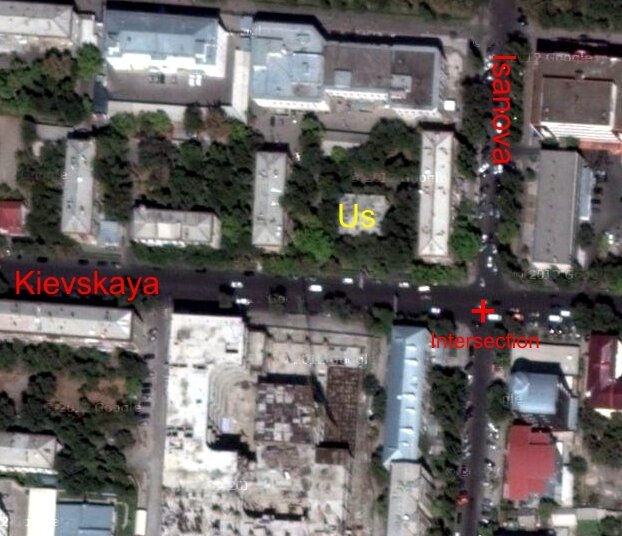
The intersection of Kievskaya-Isanova
A phrase you often hear in Bishkek is: “What’s the intersection?”. The layout of the modern city is based upon plans drawn up by Military engineers towards the end of the nineteenth century and the city centre comprises a grid like pattern and when asking for directions to somewhere you haven’t been before – the intersection is an obvious and easy point of reference.
My office, for example, is on Kievskaya-Isanova. We are not exactly on the corner but just one building from the intersection and it is no problem to explain: walk along Kievskaya from the crossroads towards Prospect Manas, and we are in the second building on the right.

Nasirdin Isanov
Kievskaya is obviously named after the city that was the first capital of Russia, but is now the capital of Ukraine … Isanova is named for the first Prime Minister of independent Kyrgyzstan, Nasirdin Isanov.
He was born in the village of Kok Bel in the Nookat District of Osh oblast in South Kyrgyzstan on 7 November, 1943. Although it was a holiday, commemorating the Great October Revolution, there was probably wasn’t much of a celebration that year because it was the middle of the war.
He began his working career at the age of 17 in Moscow in Moszhilstroy which built apartments. A year later he entered the Moscow Civil Engineering Institutre and graduated in 1966.
He returned to his native Kyrgyzstan and for several years he worked in the construction industry – at first in the Osh oblast and later in Naryn.
After joining the Communist Party in 1969, he rose through party structures, becoming first secretary of the Osh regional Komsomol. He undertook other courses of study In 1983 he became Construction Minister in the Kygyz Soviet Republic, progressing a few years later to Chairman of the Issyk Kul oblast. In 1990 he became a Doctor of Economic Science and member of the Academy of Sciences … and a Vice President of the republic and a People’s Deputy of the USSR.
Then, in January 1991 he was appointed Prime Minister of the Republic of Kyrgyzstan which, at that time, was still a constituent republic of the USSR. When, in August, Kyrgyzstan declared its independence, he assumed the mantle of Prime Minister of the new country, a post he held until his untimely death in a car accident later that year, (on 29 November 1991).
Apparently there were some questions about the car crash – returning to Bishkek after a working trip to Osh.

The statue of Nasirdin Isanov at the intersection of Moskovskaya and Erkindik
He is buried in Ala-Archa cemetery in Bishkek.
During his life ghe was awarded the Order of the Red Banner and the Badge of Honour,
For the record: Isanova street which is named in his honour, stretches from the Railway, North to the Big Chui Canal (Bolshoi Chuiski Canal, which is known locally as the “B-Ch-Ka”).
Like many of the streets in Bishkek, Ivanova has been known by many names of the years:
- Until 1924 it was known as Giorgievska Street;
- In 1924 it was renamed Pushkin Street, after the famous Russian Poet;
- In 1938 it was renamed again as Molotov Street, after the Foreign Minister of the Soviet Union – and the inventor of the “Molotov Cocktail”;
- 1957 saw the 40th anniversary of the October Revolution which brought the Bolsheviks to power – and the street was renamed Sorok Let Oktabrya (“40 years of October”)
- The name “Sorok Let” lasted for 34 years, until 1991, when the street was renamed Isanova Street, after the first Prime Minister of the Kyrgyz Republic – in 1991 – who died suddenly in “mysterious” cirumstances in a car accident.
In 1882, the area at the southern end of the street was allocated to 150 families of Dungan (Hui) refugees and became known as the Dunganskaya Sloboda (“Chinatown”). Just to the East (where Togolok Moldo square is now) was the town rubbish dump. They lived in flat-roofed single storied houses surrounded by high walls, but nothing remains of this old community (except perhaps the layout of the various alleys to the East) as in the 1930′s the area was levelled and redeveloped by the authorities … the inhabitants being relocated to “rural facilities”.




 Bishkek