Manaschi
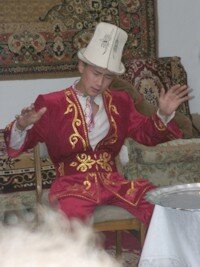
If the story of Manas is central to Kyrgyz traditional culture and character, psychology and spirit – The Manaschi holds a special place of respect in Kyrgyz Culture.
The manaschi, (traditionally they are always men – although some women have taken to narrating the story as well), alternates between a rapid declamatory style when narrating factual information, and a strongly rhythmic recitative for depicting dialogue and direct quotation. They use dramatic gestures, changes in tone, pitch and facial expressions as an integral part of their performance – employing all to hold the attention of the audience.
In many ways the recital of the epic by the manaschi is indeed a performance … the chanting involves the manaschi appearing to go into a trance … it almost seems as if he can see the scenes he is describing unfolding before him. He can waive his arms to indicate the armies approaching each other, his voice and facial expressions taking on the characters of the personalities as they play out their role and some foreigners have been known to say that they, too, can see the scenes enacted out before them – even though they cannot understand the language.
It is possible, (probable, even) that, as the epic did not exist in written form until quite recently, that it may have changed quite considerably over the years … even if the main episodes are still intact. Improvisation was a highly skilled art amongst the nomads – and many akyns were masters at it. The scholar Radlov, writing in 1885, points out that the language used in the version dictated by a manaschi for him was “very modern, corresponding to the present day Kyrgyz language without archaic words or phrases” – suggesting that in at least this respect, up until this time, the oral tradition was adapted to the “contemporary” audience.
One scholar, Musaev, comments that, although memorising and reciting the text of the epic is important, the role of the manaschi was not simply one of repeating verses which had been committed to memory – but is rather that of a storyteller, bound by tradition and the basic elements of the epic. He tells how “the audience during the epic performance are, as a rule, very active participants … ” and Radlov tells how he witnessed manaschi – sensitive to the restlessness of the audience adapted his performance accordingly. “Because any talented narrator’s performance is guided by inspiration, he never performs word for word the same piece twice,” but that doesn’t mean he was inventing new verses – just adapting the basic elements to reflect the mood and context of the performance.
Musaev identifies four stages through which a manaschi passes:
- uyronshuk manaschi – beginners – who are usually “apprenticed” to an experienced manaschi and learning the verses, techniques and other aspects of the craft of the manashi;
- chala manaschi – literally “untrue manaschi” – who have learned and perform a limited number of passages (usually the most popular ones);
- chynyghy manaschi – literally “true manaschis” – who know the complete epic and its performance is their sole occupation;
- chon manashi – or “great manaschi” – who not only have thorough knowledge of the epic, but also considerable skill in narrating it.
Becoming a manaschi carries a considerable responsibility. Not All manaschi welcome the prospect … many say: “I didn’t choose to become a manaschi, I was chosen”. It is not just the prospect of having to learn the world’s longest epic by heart – traditional holds that the manaschi must possess “a clean, open heart” – one saying goes: “Manas will punish you if you tell his tale with a dirty soul”. A manaschi must never refuse to tell, or teach someone, the story of Manas. It is a duty to pass it on.
Most manashi consider that they have been endowed with a “gift” for narrating the epic and the acquisition, or bestowing, of this gift is often linked to a dream. For example, the great manaschi Sayakbai Karalaev tells how he became an unwilling manaschi having experienced a mystical dream where the hero forced him to eat soil.
Such manaschi are believed to be blessed, and audiences try to imbue themselves with their power – drinking drops of tea left in his cup, and one manaschi reports that he often finds shirt buttons missing after a performance!
Although it is possible sometimes to catch a performance by a manaschi in the cities, there is something special about experiencing one in a jailoo – under the open sky, just as it would have been told in times gone by.






 Bishkek