Kalyk Akiev
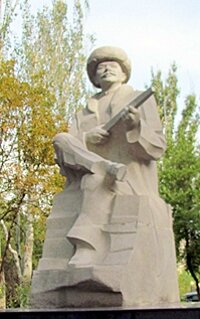
Statue of the Akyn Kalyk Akieva at the intersection of Kalyk Akieva Street and Prospect Chui
There is a street in Bishkek that used to cause me a certain amount of difficulties when I first came here – because I could never pronounce it correctly. It really shouldn’t have been a problem because Kalyk Akieva is not particularly difficult to pronounce.
The problem was that, at the time, the President of Kyrgyzstan was Askar Akaev and I always seemed to say Kalyk Akaeva … which would cause people to stop, do a double and then beam a wide grin as if to say “Who is this crazy ignorant foreigner?“.
For the record: As far as I am aware, Askar Akaev and Kalyk Akiev were not related in any way – apart from both being Kyrgyz – famous and influential Kyrgyz people in their own way.
The street is a fairly major thoroughfare, (running North – or down – from just below the Railway line across Bokonbaeva, Moscovskaya, Toktogula, Kievskaya streets, Prospect Chui, Frunze and Jibek Jolu), although it is not one of the city centre’s main streets. Where it crosses Prospect Chui there is a relatively new statue, (erected in September 2011), of the Kyrgyz Akyn in whose honour the street is named.
Kalyk Akiev was an Akyn, or bard, an improviser, singer and storyteller. He was born in 1883 into a poor family in the village of Kuldzhigach – which is in the Jumgal region in the North of Naryn oblast. His childhood and adolescent years were spent in the area of Chatkaragay in the Ketmen-Tube valley, (in the Toktogul district near the present site of the Toktogul Reservior).
From the age of 12 he attended the Aitysh; contests that were usually held at sumptuous feasts or on holidays, between Akyns who would improvise verses, many of which he would perform songs poking fun at the local bais and manaps. During these he listened intently and learned the songs of famous akyns such as Eshmambeta, Kalmyrzy, Dzhengidzhoka and, of course, Toktogul.
His first meeting with the great master took place, according to Akiev’s own account, when he was 13 years old. By the age 18, he had begun to perform his own songs, which seem to have been a bit too pointed for the local bais and manaps, as he forced to flee … travelling back and forth between Jumgal and KetmenTube. He met up with Toktogul once more and for some eight years they travelled together through Ketmen-Tube, the Talas, Chui and Fergana valleys, performing and speaking to the people. During this period, their joint compositions included well known songs: “Salamdashuu” (“Toast”), “Karymshaktykyndagy yp” (“Song, sung at Karymshaka”), “Andijan tarabynda” (“By the side of Andijan”). After the death of Toktogul, Akiev devoted a lot of energy collecting and publishing the work of his great teacher.
He was active performing before people during the events of 1916, urging them to take their freedom.
With the advent of the Soviet Union, Akiev was actively involved amongst the Kyrgyz in support of socialism in the new country, becoming the chairman of his local village council. In 1919, he attended the Semirechiye Workers Congress in Almaty and performing for the delegates.
He continued composing and performing. He composed songs, for example, about the accomplishment of the Great October Revolution, travelling between villages, performing them and calling on the working classes to build a new life. In 1918-1919 he composed the songs “Zhakshy tosup Alale“, (“Let’s meet good”), “Kytaydan kaytkan tuugandarga” (“Kinsman, returned from China”).
In 1926 he went to work as a professional musician at the Kyrgyz Musical Dramatic Studio, and in 1930 he transferred to the Kyrgyz Drama Theatre. Then, from 1936, he worked at the Kyrgyz State Philharmonic Society. His works began to appear in the Kyrgyz press in the 1930′s, including the collection “Kalyktyn yrlary” (“Poems of Kalyk”), in 1936. He also recorded and published the folk tale “Ah karyshkyr” (“Hungry Wolf”), the epic poems of “Kurmanbek“, “Djanysh-Baiysh.”
Amongst the honours which were showered on him were the titles: People’s Artist of the Kyrgyz SSR (in 1939), elected as a member of the Writers’ Union in 1938, awarded the Order of the Red Banner, “Badge of Honor” and the medal “For Labour Valour” as well as the Diploma of the Supreme Soviet of the Kyrgyz SSR.
He died on 3rd November, 1953.




 Bishkek