Absanat Masalievish Masaliev
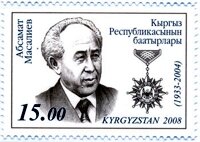 Today marks the 80th anniversary of the birth of Absamat Masalievich Masaliev who served as the leader of the Kyrgyz Soviet Socialist Republic in the final years before the dissolution of the Soviet Union and Kyrgyzstan became an independent state.
Following independence he served as the leader of the Party of Communists of Kyrgyzstan until his death on 31st July 2004, the result of a heart attack.
Earlier this year it was decided that the jubilee would be commemorated by a number of special events.
Masaliev was born in the village of Alysh in the Kadjimai district of the Osh oblast, although now a part of Batken oblast), in Southern Kyrgyzstan on 10th April, 1936.
A mining engineer by profession, he entered the the Kizil Kiya Mountain College, (a Mining Technical School), in Southern Kyrgyzstan, graduating in 1953 before studying for three years at the Moscow Mining Institute, after which he worked as an engineer at the Kyzyl Kiya coal mine in southern Kyrgyzstan.
In 1961 he became an instructor or the regional branch of the Communist Party in Osh and worked his way up through the party ranks in the South, Frunze (Bishkek) and Issyk Kul as well as at the National level. Eventually he reached the post of First Secretary of the party in 1985, and for several months in 1990 he was the Chairman of the Supreme Soviet.
As well as serving as a member of the Kyrgyz Supreme Soviet, he was also a member of the Supreme Soviet of the USSR.
He was appointed First Secretary under Mikhail Gorbachev’s patronage in a campaign to replace Brezhnev appointees having strongly criticized Usubaliev, his predecessor, for “nepotism” and departing from the Party Line as handed down from Moscow. Even so, (at least according to one Western commentator), he was only a “lukewarm supporter” of perestroika, and was identified with the “hard-line” members of the party leadership, opposing informal political movements and forbidding public meetings of reform groups. Facing rising criticism of his leadership, problems over housing shortages and rising ethnic tensions, (including the Osh riots of 1990, the handling of which cost him Gorbachev’s support), his position was becoming more untenable with more and more open opposition and demonstrations being staged in protest to his government.
In December 1990, there was an election held for the newly created post of President of the Republic. There were two candidates, one Masaliev being one of them. However, neither of the candidates could achieve a majority and so Askar Akaev was chosen as a compromise candidate and became the first President of the republic.
After the election there was, apparently, an uneasy “duality” with Masaliev supported by the extensive party and state bureaucracy, whilst Akaev had to rely on public support and political maneuverings by different factions in the parliament. As time passed, however, Akaev strengthened his position and pursued political reform, and eventually Masaliev resigned from the chairmanship, although remained as head of the Communist Party in the republic.
In 1995, Masaliev contested the Presidential election, (as an “independent” candidate), but with just 24% of the vote, lost to the incumbent who achieved a landslide victory – most of his support being drawn from his home base in the Osh and Djalal Abad regions.
Masaliev did not retire from public life, however, serving as a deputy in the Legislative Assembly, the lower house of the Jogorku Kenesh, (the parliament) – at that time the parliament consisted of two chambers, although now there is just the one.
Married, he had four children, two sons and two daughters. One of the sons, Iskhak, went on to head the Communist Party and is currently Chairman of the State Tax Service.
He has a street named in his honour in Osh, and there is a monument erected in his memory in the Central Square in Batken.





 Bishkek