Urkun – 1916
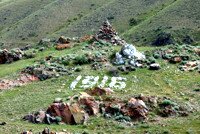
If you travel along the road from Bishkek to Issyk Kul, as you leave behind the roadside yurt encampment of Holodniya Voda (Cold Water) and enter Boom Gorge there is a monument on the right hand side of the road – where a series of whitewashed stones display the date 1916, which commemorates Urkun – an important event in local history. (In 2006, a monument was also erected here to represent the 90th anniversary).
In the summer of 1916, the Russian Empire ordered a call up of non-Russians in the colonies that comprised the Russian empire to help feed its desperate war effort in Europe. The Imperial Decree of 26th June 1916 was transmitted to Pishpek via Tashkent. It was quite specific … the locals were not to be drafted as combatants, but for support activities such as food production and road building – thus freeing the soldiers on these duties for combat. The wording of the decree was unfortunate in that it apparently referred to “requisition” rather than “conscription” – implying that the draftees were considered as “objects” rather than as people.
To make matters worse, rich “draftees” could pay for substitutes to serve in their place. The poor Kyrgyz felt forgotten and frustrated – as much ill-feeling was directed towards their feudal “overlords” (who made much use of the “substitutes”) as against the Russians. There had already been requisitions of food and property to help pay for the distant war and when the herdsmen complained they were told simply that “everyone was making sacrifices”.
There were attempts by the local Khans to prevent or delay the implementation of the decree. According to some sources, the first uprising was in Khodjent on July 4th 1916 and the movement spread to other parts of the Russian province of Turkestan. On July 11th a mass protest took place in Tashkent and the police fired shots into the crowd. The Russians arrested an additional group and summarily executing thirty-five people. The Russian settlers, who had been brought into Tashkent some thirty to forty years earlier, began looting, apparently at the instigation of the Russian police. At this, the Central Asian response stiffened.
The revolt in Northern Kyrgyzstan seems to have been centered on Tokmok, but although many of the surrounding villages were raided Pishkek (Bishkek), itself, was more or less untroubled by the uprising – possibly because it housed a strong garrison. Mounted groups of Kyrgyz – armed with spears, pitchforks and guns began attacking the Russian militia, imperial officials and Russian sympathizers of all nationalities. Their first targets were the Russian police headquarters, to acquire weapons – their only source of supply. Houses and haystacks were burnt, property stolen, women and children abducted, and many people were killed. Two local chiefs were declared Khans, and the idea grew up of establishing an independent state and there were some cases where local Europeans supported the rebels – but this is often forgotten.
Prezhervalsk (Karakol) was besieged from August 10th until August 27th – and it was at this time that the golden baton held by the eagle in the Prezhervalsk memorial disappeared.
The official Russian response was to declare martial law in Turkestan (and the Caucasus as well), and a lower quota of laborers to be drafted under the 25 June decree was announced. The new Russian statements, however, did not change the conditions. Russian settlers organized barricades and mounted vigilante patrols to defend themselves and fight back. A Cossack army led by General Aninnekov was sent from Verney (Almaty), and others from Ferghana and Tashkent and other regions of the far flung empire, to crush the rebellion. Even prisoners of war, who were being held in Russian POW camps in Central Asia, were recruited by the Russian generals as mercenaries with regular pay. The vigilantes and the army were given free reign and the result was a series of massive reprisals – slaughtering flocks, burning down Kyrgyz villages, killing men women and children, (according to eyewitness accounts, massacred even “babies in the cradle”), and hundreds of people were arrested. It is said that the trials in Pishpek were so disorganized that the authorities lost track of the people that had been executed..
More Russian settlers were brought in to occupy confiscated Central Asian land and homes. Contemporary reports estimated that between 25 June 1916 and October of 1917, some one and one half million Central Asians were killed by the Russian forces and settlers, (even the lowest estimates put the figure at 100,000), with the Russian casualties numbering around three thousand. Out of an estimated total population of 768,000 Kyrgyz, some 120,000 were killed in the fighting and the aftermath according to one source. The casualties amounted to over 41% of the Kyrgyz population from the North of the country – and in addition to the human casualties at least half of the Central Asian livestock was destroyed. Of those who were not killed, another 120,000 fled across the border to China, coming face to face with what was an even more formidable opponent – the Tien Shan (or Tenir Too) mountains. In the mountains passes, most over 3000 meters above sea level, many died en route in the snows: of hunger or as the victims of bandits.
This is what is referred to as Urkun – the “Exodus” or “The Great Escape”.
There is a mountain pass called Ashu Surk – “the Pass of Bones” – which got its name from the number that died here in their attempted flight. One recent writer described the scene as “a river whose banks are covered with human bones.” Apparently, in the Soviet period, there was a military garrison posted near here but soldiers from the Muslim republics of the USSR were never posted there.
Also, Soviet history books tended to be silent on the matter. Local historians who tried to research the project discovered that the communist authorities “did not appreciate their efforts” … and a monograph about the events was “repressed” in the 1980s. As a result there is little documentary evidence about the events in existence – but there are still some people living who can describe the bloody events … and are only just beginning to do so.
It was only in 1991 – just before the demise of the Soviet Union – that the first commemoration was held … to mark the 75th anniversary. About 70 people gathered in the village of Asylbash (in the Sokoluk region of Chui oblast) and marched to Issyk Kul and then on towards the Chinese border at the Bedel and Torugart passes. In 2006, (to mark the 90th anniversary), another expedition set out to commemorate the events – and bury some of the bones of those who perished as they fled the bloodshed in the lowlands.
The unrest and period of uncertainty was to continue, in various guises, well into the 1930s culminating in the Basmachi rebellion.
Over the years the event has been portrayed variously as: a conspiracy organized by German agents and Turkish prisoners of war; as a national liberation uprising; and as an attempt at genocide.
The Alai Tokombaev Museum in Bishkek has an exhibition dedicated to the exodus of many Kyrgyz to China in 1916 following the uprising.




 Bishkek