The National Trust

The National Trust logo : a sprig of oak leaves and acorns
The National Trust for Places of Historic Interest or Natural Beauty, more commonly known simply as the National Trust, was founded on 12th January, 1894. It is a charitable organisation which aims ”to protect the coastline, countryside and buildings in England, Wales and Northern Ireland”, (there’s a separate organization that operates in Scotland).
It is one of the largest landowners in the United Kingdom and owns and cares for many historic “country houses” and gardens, industrial monuments and important sites in the social history, (early factories and workhouses as well as the childhood homes of both John Lennon and Paul McCartney), as well as many local “beauty spots”, (including about a quarter of the Lake District; an eighth of the Peak District and a fifth of the coastline.) Most of these properties are open to the public.
It is also the largest “membership organization” in the United Kingdom and one of the country’s largest charities.
Many years ago I used to be a member, the chief advantage of which was that it gave me a discount on entry to the various properties that owned and managed. I can’t say that I visited that many of them, there are so many of them, but whenever I went to visit friends in another part of the country, say for the weekend, we would pile into the car and drive off to one of the local properties … which always made for an interesting and pleasant outing.
There was also the possibility of buying of the special National Trust merchandise, such as Christmas cards, books or videos.
On top of that, there was the feeling that I was doing something, (“my bit”), to help preserve Britain’s historical and cultural heritage.
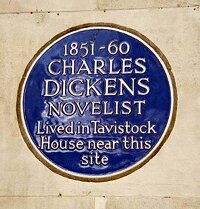
One of London's famous Blue Plaques
That becomes more important at a time when the news breaks that the Blue plaque scheme to commemorate a link between that location and a famous person or event, serving as an historical marker, has come under threat. The scheme is currently operated by another organizations, English Heritage, which is blaming the proposed suspension of the scheme on a 34% cut in it’s subsidy from the government.
There are currently some 869 plaques, with a few more in the pipeline, (which cost just under GBP1000 each to install), and they are an easily recognizable, useful and popular sight.
The scheme has been suspended twice before … as a result of war time economies during both World Wars.
Here in Bishkek we do a have a similar system of memorial plaques but, unfortunately, we don’t have anything like the National Trust – or English Heritage. For a country that straddled some of the routes that made up the Great Silk Road, there is very little still standing in the historic “country houses” … but we do have our fair share of historic sites, monuments, and quite a few sites associated with social history … not to mention a surfeit of “beauty spots”.
The state actually maintains a list of something like 600 individual sites in the country which are considered to be “of specific Historical or Cultural importance” and which come under state protection. In addition, there are four towns/cities listed separately as historical sites in their own right: Bishkek, Osh, Uzgen and Safed Bulan. (I see that I haven’t written a general postcard about Osh – I’ll have to do something about that! … actually, the list itself is another candidate for a separate postcard.)
Even if a similar body was established, however, it is doubtful that it could emulate the National Trust in the acquisition of properties – an awful lot of them were bought relatively cheap because the original owners could no longer afford their upkeep … or they were handed over in lieu of “death duties”.
Following the holiday period over the New Year, when life seemed to, if not actually “come to a stop”, everyone seemed to be on a “go slow”, things have certainly “hotted up”.
The “big” news this week has been the border clash in the Uzbek enclave of Sokh which apparently resulted in several Uzbeks receiving gunshot wounds, (although this is denied by the Kyrgyz border authorities who said that they shot into the air … and the Uzbeks have yet to produce the victims), and something like 40 Kyrgyz citizens being taken “hostage” and held by the Uzbeks.
The nine enclaves, (areas belonging to one country but entirely surrounded by the territory of another), are an anomalous creation of the Soviet Union and there are lots of stories about how they came into existence – from a desire of Uncle Joseph (that is Stalin) to divide and rule by setting nationalities to rival each other, to being a wager in a bet.
The largest, (at about 350 square kilometers), is the Uzbek territory of Sokh which is cut off from the rest of Uzbekistan and totally surrounded by Kyrgyzstan. Ironically, the population is almost entirely Tajik. It is suggested that the reason it was allocated to Uzbekistan was that the one road up to it at that time, went North to Uzbekistan and communication East and West to Kyrgyz regions was virtually non existent. There have been discussions to renegotiate the border creating a corridor to the enclave along this road but the have been stymied in much the same way as the ones between Britain and Argentina over the Falklands, (otherwise known as the Malvinas). Some commentators say that it is a problem that cannot be resolved as the necessary legal structures don’t exist.
There is now an East-West road that cuts across the enclave … but since 1991, when Kyrgyzstan and Uzbekistan became independent countries and not simply constituent parts of the Soviet Union, and the border became an International one rather than an administrative boundary, border posts have been constructed, fences erected, (although I don’t know how far they actually extend), and tensions have grown and been maintained.
The Uzbek have maintained quite a large military presence in Sokh ever since some incidents in 1999, because there were accounts that the terrorist guerrilla movement the IMU, (Islamic Movement for Uzbekistan), were using it as a base from which to destabilize the situation in the region.
At the border post you have to go through all the usual formalities, immigration and customs … I have been there, once and we weren’t stopped, but only because I was in a convoy headed by the official car of the Governor of the Batken oblast … yes, he was in it at the time. The border guards stopped what they were doing, stood to attention and smartly saluted as we went through, before returning to examine the paperwork and vehicles of the poor unfortunate ordinary people who had queued up to cross the border on their way to the other side of the enclave.
There is a Kyrgyz village in the valley just above the enclave, that can only be approached through it … and as a result of the incident, the border was closed which effectively cut this village off too. In theory there is a road which by-passes the enclave, but I understand that it also by-passes this particular village where something like 800 people live. Anyway, for most of the week they have been totally cut off from family and friends … and fresh supplies.
As usual, there seems to be a surplus of “facts” making it as clear as mud what actually happened. Both sides seem to be blaming each other for the events and the Batken prosecutor has started a criminal investigation so that they can identify and prosecute the guilty parties. Although it looks as if the incident erupted spontaneously, at least the Governor of Batken oblast thinks that it was an “organized” affair.
As far as I can tell, it began when some Kyrgyz engineers were working on installing a power supply to a newly erected post on the Kyrgyz side of the border. Unfortunately the power supply line went through Uzbek territory. This seems to have been the “flash point” although there appears to be other underlying issues involved as well. A group of local residents from the enclave then moved in on the engineers and the Kyrgyz guards discharged “warning shots” from their weapons; they say into the air.
In the ensuing melee, 15 cars were attacked, (one news agency published a picture of a tank which had just run over the front of a car, basically crushing the engine), some border demarcation markers destroyed, damage done to power lines and water pipes … which has led to inevitable demands for compensation.
Some people were injured and taken to hospital. A number of Kyrgyz were taken hostage. According to some reports, even those sitting quietly at home were not immune form the attention of the protesters, who carried them off to Uzbek territory and refused to release them. Discussions were held and eventually their release was arranged in several tranches … and in interviews with the press where they described their ordeal, some of them were full of praise for the Uzbek police who kept them safe whilst some of the angry mob seemed to be threatening them.
Almost immediately, protesters started gathering – not just in the immediate vicinity, but also here in Bishkek. “Everyone in Kyrgyzstan is upset by the events in Sokh”, said one prominent politician.
As I said earlier, the border was obviously closed and meetings held between ranking officials to try and find a resolution of the potential “ticking time bomb”. They did manage to agree the release of the hostages and agreed to share information and to take measures to deal with any guilty parties and restore order. Work on repairing the road has been started and we hope that things will return to something at least resembling normal in the nearest future. A commission has been established, (or, indeed, several commissions), to look into the events and their causes and the President has announced that he take control of the situation. Additional police have been drafted into the area and Uzbekistan has, so it seems, agreed to compensate Kyrgyzstan for any losses incurred.
It goes to show, however, that there are undercurrents and strong underlying emotions which could presage future difficulties. One of the aksakals, “elders”, living in the region said how Kyrgyzstan should be ashamed, that the government was powerless, (“toothless”), and that “if we cannot look after our “front line”, then perhaps it’s time to move”. Some of the commentators here in Bishkek have been quick echo his sentiments … at least to the extent that it shows how ineffective the government response was.
That seemed to me a little harsh … it may well be true that “prevention is better than a cure”, but given the fact that the incident blew up, the authorities do seem to have reacted and at least are doing something to try and defuse the explosive situation. That doesn’t mean to say that they will be able to resolve the issues however, as they are so complex and there have been concerns expressed, both here and in the international media, that this could simply be a harbinger of more to come. I am not sure, however, that is inevitable … if the right steps are taken now, then it should be possible to prevent, or at least limit, further problems from erupting. At least the incident has brought the situation surrounding the enclaves into the forefront of political attention, so something might well be done.
This is not, for example, the only “disputed border” issue … the local government in Batken have asked the Kyrgyz government to resolve 15 different disputes with its neighbours, (almost 350 kilometers of the 1395 kilometers of the border with Uzbekistan remain in dispute). Although it is probably the most dramatic incident, it’s also not the first time that trouble has blown up in the enclave … its the fourth major incident in this enclave in the last seven years – and according to one source it was the 19th incident over the enclaves since Independence.
Just a few days before all this happened, Uzbek border guards shot dead a Kyrgyz citizen who they say was a smuggler.
“Despite all this,” the Kyrgyz Foreign Ministry declared, “Kyrgyzstan holds the position that Uzbekistan is a friendly country and a good neighbour.”
Thinking about it, I couldn’t help but compare it to the situation in Ulster, (and other places), where distrust and strife have incubated over many generations and occasionally come to a head in violent outbursts that could develop … or be resolved. It’s all down to the goodwill of the participants and careful handling.
Meanwhile, it was announced that the commission considering the demarcation of the border with Kazakhstan was almost complete, all that was left was the construction of 30 border markers which should be completed this year … so, hopefully we won’t see any problems on that “front”.
At least our border incident isn’t like the one in Kashmir, which cost some soldiers their lives in the skirmishes which erupted there.
The Ferghana valley in the South, where all this took place, is the center of the drug trafficking routes from Afghanistan to Russia and Europe … a in insipid version of the Great Silk Road. Its geographical location, the poverty and level of corruption all conspiring to the development of this trade. This aspect of the region has also received a fair amount of attention during the week.
Another incident blew up in the Ferghana valley – a group of about 70 Chinese workers, (apparently, about 20 of them were intoxicated), engaged in the construction of a power line, were involved in a brawl with locals. It seems that an argument over an alleged theft of a mobile phone started it all off. 18 of the Chinese and 4 Kyrgyz needed hospital treatment … and the Chinese were all evacuated for the time being, “for their own safety”.
Up here in Bishkek, there a journalist working for one of the local TV channels was on an assignment covering a story about people who don’t pay for the electricity that they used, when someone came came and started to beat both her and the cameraman, before escaping in a car. Apparently it was quite serious – serious enough for the President to decide to an interest in the investigation. Speculation was rife about who could have been involved, but within a couple of days, someone was detained and has apparently given a confession.
The premises under investigation have already been the subject of much controversy, built on former parkland, the acquisition of which has been the subject of much speculation … especially as the previous President had given assurances that houses would not be constructed there. During the week, a similar controversy arose about construction in or around another of Bishkek’s parks – again after assurances had been given that none would be allowed.
So, it was interesting to see that the Mayor of Bishkek has issued instructions to the GlavArchitechtura, the city’s planning department to forbid new construction projects … or at least to insist that any new projects should have ample parking space … if it is proposed to build a block with 40 apartments, then there should be an equal number of parking spaces allocated. He also asked them to suspend the conversion of residential buildings for other purposes, such as workshops, stores and car washes.
Traffic in Bishkek is indeed an issue. The Ministry of the Interior caused a few eyebrows to be raised when they asked the Ministry of Finance to allocate a quarter of all the money collected from fines for traffic offences to be allocated to the traffic police to help meet administrative expenses, (the cost of uniforms, maintenance of vehicles, purchase of fuel and buildings maintenance – the main building hasn’t received any repair work for something like 15 years). It seems that in the past the force was self financing, but since 2009 the funding arrangements were stopped and the force is having difficulty in meeting essential expenditures. Opinion seems to be divided about whether this is a good idea, but one report I saw had comments in the ratio of 2-to-1 in favour of the proposal. The Ministry of Finance, however, have simply noted the request and “will consider it”.
The staff of the Ministry Emergency situations has been kept busy. In his review of last year, the Minister reported that … currently they are working on preparations for avalanches … unfortunately, a week ago an avalanche took two teenage girls who were in the mountains on a school trip. In a review of last year, he said that it was one of the worst years in recent times with a string of “major emergencies” – some 449 events which killed 47 people … although that was down on last year, (82 people died) and the rescue services saved 415 lives. Events such as: fires; avalanches, mudslides and rockfalls; a mine poisoning; and 33 sizable earthquakes, (above level 3).
The new year also got off to a bad start … as if border disputes, mass brawls and the beating up of journalists wasn’t bad enough … when a herd of sheep and goats through the ice on an artificial reservoir used for irrigation purposes. Although most of them were rescued, 12 died as a result of the incident. Reading it, I couldn’t help but think of the reports I have seen in the last week of firemen having to resue a cat and other animals in dire situations.
There have been more reports about the meeting with the Russians at the end of December about the future development of Manas airport as a transport hub. One correspondent went as far as question the commercial viability of the project. ”To transform the airport into a major international transport hub requires several conditions: stable environment, favorable geographical location, infrastructure, economic development, which will provide orders etc.” … but if you consider things like the state of the road linking Bishkek and the airport, the fact that there are only three cargo flights a week at the moment, then it may be a stretch of the imagination to conclude that “there is only one condition – the geographical location.” In addition, he said, “one should not forget about the competition: Kazakhstan is investing in the international airports of Almaty and Karaganda; and Uzbekistan gave the management of the Navoi airport to Korean Air – one of the world’s largest cargo airlines.” This was underlined when I saw that the French and the Kazakhs have agreed a package about the withdrawal of troops and equipment from Afghanistan. Even the Americans are, apparently, considering a variety of options when it comes to supporting the Afghanistan government after their withdrawal in 2014, with the number of personnel involved varying from 3000 to 15000 … and also also a “zero” option, indicating that there might well be less traffic for such a facility.
There was an interesting statistic reported during the week that almost 60% of the population use the internet on a daily basis. Indeed, last year was a busy year as far as the internet was concerned with several special events and conferences; a large increase in the number of pages on the Wikipedia Encyclopedia in Kyrgyz; a considerable amount of internet advertising – especially in the social media; the development of two “co-working spaces” used by independent programmers and freelancers as office space; a number of packages offering unlimited Internet access provided by a number of telecommunications providers; special awards for internet sites … and also a draft new law which the industry is concerned might be used to bring in some form of censorship.
There have been a whole host of economic statistics issued … showing an interesting discrepancy between governing departments that both measure inflation. One seems to indicate some prices falling, which comes as a surprise to most people. Some categories of items show a steady and inexorable climb. It is difficult to say what will happen in the future as to food costs because, as well as seasonal variations, a lot will depend on the local harvest and fluctuations on the world market. The different ministries, however, seem to come to different conclusions. The cost of housing, at least, has stayed more or less stable.
One of the most interesting sets of statistics concerned the 24 “most important” international grants and loans granted to Kyrgyzstan in the last year, ranging from the USD389.74 million dollar loan from China for the construction of the Data-Kemin power transmission line and Kemin substation to the USD21.6million dollar load from the EBRD, (European Bank), for the construction of a garbage recycling plant and a USD6million dollar grant from Turkey which (at least, according to this list) doesn’t seem to have specific purpose. The finances are provided for a wide variety of projects from Road construction to Banking sector reform, from “budget support” to improving the investment environment, from construction of a sports complex to the purchase of wheat seeds, and from rehabilitation in Southern Kyrgyzstan to construction of the China-Kyrgyzstan-Uzbekistan railway.
There have been three International surveys reported during the week with mixed results for Kyrgyzstan.
- The survey on Economic Freedom conducted by Heritage House, (based on such statistics as the unemployment rate, GDP growth, inflation, the amount of debt, and so on), placed Kyrgyzstan in 89th place, out of 177 countries. Somewhat surprisingly, the USA was ranked 10th and Russia rose five places in the rankings to 139th place. Oddly enough the two countries at the top of the list, (Hong Kong and Singapore), are both fairly fairly authoritarian. For the record, North Korea came bottom of the list.
- The Failed States Index put Kyrgyzstan in 41st place (out of 177) - which doesn’t sound so good when you remember that the higher a country is on this particular index, the worse the situation is in it. However, the countries combined score across 12 different factors marks a considerable improvement on last year’s position and Kyrgyzstan was hailed as the most improved country in the index. Improvement were measured of the contributory statistics, but it wasn’t all good news; for example, the Group Grievance statistic, (which measures things like ethnic tensions), remained the same as last year indicating that there it will take some time to see if the progress can be maintained.
- Transparency International have issued their annual Corruption Perceptions Index … and Kyrgyzstan has improved its place in the rankings from by 10 places, to 154th place. This is being attributed to improved budget transparency, the role of the media and the efforts of the anti-corruption agencies.
There is some good news … we’ve been told that all the restrictions on the use of electricity have been lifted. The broken turbine at the Toktogul powwer station, (which is responsible for about 40% of the country’s production), has been repaired and is now able to meet the demand. Bishkek’s street lights have been turned back on. The very next day, however, there were reports of power cuts in certain parts of the North of the country … and again today in parts of Bishkek, but at least that was because maintenance work was carried out.
The situation with Gas also seems to have been resolved with agreements reached with both Kazakhstan and Uzbekistan, and price levels will be maintained rather than increased as had been threatened and although the situation is now “back to normal”, e are told that this could change”. There was a moment when it looked as if something was amiss, as the “eternal flame” in Bishkek’s Victory Square was turned off … but nobody seems to know anything about it.
Meanwhile the weather has become milder … not as warm as in Australia, (thank heavens) – but colder than London, (snow is expected today and the temperature should be between 1° and -9° whereas London is expecting rain with temperatures between 4° and 1°). I hope the milder weather doesn’t spoil the ski season.
I’m sorry it is such a long postcard this week but, to be honest, I hadn’t expected the dramatic turn of events when I was planning this postcard, thinking that the peace and calm of the New Year period would carry on … I had planned to spend time this week looking at some of the historical and cultural things that have been happening, such as the opening of two new Museums. Hence, the National Trust anniversary seemed an appropriate theme. It just goes to show what a volatile and changeable world we live in.
As an aside: I have to say a big “Thank you” to one of my correspondents who took up the challenge and went looking for the photograph of protesters putting flowers into gun barrels that I referred to last week … and, “almost by return” came up with this link. It seems my memory was indeed playing tricks with me and I was confused: it was:
- carnations and not daffodils;
- rifles and not tank guns;
- in America and not Prague;
- in 1967 and not 1968
… I thought that I had “remembered” and had gone looking for something like these: the top photo on this page, this one, this one and this one.
_______________________________________
Postcard from Bishkek: the weekly postcard that I send out as an email also gets posted on the website ianbek.kg each week – and there are other postcards which don’t get sent out. This week, for example, there has been the following postcards:
- Spherical Panoramas of the Naryn Guesthouse - Some views of our gouesthouse in Naryn .. with a little history in the commentary – 06/01/13
- Seasonal films - On the occasion of Orthodox Christmas, I took a look at the films on offer on local TV over the holiday period – 07/01/13
- A Tax Minefield - trying to navigate a course through the Kyrgyz tax system – 08/01/13
- Bomsh - a “sarky” comment about my needing a shave got me thinking about the homeless in Kyrgyzstan – 09/01/13
- Kyrgyzstan’s Railway Network - On the 150th anniversary of the opening of the London Underground I took a look at Kyrgyzstan’s somewhat limited rail network … we don’t have a Metro – although, at one time, one was mooted for Bishkek. – 10/01/13
- Spasibo – Rahkmat - It’s more than just a courtesy – saying Thank You on International Thank You Day – 11/01/13
It is now possible to follow me on Facebook, (where I have specific pages for Celestial Mountains and ianbek … and also links.kg and Kyrgyz Diary), and on twitter, (@Bishkekpostcard and @celestialMTC ).




 Bishkek
This is an exceptionally interesting postcard. I have just read every word!
Thank you., I am glad that you found it interesting.
You have a good point! They are quite different, but the main issue was that they are both disputed territories for which blood has been shed … and with which I have connection.
Enjoy the sunshine!