Seasonal films
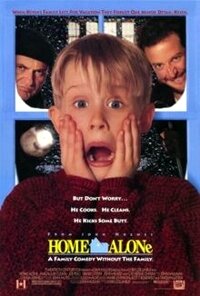
Poster for Home Alone, showing Macaulay Culkin displaying his famous "Munch's Scream" pose
Over the New Year I was channel hopping and saw that, once again, the film the traditional films were being faithfully screened in their customary time slots. Just as we used to sit down to watch our regular annual dose of The Sound of Music, The Great Escape or Zulu … so the television channels here have their own traditional films. At least theirs are more or less in keeping with the season!
There was, for example, Macaulay Culkin staring in Odeen Doma, (or Home Alone!), as the eight year old Kevin McCallister who is accidentally left behind whilst his family fly off to Paris for the Christmas holidays.
Waking up to discover himself alone, at first he is filled with shock and horror at having made his family disappear following a row with his older brother. This, however, soon disappears as he relishes his new found freedom.
Trouble is not far away, however, … and he overhears a couple of incompetent burglars, (who call themselves the “Wet Bandits”), planing to break in and rob the house. He sets about to defends his home against them with a variety of ingenious traps in a delightful, “feel good”, slapstick comedy.
As of 2009, Home Alone was the highest grossing comedy of all time.
Here’s a trailer for the 1990 film:
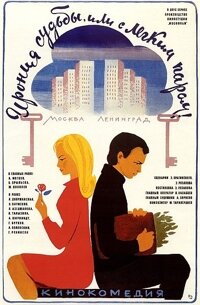
S'lorgkim parom!
Then, again, there was S lyogkim parom!, written and directed by one the most famous and successful, (and, incidentally of my favourite – although, to be strictly truthful, he’s probably the only one that I know by name), Russian film directors: Eldar Ryzanov, was being screened in its traditional time slot on New Year’s Eve … not just on one channel, but on two!
For the record: S lyogkim parom! is actually only part of the title … in its full glory it should be called: Ironiya sudby, ili S lyogkim parom! … which means: The Irony of Fate, or Enjoy your Bath!
Well … even that’s not quite right. The second phrase is used colloquially to mean “Enjoy your bath” but it literally means “with easy steam!” … which is, in turn, a reference to the steam that accompanies a hot bath, (or shower or sauna … in fact, the Banya - or sauna – is still the traditional way of taking a bath”, especially in many rural areas … and the banya plays an important part in the development of the plot).
It’s a classic story of Mistaken identity, but in this case it’s not two people that are mistaken for each other … but two apartments … in two different cities. Having met his friends for their traditional New Year gathering in a Banya, Zhenya has a little too much to drink, (actually, much too much) … and his friends take him to the airport so that he can catch his plane. As the result of a simple mistake, catches the wrong flight and ends up in another city. Senseless to his surroundings, he hails a taxi and gives the driver the address of his apartment block. No problem – the beauty of Soviet centralized planning means that virtually every city is identical! Zhenya gains access to the apartment and goes to bed … to sleep the deep sleep of the intoxicated … However, whilst he is asleep, the rightful owner eventually turns up … and so does her boyfriend!.
S lyogkim parom is also a comedy, but although it has it’s element of slapstick, there is also an element of sadness, pathos and even social comment … (directed at, for example, the identical “soulless” apartment blocks found in towns throughout the former Soviet Union … or the culture of binge drinking vodka to excess, as in the incessant phrase: “Nado Menshe peet” – I must drink less!).
I remember the first time I saw it … I was so impressed because, although I didn’t understand everything, I was able to follow the gist of the story. As a result, I have always had a soft spot for the film … but even if I am fond of the film – for the Russians it has a very special place in their New Year traditions.
It’s in Russian … but here’s a montage from the film to give you a feel:
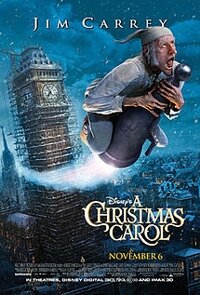
The 2009 Walt Disney Animation
Finally, there was a cartoon version of Dickens’ A Christmas Carol. We turned on part way through … we had missed the visitation of Marley’s Ghost and Scrooge was already receiving the first of his Christmas Spectres … the Ghost of Christmas Past who took him to the Christmases of his youth so that he could see that the Season of Goodwill was far from being a case of “Bah, Humbug!”
Because the film was already underway, I found I had to explain the plot to the kids – which was pretty good going as I have never actually read it from beginning to end. Fortunately, Maksim had already seen different versions of the film and so found it easier to follow without explanation but Andrei and Sveta needed the scene to be set.
The story is a classic – with numerous adaptions for stage, screen and television – Donald Duck, Buggs Bunny, Brer Rabbit, Mr. Magoo, the Flintsones, the Muppets and Sesame Street have all had a turn at telling the story. Many of these have managed to introduce an element of comedy, but the story is, and was meant to be, really quite dark and disturbing.
It wasn’t the version on TV the other day, but here is a trailer for the 2009 Walt Disney version starring Jim Carrey:
Now, although these films are perhaps more fitting to the Christmas season than the sort of Blockbuster that we were offered as The Christmas Film in order to win the ratings war between the BBC and Independent Television, I have to confess that IO found it a little off watching A Christmas Carol just before New Year.
In a way I still a conservative traditionalist and, although Christmas decorations usually remain in place for the Twelve Days of Christmas, (that is until 7th January), many aspects f the celebrations belong to the period in the lead up to, or the day itself.
For examples, I always think that Christmas Carols, (such as Hark, the Herald Ages Sing, or O little Town of Bethlehem, or O Come All Ye Faithful!), really belong to the period before Christmas or on the day itself. It seems out of place to sing them a week afterwards. On the other hand, certain traditions do seem to belong to the period after Christmas Day, (such as going to see a Pantomime).
The trouble is that Dickens’ story is about the meaning of Christmas … and so, it seems to me, belongs to the the period before Christmas. Here we were watching it just before New Year – almost a week later.
But then, I said to myself, Christmas is not the big holiday here; New Year is … and just as Santa Claus has a local equivalent in Bed Moroz, (Grandfather Frost), so the message of a Christmas Carol can just as easily be applied to the spirit of New Year.
Also, I had to remind myself … for the Russian Orthodox Church, Christmas hadn’t yet arrived … because they still work according to the old Julian Calendar, Christmas doesn’t come until January 7th … that is, today.
So, in fact, the timing was perfect … the film was shown before Christmas so that we could watch it and reflect on the lesson that Scrooge and his ghostly apparitions had to teach us about the true meaning of the holidays - about how we treat each other.
So all that is left is for me to say, once more:
S’Rozhdestvom! - Merry Christmas!






 Bishkek