Memorial Plaques
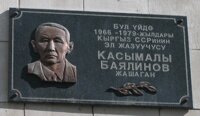
On the side of some of the buildings in Bishkek there are memorial plaques commemorating prominent people and historical places or events.
In London there are almost 900 ”blue plaques” which commemorating prominent people and historical places or events. The five most searched for are:
- Sherlock Holmes on 221B Baker Street,
- Charles Dickens in Doughty Street,
- Preseident John F. Kennedy in Princes Gate,
- Karl Marx in Dean Street and
- John Logie Baird in Frith Street.
Most of the characters commemorated with a Blue Plaque are internationally famous, but not all. The first of these plaques were erected in 1867 by the Royal Society of Arts – but most are now subject to the local authorities. They are subject to various regulations governing their size and appearance, and a committee decides, who or what deserves commemoration although a number of individuals and organizations now install some plaques on their own initiative.
It is not only in London that such plaques are erected - Cairo, for example, also has such a system.
Just like the famous Blue Plaques of London, the plaques of Bishkek are erected to commemorate famous or important personalities associated with the city. They commemorate scientists; outstanding figures of culture, (composers, artists, writers, etc.); outstanding members of trade unions, builders, and so on. Few, if any, will be of international renown.
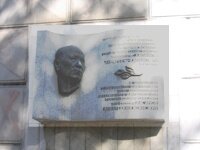
The plaques are subject to regulations – they have to be approved by a special commission of the city council. The commission can decide to commemorate a person, or the relatives and descendants of the person can apply for permission to erect a plaque. The commission will ask for submissions explaining why the
Also, the architectural authority have regulations governing their size and appearance – although a walk around the town may well expose several that have been erected that breach these rules. For example, they should measure 1.2m by 60cm; they can be erected either vertically or horizontally, and they can bear a portrait of the person concerned. (If there is no portrait then the size is limited to 60cm by 90cm.) They can be made metal or stone, and, ideally, they should be placed at the height of the second floor. The lettering has to be of a size to be legible from the street, and so on. In theory there should be a universal style to the plaques – but this aspect has obviously been often ignored as a walk around the city centre will show.
There were (as of August 2006) some 135 such commemorative plaques in Bishkek. The first ones erected were dedicated to the memory of to the scientists Lushchihina and Malyshev:
- Lushchihina was a zoologist who was responsible for several improvements in sheep breeding in the republic, including the introduction of Australian Merino sheep to Kyrgyzstan;
- The one dedicated to Malyshev was of metal and was stolen shortly after independence in the 1990′s – presumably for its value as scrap metal – it was never recovered and has not been replaced.
Those plaques erected by the authorities or on official buildings then become the responsibility of the city authorities for maintenance.
Most buildings in Bishkek are not adorned by a plaque, and whereas some buildings have one, there are some buildings with two or three, and at least two(on the corner of Erkindik and Kievskaya and the Centralni-Gastronom, (now a Narodniy Supermarket) on the corner of Prospects Manas and Chui), has four.




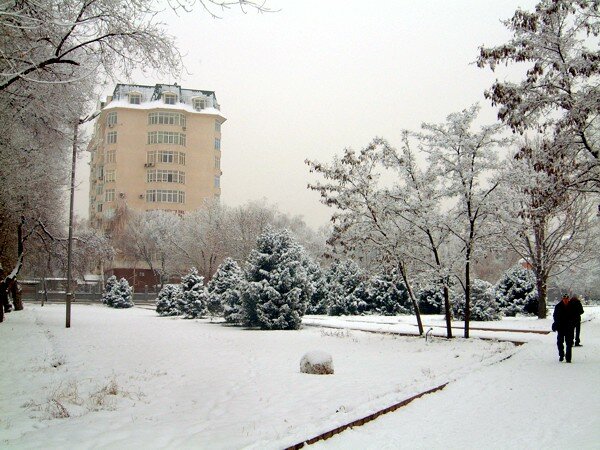
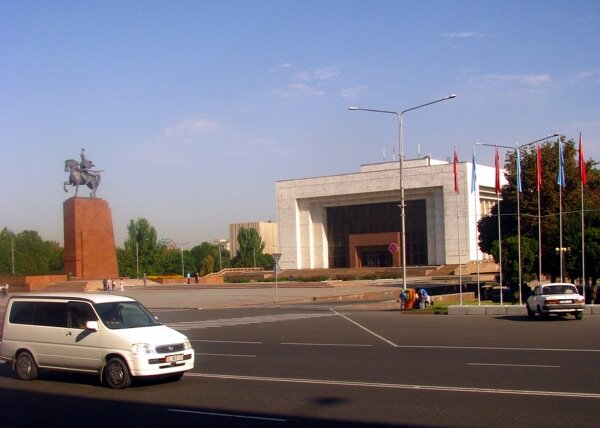

 Bishkek