Bomsh
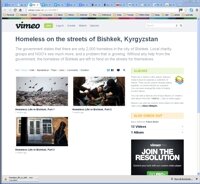
A series of short video clips about the Homeless in Kyrgyzstan on Vimeo
I got a bit lazy over the Christmas and New Year’s holidays, after all, the office was closed and I wasn’t expecting visitors or having to go to any meetings.
For several days I didn’t shave. One day, Maxim told me he was going top have a hair cut and then suggested that I might want to do the same … and then paid me the “compliment” that I looked like a “Bomsh“.
Bomsh is the Russian word to describe a tramp or vagrant.
At first I wasn’t sure what he meant … I keep my hair fairly short; it had already started receding when I was quite young and there isn’t much of it.
As I stroked my chin, however, (which was sporting several days of hair growth), I decided that he had a point .. and went and had a shave.
I was lazy when I was younger as well. I used to wear a beard and I have to admit that sometimes it got a straggly. Basically, I grew it originally because it was easier not having to shave each morning … I still had it when I first came here but it was already turning from dark to white – not even grey – and I decided to shave it off when a friend of mine made a sarky comment about me looking like Santa Clause.
This time it wasn’t a full beard – just stubble.
Anyway, since the collapse of the Soviet Union in 1991, like most of the former Soviet republics, Kyrgyzstan had been in the transition from a socialist to a democratic system of governance with a free market economy – hence it is often referred to as a Transition Economy. The process has not been easy … factories closed and many people found themselves without work … and without the support provided by the central government, some found themselves without homes.
Kyrgyzstan is one of the poorest of the former Soviet republics, and is sometimes counted as being amongst the poorest countries in the world … apparently it’s the second poorest in Central Asia. Statistics vary but a report from the World Bank in 2007 indicated that 43.1 percent of Kyrgyzstan’s people lived in poverty in 2005 … of which 11 percent were deemed to be living in extreme poverty.
Now, every society and major city in the world has it’s fair share of homeless people … certainly there are homeless people in Britain and in the capital, London. So what is the situation here in Kyrgyzstan?
It’s difficult to know what the real scale of the problem is. In 2001, an official working for UNICEF said: “We don’t have any real statistics, but I can say there is no real family support system in Kyrgyzstan, nor preventive strategies to curb this problem.” (That sounds so familiar!)
On the other hand, the government says that there are something like 3,500 homeless in the city of Bishkek, although only 500 are actually registered – which raised in my mind the question: there is a register? (That information was in a report on KABAR, the Government’s own News Agency, about a Round Table held last year to discuss approaches to the issue.)
Local charities and NGO’s, however, claim that there are many more. (One article, in 2002, suggested that there were as many as 15000 homeless children in the country as a whole!) These organizations also say that this is a problem that is growing, and that, without any help from the government, the homeless of Bishkek are left to fend on the streets for themselves.
That’s not exactly true … there are apparently three shelters for the homeless in Bishkek, which can accommodate about 150 people, but the conditions are pretty dire according to the accounts that I have see, (for example, on the website of Los Angeles based photographer and journalist, George Hsia). However, it seems that it’s not free accommodation, and although the cost is just a token, (a report in the Vecherniye Bishkek newspaper talks of 5 som), but it seems that is still an expense that many, apparently cannot meet.
Many homeless simply cannot survive its harsh winters. To escape the cold many hide under manholes, in the conduits which carry the hot water for the city’s central heating system … at least it’s warm if not very pleasant. Someone posted a short clip on youtube of one such refuge … it’s difficult to everything because of what seems to be steam coming from a leak.
Also, when George Hsia heard about this situation, he decided to investigate and you can find some of his photographs on his website.
Apparently, those who do not live in manholes often lose limbs due to frostbite … or die of the cold. Apparently, 20 people died in 2010 only on one weekend. Another report indicated that 10 people die every few days during the winter. Some die from frost, whilst others die from burns they get from fires that they light.
It has been suggested that many children prefer life on the streets to the difficult life they lead at home. It is said that most of the parents of street children are drug and alcohol users who sometimes beat their children. Several are forced to work hard to find some money for their parents to have something to drink. ”Outside, they feel freer and independent.”
Although some leave home of their own volition, others seem to have been abandoned … one report speaks of migrant workers having left for Russia in order to seek work, with the children left behind with relatives.
The term street children can be used to describe not just those who are homeless but also those who sometimes live with their family but also work on the streets. In the bazaars. children can often be seen cleaning shoes or selling goods such as cigarettes or bread, sitting behind scales to weigh people, or acting as porters pushing trolleys of goods.
Last year I wrote a postcard Almaz, who worked in order to pay for his schooling, becoming one of the boys selling lemonade at one of the local bus stations and later graduating to be a tachist, (collecting bottles) in Dordoi, Central Asia’s largest bazaar.
As it happens, a lot of the bomsh collect bottles – and they are often to be seen searching through the rubbish discarded by householders to see if there is anything in it which can be salvaged and sold. During the warmer weather especially, they can be seen carrying large plastic bags slung over the shoulders in which they place whatever they have found.
Today, approximately 1250 children live in over 20 facilities, (orphanages or similar institutions), around the country. However, only about a quarter are actually “biological orphans” – that is, without parents. The majority are “social orphans”, or children who have families, but whose families lack the support systems needed to keep them in their homes.
Some of the efforts to help the homeless
This is by no means a complete list, but just some that have come in attention recently:
Drop in Centers
The British based charity EveryChild has established a number of “drop in” centres in the southern city of Osh and Bishkek to provide refuge to working children and a place where they can come and eat, seek medical attention, or get advice on any benefits that might be available to them.
Street Football
One initiative a couple of years ago was the introduction of a “Street Soccer” competition. Tournaments were held in both Osh and Bishkek. The Street Football Federation has worked with more than 1000 orphans and children in villages. They also want to work with children in “Child prisons” and Correctional Institutions in the future.
One of their activities was organizing and giving logistic for a Kyrgyz team to participate in the annual Homeless World Cup. Kyrgyzstan puts up teams to compete in both the Mixed and the Women Competitions – the Women’s team got through to the play-off for the 5th/6th place – drawing 3-3 with Bulgaria. There were teams form 68 countries participating at the 10th annual Homeless World Cup in Mexico City during October, 2012. (Just 18 teams participated in the first such tournament took place in Austria in 2003.)
Charity Concert
In December, the Kyrgyz pop star, Kanykei, hosted a glitzy gala evening at the Hyatt Hotel in support of a struggling Bishkek homeless shelter … .
Oasis and Kairat House
Oasis is a Christian charity which works in several countries around the world … as well as in Kyrgyzstan. They have a base in one of the correctional institutions and have also set up Kairat House, a transitional base for children leaving the institutions, providing them with safe housing, the opportunity to receive vocational training and mentoring to enable them to lead an independent life.
Here is one of the three videos that they’ve posted on the vimeo website, telling the story of two of the former street boys that lived in Kairat House



 Bishkek