Kyrgyzstan’s Railway Network
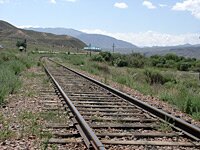
Kyrgyzstan has a very limited rail network
Today marks the 150th anniversary of the opening of the world’s first underground railway, with a section between London Paddington station and Farringdon station.
A few years ago there was a news report on the internet that Bishkek was planning to build a Metro … I’m not sure if it was meant to be joke or a if they got confused with Almaty, (which did build a metro that opened last year – after more than 23 years of construction). It was the second such Rapid Transit System in Central Asia, the Tashkent Metro opened in 1977).
As far as I am aware there has never been a plan for a Metro here in Bishkek, and I don’t know where the cash would come from for such a major infrastructure project.
Bishkek does have a railway, however, which brings some commuters in from some of the outlying villages … however, it is part of a fairly limited rail network.
For the record: The Soviet Union operated an extensive rail network with both local and long distance services, the most famous being the Trans Siberian Railway.
The railway played an important role in the opening-up of Central Asia enabling Russian and other migrants to travel the vast distances easily, and also in the conduct of the Civil War between the Bolsheviks and the “White” Russians in the early years of the Soviet Union.
The country is not, however, particularly well endowed with rail services as the terrain is not particularly suitable, and it is questionable if there is enough traffic to justify the investment needed to develop such a network. Official statistics, according to the Ministry of Transport, state that there are 424.6 km of railway line in the republic – although other sources put the figure at 372 km.
The construction of railways in Central Asia began in the Russian Empire, and was consolidated in the Soviet Union. It was primarily aimed at the distribution of coal and industrial output across the vast distances between the region and the markets of Western Russia. It also played an important part in the transport of passengers – and was used to great effect to move troops and supplies by Mikhail Frunze during the civil war.
When the Czech volunteers in Interhelpa first came to Kyrgyzstan, including the family of the Alexander Dubček, in answer to Lenin’s call to the Socialist of the world to come and help build a Socialist Paradise in the newly formed Soviet Union, they had been told that they would travel by train to Karakol … but, at that time, the line stoped in Bishkek – and so did they.
The main routes are from the Kazakh border, through Bishkek and onto to Balykchi at the Western end of Lake Issyk Kul, and from Uzbekistan into Djalal Abad and Osh.
During the summer, there are several trains a day on the Bishkek-Balykchi track, carrying tourists up to the resorts on Lake Issyk Kul. They are quite slow but the journey, and for the most part, not very dramatic, although through Boom Gorge is interesting as, at one point, the track rises quite high above the road giving a good view of the valley.
There have been several proposals to extend the network:
- In 1995, it was decided to extend the railway from Balykchi to the Kara Kechi coalfield just North of Lake Son Kul – but the line was never finished, although there are plans that it should be – and possibly extended as far as Djalal Abad.
- The Chinese have extended their railway network with a line from Urumchi to Kashgar and there are currently discussions to extend this with a link along the route of the “Silk Road” – the China-Kyrgyzstan-Uzbekistan line. Several potential routes were considered but the current plan is for it to cross the Torugart Pass before swinging West towards Djalal Abad, (where there is an existing link with Uzbekistans network – and hence complete a route that would travel from China’s Pacific coast and Europe), and Osh.
Everyone is very keen to have it constructed; the Chinese because it will provide another access route to Europe and it will give both Kyrgyzstan and Uzbekistan access to a sea port. The Chinese are so keen that they are prepared to finance the project, although there have been some hiccups in the negotiations as to their quid-pro-quo. Despite this, it looks as if the project is definitely going to happen.
It would create a Southern rival to the Siberian Railway – and complete the ambitious plan for the construction of a TransCaspian Railway that Jules Verne used as the basis for his adventure story, Claudius Bombarnac.
- There has also been discussion about the construction of two other extensions to the network … one going North-South, connecting Kazakhstan with Tajikistan, Afghanistan and Iran. The plans for this, however, do not appear to be particularly well advanced – so it’s probably still on the drawing board.
- Another one that is probably still on the drawing board is a link over the Kungey Ala Too mountains between Almaty and Cholpon Ata, on Lake Issyk Kul. In 2003, it was also announced that there were plans for a such a rail link to be built – but it has come to nothing and if the history of the road linking these two is anything to go by – it will be a long time before it is implemented. Even the official estimates suggest that it will take some 10 years to complete the project.




 Bishkek