Happy Birthday Mr. President!
Birthdays are pretty important here.
Today is the 51st birthday of Barack Hussein Obama II. So, I suppose it is in order to wish him “Many happy returns of the day”, “Happy Birthday”, “Se Dnyom Rozhdeniyeh!”
Over the years, there has been considerable controversy over his middle name, Hussein. I was a bit surprised, however, that there has been less attention paid to the “II” – a bit like Queen Elizabeth II. (Yes, his father was called Barack Hussein Obama.) At first I was not sure about the “II” but it is there on his birth certificate, at least as published on the official White House website.
Perhaps it is just me, but I wondered if I detected a hint of “dynasty” here? It occurred to me, as I pondered this particular feature of his name, that a more American approach might have been to adopt the epithet Junior.
As it happens, there have been a number of dynasties to reach the Oval Office. Perhaps the obviously examples are the Bushes, (George H. and George W.), and the Roosevelts, (Theodore and Franklin), but further back there were the two John Adamses, (John Adams, the second incumbent and John Quincy Adams, the sixth).
As it happens,someone has apparently done some genealogical research and come up with the conclusion that virtually all the American Presidents are, in fact, descendants of King John of England … yes, John Lackland the brother of Richard the Lionheart who is known as one of England’s worst kings, (if not THE worst), who not only lost the Duchy of Normandy, (which basically led to the disintegration of the Angevin Empire), and the Crown Jewels, but was humiliatingly forced to agree to approve Magna Carta. Hardly, it seems, someone that most of the leaders of the one of the world’s most powerful nations might want to claim as an ancestor, (yet alone a common ancestor).
(For the record – the exception was the eighth president, Martin Van Buren – who was, incidentally, the first American president to have been born a citizen of the United States!)
It has been suggested that dynasties, (or at least attempts to create one), were at the root of the two revolutions that led to the downfall of the first two Presidents, Akaev and Bakiev. Although family and tribal connections have been important aspects of traditional culture, (and feature prominently in the Kyrgyz epic trilogy of Manas, Semetei – his son – and Seitek – his grandson), the Kyrgyz have never really favoured an hereditary system.
One of the saddest tweets that I saw during the week was written by a journalist whose sister and family have just emigrated to Russia leaving him as the only member of his family still a Kyrgyz citizen. Since Independence a large number of people have left Kyrgyzstan, either as emigrants to settle and live abroad or as “migrant workers” who earn a living and send remittances home.
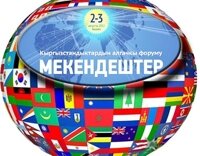
Mekendeshter - Forum of Compatriots
This week Bishkek has hosted Mekendeshter, a two day International Congress of Citizens of Kyrgyzstan and compatriots, (representatives of the ”Kyrgyz diaspora” from all over the world – but especially Russia and Kazakhstan). It was planned to discuss issues such as the legal status and protection of labour rights of Kyrgyzstan citizens abroad as well as trying to bring together and unite Kyrgyz citizens.
Kurultai, traditional councils or assemblies were a feature of traditional nomadic Kyrgyz society. In times of need they might elect a Grand Khan such as Barsbek, Manas or Ormon Khan – although this particular assembly didn’t have this on the agenda. There were, however, lots of speeches on a variety of topics. Not all of them seem to have been well received.
I suppose it provided ample opportunity for some politicians to make a headline or two. The Prime Minister, for example, raised a few eyebrows with his description of how he sees the country over the course of the decade … as well as improved credit facilities, he sees a population of seven million, with three children in “every” family, pensions will exceed the cost of living by 50% or more, and the average salary should be between 30 and 50 thousand soms a month. I couldn’t help thinking that it was not so long ago that he was apparently complaining that the country was becoming a dependent society with a substantial portion of the budget going on social security payments … and I couldn’t help wondering where the cash was coming from in order to meet such “dream projections”. Interestingly, he seems to be banking on developments in hydropower, predicting that it provide some 30% of the country’s GDP. I know that there are some pretty impressive projects under consideration or in the pipeline, but I wonder what that means for the mining which seems in this vision to have been knocked of it’s pole position as the leading element in the economy.
Mining is still very much in the news – with another company dealing in “rare earths”, important in electronics and with a market virtually controlled by the leading producer, (China), taking the lion’s share of the headlines. The price of Centerra’s stock seems to be on the rise again in the closing days of July, but it still seems a long way off the levels of just half a year ago. The company have declared that they will pay a dividend but I am not sure if that will be enough to satisfy its critics. What’s more, the government seem to be looking for lawyers in case they need to go to court.
The commission established to check Kumtor’s “compliance with the norms of reasonable use of natural resources, environmental protection, safety of production process, and population social security” has gathered to begin work. During the Mekendeshter, one of the speakers, a businessman Kyrgyzstan “needs to develop the service sector and that natural resources should be left for future generations”. Pointing out that education, science and medicine contribute something like 80% of the American GDP, he suggested that Kyrgyzstan should concentrate on similar areas of our economy. All this, it seems to me, is in keeping with popular sentiment expressed by local populace around some of the mine sites.
It seems that, the Minister of the Economy has been making statements about the economy, (particularly the tax burden), being somewhat lopsided and needs to be corrected. He also announced during the Mekendeshter that the government has asked the World Bank to assess the size of the “shadow economy”. I loved the way that he declared that a result of the survey would result in “exact figures” giving “the size of shadow economy” and enabling them to say that the shadow economy “varies from 50% to 70%” according to the findings. Apart from prejudging the results, and the fact that it is, (by the very nature of the shadow economy), difficult to measure, 50%-70% didn’t seem to offer a particularly degree of accuracy.
One interesting moment during the week came in a small item noting that the tax authorities were conducting a raid on the traffic police … Hmmm, interesting.
I expect that most of the Kyrgyz diaspora working abroad at least get their salaries paid on time. There was a report this week about the employees of an oil refinery in Kant, (not far out of Bishkek), where the workers haven’t been paid for over a year despite protests from the unions who eventually lost theit patience and took the case to court. Needless to say, they won. When I first heard about it, I couldn’t help wondering why the staff kept working if the management haven’t paid them, but it turns out the the depot is closed and they are engineers, fire crews and so on – basically, if I understand correctly, kept on the workforce for safety reasons. All the same, it is hard to see how they are going to be paid.
One of the areas of the service economy which the government wants to develop is that of insurance. There are plans to introduce a number of types of mandatory insurance including, for example, householders insurance, in order to help reduce expenditures in the “liquidation of emergency” – that is providing emergency relief following earthquakes, landslides and so forth – and facilitate a shift away from a reliance on using public funds.
Environmental issues and potential natural disasters have been somewhat high profile this week, with a small lake, Lake Tez Tor, in the mountains above Bishkek bursting its banks and cascaded down the Ala Archa river. The general impression seems to be that the water levels rose as a result of glacier melt – but, confusingly, there was another report during the week that reservoir levels are low, lower than expected for this time of year. There was some concern in the city about the river posing some threat, bursting its banks and some villagers were evacuated from their homes for a period although, according to officials, the situation was under control and there was little danger of catastrophe; although they are monitoring other mountain lakes – just in case.. The weather forecast for August is for temperatures a little lower than the monthly average, so perhaps there won’t be more glacial melt.
Most people would agree that one of the uses of public funds should be for the construction of schools. Oddly enough, this has provided some controversy during the week. Apart from the fact that some construction has been suspended, apparently for lack of funds whilst, on the other hand, the Minister of Finance has criticised the use of public funds to build two schools, (each of which would be busy for half the day), when one school could work in two shifts, (and be busy all day).
An interesting news item revealed the fact that there are nine hundred places for students at Kyrgyz universities still vacant. A third of them, it seems, on teacher training courses. That doesn’t seem too promising for the future state of Kyrgyz education.
Another opportunity for officials to make a mark was the meeting National Coordinators of the SCO, (Shanghai Cooperation Organization), of which Kyrgyzstan has assumed the chairmanship. Bishkek will host the 2013 summit of the organization. Economic issues took the fore during this week’s discussion: transport infrastructure, processing industry, and food security. In this context, “transport infrastructure” is usually taken to mean the reconstruction of the main international trunk roads and the construction of the China-Kyrgyzstan-Uzbekistan railway. The Chinese and the Kyrgyz side have apparently signed a protocol agreed to speed up the construction of the railway … but I have to admit that I won’t be holding my breath. Recent developments, however, suggest that the phrase might also include a new international flight between Kashgar, Osh and Bishkek. Even more exciting was the report that the German airline Lufthansa is interested in flying to various destinations in Asia via Bishkek … perhaps, starting as early as this winter.
They are planning to hold the next Mekendeshter in two years time.
If the Mekendeshter was the big event in Bishkek this week, the big event in the rest of the world is the Olympics, which will next be held in four years time. Kyrgyzstan hasn’t been doing too well, but that wasn’t too surprising as Kyrgyzstan’s strongest contenders are yet to compete.
As an aside, it was interesting to see that the UK’s Waterstones chain of bookshops has selected Chingiz ‘;s Aitmatov’s Jamilia as its Book of the Month for August. It’s an excellent read and I strongly recommend it as worthy of attention – if, that is, you haven’t read it already.
Although it probably wouldn’t be up there with Marilyn Munroe’s memorable rendition of “Happy Birthday” for one particular president, I think it would make a nice Present for a another one today …
_______________________________________
Postcard from Bishkek: the weekly postcard that I send out as an email also gets posted on the website ianbek.kg each week – and there are other postcards which don’t get sent out. This week, for example, there has been the following postcards:
- Visa Free Regime – What it means and what it doesn’t! - some thoughts about the extension of the visa free regime to another 44 countries;
- The Historical Museum - A brief look at one of Bishkek’s iconic sites;
- Arbus - a look at the watermelon which is part of a staple summer diet – as a fruit or as a vegetable?
- Did I say that? - I am not keen on giving interviews for the press; the result does not always reflect what you thought you had said …
- Toguz Korgool - this ancient board game is not in the Olympics, but the World Championships have only recently finished and despite the fact that it is sometimes referred to as Kyrgyz Chess, we only managed to accrue a couple of Bronze medals.
- Enver Pasha - I am not sure that he ever made it to Kyrgyzstan, but he certainly played a major role in Central Asia during the civil war and the Basmachi rebellion.
It is now possible to follow me on Facebook, (where I have specific pages for Celestial Mountains and ianbek … and also links.kg and Kyrgyz Diary), and on twitter, (@Bishkekpostcard and @celestialMTC ).




 Bishkek