Arbus
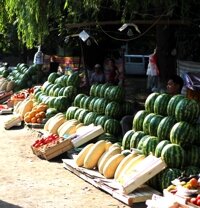
Arbus for sale ...
A staple food during the hot summer months here in Kyrgyzstan is the Arbus – the watermelon.
From the early days of summer piles of melons can be seen in the bazaars. Even more impressive are the piles that line the roadsides on some of the trunk routes on the outskirts of Bishkek or the road up to Issyk Kul. Sometimes they are piled high under an awning, but sometimes they are sold direct from the back of a lorry. The first fruits of the season are usually imports from Uzbekistan, but as the season progresses then home grown Kyrgyz fruits appear.
There are many different types of Melon, according to one source I have seen about 1200 varieties. I remember on one occasion visiting Osh Bazaar to stock up for a picnic and being bowled over by the range of different types of melon that were available – most of which I had never tasted. We got carried away and bought twelve different types.
Back in the UK, I was familiar with two types of melon – the traditional watermelon which was often associated with Mediterranean culture and the more exotic Honeydew Melon.
Although the humble watermelon is most commonly found in Kyrgyzstan, I am not particularly fond of having to cope with picking out the seeds from the pinky flesh. The Dinah, or honeydew melon, is my favourite.
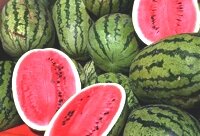
Arbus - Watermelon
Actually, although the Arbus, (watermelon), is generally considered to be a melon – it belongs to the Citrullus genus and not the Cucumis to which most melons belong. Apparently that means something – but I’ll come clean and admit that I haven’t the faintest idea what. I do understand however, that melons are a flexible fruit and although they are technically a fruit, (biologically, that is … some are classified as berries, pretty big berries I suppose), they are often used in cuisine as a vegetable.
It seems that melons originated in Africa and Southwest Asia. It seems that there is archaeological evidence to suggest that they were cultivated in its native Southern Africa as long as 4000 years ago, and where it can still be found growing wild. It was being cultivated in the Nile valley in the second millennium BC, (some seeds were found in Tutankhamen’s tomb, for example), and the started to appear in Europe in Roman times. They were being cultivated in China by 10th Century and, I suppose, may be an example of goods travelling along the Silk Road to China.
They are called Watermelons … and, in fact, by weight they are are about 90% composed of water – which is probably why it is so popular as a refreshing food on a hot summer’s day. Another 6% is sugar. It is a good source of vitamin C.
The skin, or rinds, of the fruit are technically edible but don’t have a particularly appealing taste and so most people just throw them away – I know that I do. However, some people do actually the skin by stir frying, stewing or pickling them.
I have seen some watermelon juice, but only once or twice and I remember thinking that it must be simpler to just let the pieces of watermelon dissolve on the tongue.
For some reason, Comments are closed … but I thought I would add that I came across this interesting article recently: Five Reasons to Eat Watermelon





 Bishkek