Enver Pasha
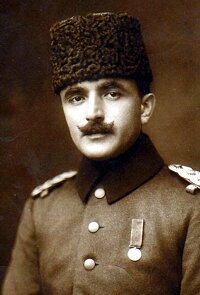
Enver Pasha
Tomorrow marks the 90th anniversary of the death in a dramatic Wild West type shoot out, of one of the most enigmatic characters of the history of the civil war that engrossed the fledgling Soviet Union: Enver Pasha.
To be honest, I am not sure that Enver Pasha ever made it to Kyrgyzstan, but he certainly played a major role in Central Asia during the war and the rebellion of the Basmachi, active in what is now Uzbekistan and dying in Tajikistan.
Born on November 22nd, 1881, Ismail Enver’s father was a minor Turkish official, (a bridge keeper), and his mother an Albanian peasant. Pasha was not his name, but a title that came with military rank.
As a youth, Enver studied in Military schools and graduated as an officer serving in the Third Army of the Ottoman Empire. He rose not only in rank, but also as a member of the Committee of Unity and Progress, and as one of the leaders of the Young Turk movement which formed a revolution in 1908, seized power and ran the empire until the end of the First World War.
He was sent as Military Attache to Berlin and was instrumental in bringing German officers to Istanbul to help train and reform the Ottoman army. He was also to be one of the architects of the German-Ottoman alliance that would form part of the axis powers during the First World War.
During the war, Enver served as Minister for War. When the empire fell at the end of the war in 1918, he was forced to flee and ended up in Moscow. Here he managed to convince Lenin that he just the man to bring Central Asia, Afghanistan and British India to heel, and was despatched to Bukhara in November 1921 to prepare an army for the conquest.
Pasha, however, had different plans. He wanted to create a Pan-Turkic state with Central Asia as its centre and power base. Once in Bukhara he set about conspiring with Basmachi leaders who had already, with their grassroots support and intimate knowledge of the mountainous geography, proved worthy opponents of the Soviet fledgling government. Pasha was to provide the one thing that they lacked – a leader who could unite them.
It is perhaps ironic that Enver – who had once, (as a Young Turk), fought against the Islamic “Scholasticist Recidivists” demanding Sharia law in Istanbul – should collaborate with a similar group, using religious epithets more than a dozen years later and more than a thousand miles away, and also should be remembered as the leader of an Islamic Revolt.
Sneaking out of Bukhara, he soon amassed a force of 20,000 recruits. Initially his army scored great successes: capturing Dushanbe and most of the former Emirate. He refused to negotiate with the Bolsheviks, who responded by sending an army of 100,000 men and announcing reforms in order to win over the ordinary people – reconvening the Islamic courts, tax cuts and returning confiscated land. These reforms were successful in that they were to eat into the support of the rebels amongst the populace.
Other support also faded away, or failed to materialise. His troops disappeared back into the mountains from where they had emerged, and the Emir of Afghanistan refused him reinforcements (instead signing a treaty with the Bolsheviks). In August 1922, he rode out from Dushanbe with a small band of loyal officers and supporters.
No-one really knows what happened to him – there are several accounts. According to some sources a Red Army Bashkir cavalry brigade launched a surprise attack whilst his troops were celebrating the the Idi Qurbon holida. Enver, together with some 25 of his men mounted their horses and charged the approaching troops, during which he was killed by machine-gun fire. Alternatively, according to the Soviet commander, Enver managed to escape on horseback and hid in a neighbouring village. Four days later, the Red Army found his hideout and an officer infiltrated the village in disguise before the village was stormed Chaghan.
Apparently his body was buried near the village of Ab-i-Derya, near Dushanbe and in 1996 his remains were exhumed and taken to Turkey where they were reburied in the Obelisk of Freedom cemetery in Istanbul.
Enver Pasha’s death, however, did not end the rebellion in Central Asia. Isolated bands continued to fight on against the Red Army, scattered and dwindling in numbers well into the 1930’s. There are many accounts of raids and the brutality they inflicted on the local population only further served to undermine their popular support.




 Bishkek