Did I say that?
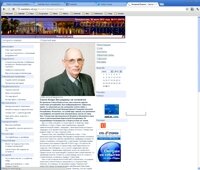
The interview, as it appeared - in Russian
A week or so ago, a journalist phoned and asked if they could come and take an interview from me. To be honest, I am not very keen on giving interviews but, as they say, it “goes with the territory” … so I agreed.
At the appointed time, the journalist appeared in my office and we chatted away. She put a mobile phone down on the desk and recorded the whole conversation, so the question “Did I say that?” shouldn’t really apply. As it happens, as I read the piece when it eventually appeared, it occurred to me that, Yes, it was a did reflect the discussion that took place, but I wasn’t too sure that it was accurate account of what I had said …
But as she had had to cut almost two hours of conversation down to less than six hundred words, and keep the attention of the readers, I suppose that it was inevitable that I might find the final result a little strange.
Th headline, “Santa Clause will not remain without a home” … seemed to me, perhaps, one of the strangest aspects of the article. Some people who read the article tell me that they also found the headline confusing. It is true that we did talk about Santa Clause – but it wasn’t by any means the main theme of the interview.
What’s more I found it difficult to follow the logic … and it was supposed to be my interview!!! Actually, more embarrassing, it went out over my name … the journalist’s name was nowhere to be seen, so it looked as if I had written the article. One person, who seems to have been as confused as I was, even told me that they thought I had written it originally in English and it may have been “mangled” somewhat in the translation.
The journalist opened her article with an observation that many of us working in tourism repeatedly make – that beyond our borders there aren’t actually that many people that know much about Kyrgyzstan. In the days of the Soviet Union, Kyrgyzstan may well have been well known within the USSR but it was very much a closed book as far as most people in the West were concerned. Those who might have specialist knowledge and a particular interest in the region might be historians who specialized in the Great Silk Road, or the details of the Great Game between the British and Russian empires, or perhaps mountaineers with an interest in the peaks of the Tien Shan mountain range, but for most people … it was unknown territory.
So, I suppose it was a fair question to ask me how I came to be here. I tried to answer that … and explained how it was a friend who told me about the country and what it had to offer … and how I came, originally for just a year, but then having learned about the country as result of being here, decided that I wanted to stay on.
As it happens, of course, people in the West may now have heard of the name of Kyrgyzstan – mainly as a result of our two revolutions. This had both positive and negative results on the development of tourism. Positive in that people were now at least more familiar with the name of the country, but negative in that many tour companies and tourists were discouraged from visiting Kyrgyzstan. Over the course of time, however, it is to be hoped that this negative effect would lose its influence and more tourists might be expected.
It was important that we do our best to get the name of Kyrgyzstan before potential visitors so that they became aware of Kyrgyzstan as a country, a possible tourist destination and all that it had to offer.
It was than that we got to the point about Santa Clause … we were talking about exposure in the media … A group of Swedish “scientists” had announced the result of their research that the best place for Santa to begin his annual journey distributing gifts to children around the world was Kyrgyzstan. Kyrgyzstan had seized on this and began a campaign claiming to be the Land of of Santa Clause. As with the revolutions which Kyrgyzstan has experienced, this campaign had both positive and negative aspects: Positive in that brought the name of Kyrgyzstan into the public eye but negative because Kyrgyzstan is clearly not connected with Santa Clause – and what we need to publicise are the landscape, pristine natural environment, the wildlife, the historical connections such as the Great Silk Road and the traditional nomadic culture of the the Kyrgyz.
There are other things that we can do including organizing Press Tours … so that journalists could visit the country who then go away and write about what they have experienced. We also used our various websites, some of which were specifically about tourism whereas others address more general themes trying to draw attention to the country and what it has to offer the potential visitor. In fact we have to use whatever opportunity that comes along in order to publicize the country … anything, such as pure, natural Kyrgyz honey 0r even Santa Clause. I even gave the example of Borat and our neighbours Kazakhstan. The exposure that the country received as a result of the film had both positive and negative aspects. Negative in the unflattering and untrue image that it created in the West but positive in that it helped to raise the public profile of the country, improved name recognition and led to a vast increase in the number of visitors who decided to “have a look for themselves”. It had led, for example, to dramatic increase in the demand for visas.
That brought us to the question of the recent extension of the visa free regime to cover another 44 countries. In answer to question whether I thought this was a good move, of course I replied “of course!”. For one thing it sent the welcoming message that “we are pleased to see you!” to potential visitors.
It wasn’t however, the end of the story. It wouldn’t guarantee the development of tourism on its own. We had to try and make it easy for visitors to get to the country and at the moment there were only a few airlines operating flights into Bishkek’s main airport. There is a need to pay attention to the range and quality of services here in the republic. I said that, in my opinion, although there are some areas where the government has a legitimate role to play, the people best placed to address such questions were those working in the industry. We knew our clients and what they required from us. It was in our interests to make sure that they were well received.
I couldn’t help thinking that, as the article seemed to be a collection of thoughts that I had expressed during the interview, it was a pity that so many “gems” had escaped … such as: “in tourism it takes years to develop a business”, or “we have to find new clients every year – there may be some, but not many ‘repeat guests‘ each year”, and “if people have been on holiday somewhere, then they think they understand the business – they act as if they are experts …” …
But then again, she only had something like 600 words … aft6er all, I have already take twice that in this postcard.




 Bishkek
That was probably the first mistake: … to grant two hours to an ‘untrusted’ journalist for a 600 word piece, where a 5 min phone talk would do the trick.
Let me share a few insights that I got from getting engaged in local politics, back in Germany.
1. If you don’t know what you message is, journalists will just make one up and most of the time it will not suit you.
2. Explicitly say what your message is. The journalist will not figure it out.
3. You can vent hot air for 90 minutes and just give one focused statement for up to five minutes. The journalist will use those five minutes because the rest is unusable and any reader of the 600 word piece will be sorry for having missed this “great” two hour speech. I know politicians that are masters of the technique. Sure the 30 people in the room will all be bored to death, but the 1000+ readers of the newspapers will receive them as great presenters.
4. Your call for discussion, like published in your article “Uniquely Kyrgyzstan”, is fine for a touristic specialists magazine, but it is programmed to fail in a general newspaper. The journalist is not deep enough into the subject to understand what you are talking about and the target group of the newspaper is neither.
IMHO in a local newspaper you should focus on changing the mindset of the population towards tourism, e.g. by giving them information about the expectation of the tourists/westeners.
That could be explaining that a “clean city/country” campaign is important because tourists are frustrated if they traveled around the world and sit at a theoretically nice place which is blemished by garbage. The clear call to action: Throw your garbage in the garbage can – it is good for tourism and the economic development of the country.
Your comments are perfectly valid … My mistake was in not getting a clear idea from her of what she was looking for.
Normally, I try to avoid pieces/interviews where I am the centre of attention … rather than the story … In this case I was under the impression that she was looking for “background” material to use (with material taken from others) in a more general piece. Hence I wasn’t too worried about the wide ranging nature of the discussion … I thought she had several themes that she wanted to explore and was looking for the odd “sound bite”, (albeit in printed form), which she could quote.