Toguz Korgool

A Torghuz Korgool board in the Burana Museum
The 2012 London Olympics may well be underway … but they are not the only international contest taking place at the moment.
At the moment in the city of Pardubice, (in the Czech Republic), they have just held the Second World Championship of Toruz Korgool, which brought together “athletes” from ten different countries: The Czech Republic, Germany, Kazakhstan, Latvia, Russia, Switzerland, Turkey, Ukraine, USA and, of course, Kyrgyzstan.
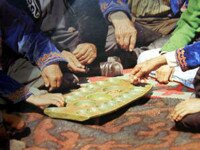
Detail from a painting depicting a game in progress
Toguz Korgool is a board game for two players – a version of Mancala. Although it is an ancient game, (involving counting and strategy), it is sometimes referred to as “Kyrgyz Chess”, it is found in many parts of the world, even as far afield as Africa – where it is known by such names as Awari and Awo and in Ethiopia, where it is thought to have originated, it is known as Gebeta. (Mancala is the Arabic name given to some forms of the game – and has come to be a generic name for a wide family of similar games).
There are some suggestions that the game could be as much as 4000 years old, but it is likely to have come to Central Asia sometime between the 8th and 14th centuries, perhaps coinciding with the arrival of Islam or the campaigns of the Golden Horde.
The game consists of a board with two rows of nine otau, bowls or pockets, and two kazan, large bowls – and 162 qumalaq, small balls, beads or pebbles.
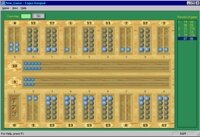
Click on the image to download a computer version
Each player has a row of nine “pockets”, (otau), along one side of the board – and at the start of the game each contains nine qumalaq. (Toguz means nine in Kyrgyz and several other Turkic languages). Each player also has a Kazan but this is not used in the course of play other than as a depository or store for the stones that they capture from their opponent.
The players takes turns moving beans from one pocket to those on the right, distributing them to other holes.
On his/her turn, a player takes all the stones of one of his holes, (so long as it is not a tuz – the word means “salt” and is used to describe a rather complex) and distribute them anticlockwise, one by one, into the following holes. The first stone must be dropped into the hole, which was just emptied.
If the move began from a hole, which contained only one stone, this stone is put into the next hole. (This is the only time that the starting hole remains empty)
If the last stone falls into a hole on the opponent’s side, and this hole then contains an even number of stones, then these stones are captured and stored in the player’s kazan.
If the last stone falls into a hole of the opponent, which then has three stones, the hole is marked as a tuz. There are a few restrictions on creating tuz:
- A player may only create one tuz in each game.
- The last hole of the opponent (his ninth or rightmost hole) cannot be turned into a tuz.
- A tuz cannot be made if it is symmetrical to the opponent’s one (for instance, if the opponent’s third hole is a tuz, you cannot turn your third hole into one).
It is permitted to make such a move, but it wouldn’t create a tuz.
The stones that fall into a tuz are captured by its owner. He may transfer its contents at any time to his kazan. The game ends when a player can’t move at his turn because all the holes on his side, which are not tuz, are empty.
When the game is over, the remaining stones, which are not yet in a kazan or in a tuz are won by the player on whose side they are.
The winner is the player who, at the end of the game, has captured more stones in their tuz and their kazan.
If both players have 81 stones, then the game is a draw.
It is also possible for the game to end as soon as oner player captures more than 81 balls.
The Championships in Pardubice consisted of three different disciplines: Rapid, Blitz and Classic. Personally, I’m not sure of the difference although I suppose a parallel can be drawn with Chess which has a regular, (or Classic), version and a Speed version … but the distinction between Rapid and Blitz is lost on me.
For the record:
- In the former Soviet Union it even became a form of National Sport.
- In 2001, one of the Top Ten Kyrgyz Sportsmen was a player of the game.
- During the recent world Championship competition, Kyrgyzstan won four Bronze medals.


 Bishkek