The Bactrian Argali
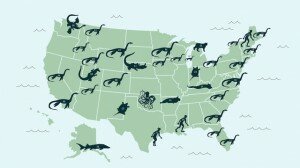
A map of lake monsters in the United States (click on the map to go to the page)
The other day I came across an interesting map on the internet …
While Bigfoot, the Jersey Devil, and the Mothman might get most of the attention on land, there are plenty of cryptozoological myths surrounding the US’s lakes, rivers, and swamps as well … Swamp Thing may well be a comic character (sorry, character in a Graphic Novel!) … but what about the Eel Pig of Herrington Lake and the ape-like Honey Island Swamp Monster?
It may sound like something out of a 1950′s B-film plot … but Atlas Obscura has mapped out the Loch Ness-type monsters, webbed hominids, and giant killer sea creatures that, according to legend, lurk beneath the watery surface.
We actually have our own “monster” here in Kyrgyzstan … not as famous as Nessie, or some of the other creatures, the possible existence of which scientists have seriously researched over the years … The Toktogul Monster.
Back in January 2004, the Vecherniye Bishkek newspaper carried an interesting story about some Bishkek residents who had gone fishing in the Toktogul Reservoir.
The men knew the area very well and the waters where they were only about a meter deep. They felt their fishing line snag on something. When they investigated they saw something grey, about 20 centimeters across. It looked like a snake – and when the line was eventually freed it was stripped of all the bait and catch that had been there.
It was at this point that they remembered having been told by local people not to fish there as there was “a huge snake can cut off something between your legs!”
When asked what he thought it could possibly be, one of the fishermen is reputed to have said: “I have never seen anything like it in my life. But I know one thing: I will not go fishing to Toktogul Reservoir anymore!”
That might sound fanciful … but no more fanciful than the stories told by Marco Polo in his account of his of his travels to the court of Kublai Khan and his years of employment in the great Khan’s service. Many people found it hard to believe all that he described.
These days there is some considerable controversy about whether or not he actually undertook the journey – with some scholars expressing doubts over the accuracy of his accounts. Despite the problems, his account has many features of fact … for example, he was able to identify for the first time in Europe that asbestos was of mineral origin rather than vegetable … and among the other curiosities he describes which were questioned at the time as flights of fancy were the wild animals he saw, particularly the large wild sheep, having horns “three, four and even six palms in length”. This, the largest of all wild sheep, remained an enigma in Europe for 600 years and is now named after him, “Marco Polo sheep”. Could he really have just picked up such details from traveler’s tales overheard in a market?
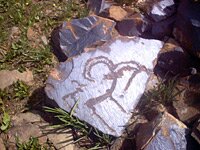
A “Marco Polo Sheep” depicted on a petroglyph from Saimaluu Tash
It might have helped if he had something to back up his story … but even if he had collected something – the party had been robbed of everything during their return journey.
Photography was still a long way in the future … and, anyway, despite the old saying that “the camera doesn’t lie“, the use of computer programs like Photoshop means that we tend to question the veracity of what we see and the “evidence of our eyes”.
He could, however, have had a petroglyph … like the ones to be seen on the Saimaluu Tash plateau … but I don’t suppose there was much of a market for such things in the Venice of his day.
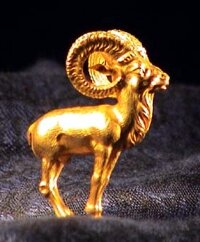
The Bactrian Argali
Perhaps, as a merchant, he would have been more interested in something made from Gold … like the Bactrian Argali – one of 20,000 gold items, (things like bracelets, bowls, clasps, buttons, weapons, statuary and jewelery), over 2000 years old, discovered by Soviet archaeologists in six burial mounds at Tilla Tepe, (Tillia Tepe, “Golden Hill” or “Golden Mound”), in 1978 – just before the Soviet invasion of Afghanistan.
Tilla Tepe is considered to be the most significant archaeological discovery made in Afghanistan since the excavation of Begram in the 1930′s. The collection, however, went missing for more than two decades but was later found in secret vaults underneath a bank in Kabul.
There would have definitely been a market for such objets d’art … and maybe this is the sort of thing the merchants would have brought back with … but, as I said, everything they brought back from the East was stolen en route.
Although that particular object was found in present day Afghanistan … other archaeological discoveries are constantly being made … there have been several treasure troves unearthed in Britain, for example … and here in Kyrgyzstan … whilst they might not be as grand as the Tilla Tepe find … there are still fascinating finds that emerge from the bowels of the earth – or the depths of Lake Issyk Kul,
Perhaps the classic find was that of the Shamsy Horde:
One day, back in 1962, a tractor driver was ploughing a field when he came across something unusual. He got down from the tractor and examined his find. The police were summoned and an inventory taken. Experts came out from the Historical Museum in Bishkek and over the next few years a number of expeditions explored the neighbourhood – but nothing more was ever found.
That find was an ancient treasure trove consisting of jewellery, (gold on copper medallions that might well have adorned a horse’s harness); a beautiful, finely crafted, medallion containing a miniature portrait; a golden cup; bracelets and earrings; a headdress (measuring just 17 cms in diameter) and a golden funeral mask.
All of the items dated from the 4th or 5th Centuries. Most of the jewellery, like the headdress, is incredibly small – suggesting that either this was designed for a child – or the people of that period were much smaller than those of today.
It used to be said that the mask had been sent on loan to St Petersburg – never to return, but in fact it is still in the custody of the Historical Museum in Bishkek … and forms the centerpiece of the Gold Fund.



 Bishkek