Marco Polo
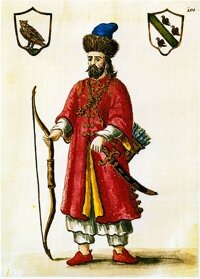
Marco Polo in Tartar Dress
Let me say from the outsaet: As far as we know, Marco Polo never made it as far north as Kyrgyzstan.
There is considerable controversy about whether he actually made the journey for which he is famous but assuming that he did, then he crossed from what is now Afghanistan to Kashgar before travelling further East. However, this intrepid explorer holds a special place in the story of the Silk Road … and reawakening interest in Europe about China … and Central Asia.
He was born into a wealthy family of Venetian merchants, who travelled wherever business led them. They had set up trading posts in Constantinople and the Crimea. His father Nicolo, (along with his uncle, Matteo), went on a “business trip” to Xanadu (in search of new markets?) for the early years of Marco’s life and they did not meet until 1269 when he was 15 years old.
They travelled to Acre and then onto what is now eastern Iran and Afghanistan, where they stayed for a year. Setting off again, they reached Kashgar in what is now China. By then they were on the main Silk Road, which they followed to the then Chinese borders. By 1275, they were back at the Mongol court, presenting sacred oil from Jerusalem and papal letters to Kublai Khan.
For the next 17 years the Polos lived in the Emperor’s dominions. Little is known of these years – he gives only vague details in his book, written after his return to Europe.
Marco Polo was popular with Kublai Khan, who sent him on fact-finding missions across the empire. Sometime around 1292, the Polos offered to accompany a Mongol princess, who was to become the consort of Arghun Khan in Persia. Sailing to Hormuz, via the Malay Peninsula, Sumatra and Ceylon they proceeded to Khorasan. Eventually they left for Europe, reaching Venice in 1295 with a fortune in jewels sewn inside his ragged, outlandish clothing where they met their family, (who had long given them up for dead).
Three years later Marco was taken prisoner of war during a naval battle by the Genoese. In jail, he met another prisoner, a writer of romances and chivalry. Marco began to tell his story and, slowly, his book, “Il milione”, began to take shape. When it was eventually published, it was an instant sensation. He was freed and returned to Venice, where he led a quiet life before dying at the age of 70. It is claimed that on his deathbed he claimed that he had not told “a half” of what he had seen.Some scholars have doubted the accuracy of his accounts – however, the details he quotes suggest that he not only visited the places he describes, but that he did indeed have a position of influence in the court of the emperor. Despite the problems his account has many features of fact … for example, he was able to identify for the first time in Europe that asbestos was of mineral origin rather than vegetable … and amongst the other curiosities he describes which were questioned at the time as flights of fancy were the wild animals he saw, particularly the large wild sheep, having horns “three, four and even six palms in length”. This, the largest of all wild sheep, remained an enigma in Europe for 600 years and is now named after him –“Marco Polo sheep”. could he really have just picked up such details from traveller’s tales overheard in a market?
He died on January 8th, 1324.






 Bishkek