Organic Kyrgyzstan
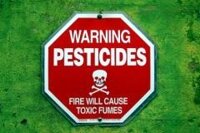
A sign warning about pesticide exposure
Today happens to be International Day Against Pesticides.
It is not an official UN recognized commemorative day, but was established by the 400 members of the Pesticide Action Network International, (PAN).
Their aim was to draw attention to problems caused by production and use of hazardous chemicals used as pesticides in order to increase cop yields. The choice of 3rd December was to commemorate an incident at Bhopal, in India, in 1984.
The incident is classified as one of the worst industrial accidents in history and involved a chemical leak from the Union Carbide pesticide plant in Bhopal, which resulted in the death of more than 3,800 people, (some reports say 8000), and caused injuries to many more, (… between 150000 and 600000 depending on different estimates), including some 6,000 of whom would later die from their injuries.
Pesticides are substances intended to prevent, destroy or mitigate the effect of different types of “pests”, (weeds, diseases or insects), and this improve crop yields. Although we tend to think of pesticides as being synthetic chemical agents – different measures of crop protection – such as the use of sulfur – date back to around 2000BC. Over the years different chemicals have been used, arsenic, lead, mercury, nicotine sulfate, pyretheum … to name just a few.
The use of pesticides has been increasing over the years as farmers have sought to improve harvests.
In the 1950′s the use of DDT began to predominate, but a decade later warning signs emerged – DDT seemed to inhibit many fish-eating birds from reproducing … the loss of these bird species would have a starting and significant effect on the biodiversity in their locales and as a result of theis discover, the use of DDT as a pesticide is now basically banned by an international convention. It is still used, however, in some parts of the world where it is sprayed onto walls in order to kill or repel mosquitoes, thus providing a means of preventing the spread of malaria and other tropical diseases.
This unexpected side effect of the use of a pesticide is just one problem that activists highlight when trying to point out what they see as the inherent dangers of the use and reliance of these chemicals. Other risks identified includes a growing resistance developing in the targeted pests against the pesticide – creating stronger and more virulent strains. They also point to mutations and diseases developing or being caused by the chemicals.
Many people suggest the use of “natural” or “organic” means of pest control – as opposed to using synthetic chemicals.
In the West, Organic Farming is seen not just as a way of producing environmentally friendly crops, the harvest also attracts a premium price as a more demanding and sophisticated public appear to be willing to pay higher prices for ecologically pure produce – both a health choice and/or as a statement of support for environmental values and policy.
Here in Kyrgyzstan producers have often proudly the ecologically pure nature of the crops – and not just producers; I remember some early discussion about an information brochure about Kyrgyzstan when one official from the Tourism department wanted to emphasis the “ecologically pure” nature of the food grown in Kyrgyzstan.
Some have cynically suggested that this support for organic farming is more pragmatic than based on philosophical principle … the farmers being unable to afford the high cost of chemicals.
At the beginning of November, here in Bishkek, there was a forum dedicated to the development of organic farming, where the Minister for the Economy said that Agriculture is one of the government’s top priorities in its strategy for sustainable development over the next four or five years. The strategy includes specific provisions relating to the development of organic farming … but there is a still a lot of work to be done in order to create an effective and trustworthy system … where products can be tested and certified as organic.
There has already been some work done in this field – supported by the Swiss and the Koreans … the Swiss agency Helvetas, for example, working with farmers in Southern Kyrgyzstan … and the Koreans in growing, certifying and selling organic fruit and vegetables. Further support for organic farming was forthcoming last week from the German Society for International Development (GIZ), which currently support the development of production of organic apricots and medicinal herbs, as well the Kyrgyzstan’s participation in various international exhibitions and trying to raise public awareness about organic farming.
One of their project managers told the Parliamentarian Committee for Agrarian Policy that ““Development of organic production will help to minimize impact of human activities on the environment,” but also pointing that this would require a internationally recognized form of certification. He even thought that this might be a requirement imposed if and when Kyrgyzstan joins the Customs Union, in order to export produce to other member countries. Furthermore, it reduce the country’s dependence on imported supplies of fertilizers, health risks, and adverse effects on the environment, whilst increasing the income of farmers.
There is also a company, Ecoproduct Asia, based in Sokoluk which specializes in producing “organic juice” made from products purchased from growers – primarily from the Issyk Kul oblast.
There’s even an online virtual co-operative, a sort of Farmville - where users, (members of the public), can place advanced orders for products … and in exchange for their early investment they are guaranteed both organic food and guaranteed prices.
In fact, although still relatively small, both the acreage and number of producers dedicated to organic farming. I am not sure to what extent the local population will be prepared to pay premium price for organic foods, but there is growing middle class and the Korean collective in particular targeted both hotels and restaurants, (both of which rely on high levels of disposable income among the population), in their early marketing – as well as potential export markets.



 Bishkek