Mosques
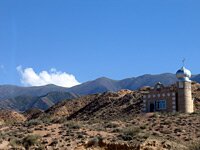
The mosque at Mazhiliy Ata
Sometimes you see references to Kyrgyzstan as a Muslim country but, technically, according to the constitution, it is a secular state and it is probably better to describe the country as “predominantly Muslim”.
The majority of the population – possibly as much as 80% – probably consider themselves as Muslim but for many people it seems to be more of a cultural background than one of devout daily practice. Indeed, some of the strictures of the practice of the religion do not lend themselves well to nomadic life in the mountains … where there is no muezzin to call from a minaret for the faithful to pray five times a day.
As a result the Kyrgyz have sometimes been described as “half Muslim” because they have preserved many aspects of the Tengrist traditions which predate the adoption of Islam. Another description that is sometimes used is the Islam “tends to sit lightly on their shoulders – as did communism under seventy years of the Soviet Union”.
There are signs, however, that Islam is a growing force in Kyrgyz society. One of the most obvious is the number of mosques that have been built in the republic since Independence.
Some of them are big and rather grand, whilst others – especially in the villages – are small, sometimes comprising little more than a room with a tower attached as a minaret and a dome encased with metal tiles which seem to reflect the sunlight.
Almost every village seems to have a mosque and some, (for example, several on the road from Bishkek to Issyk Kul) appear to be placed in the middle of a field with no obvious settlement nearby. In the case of the tiny mosque at the foot of the Dolon Pass, (on the Kochkor side of the pass), it marks the site of Dolon Ata – a holy site which may predate Islam but could also be associated with Dolon Bai, the grandfather of Mohammed Kyrgyz.
The roadside cafes in Boom Gorge often have have a namazkana, (“prayer room”), and one was opened in the Parliament building in 2011 after a somewhat heated debate.
Many of the mosques were built with financial support from Turkey or Saudi Arabia and many were built using the system of ashar; a traditional system of community mutual assistance where individual villagers donate either money or labour, or both, for charitable or public projects.
There are several examples of mosques worthy of note, such as: .
The Central Mosque in Bishkek – on the intersection of Moskovskaya and Gogola – is a modern construction and at busy times such as the main Friday Prayers and High holidays, cannot accommodate the crowd of believers that have gathered and who overflow into the grounds and into the street.
There are plans to construct a new mosque on Jibek Jolu, on the Northern edge of the city center – on the site of a former cinema – and before that a cemetery. The project has proved somewhat controversial. On the one hand, there are complaints that the site is not big enough and doesn’t offer sufficient space for the necessary facilities – such as car parking space. On the other hand, there have been calls for the site of the original City Mosque to be returned to the Muftiat so that they can build a new one. The mosque was closed, and the site commandeered by the Soviets shortly after the Revolution of 1917. The building was demolished and the city bazaar constructed in its place. (Later, the bazaar was moved to its present site on the Western edge of the City Center – Osh Bazaar – and the site became Park Podeba – which houses the city’s main war memorial).
In 1899, the local community addressed a petition to the local entrepreneur and philanthropist Ilshat Daulbaev asking for help in building a mosque. At that time there were over three and a half thousand Muslims living in the city … and Daulbaev responded by financing the construction of a wooden building on what is now the site of the fountain in the grounds of the Hyatt. It was considered one of the sights of the city – unifying Central Asian design with European monumental architecture and had beautiful carvings, elaborate painted ornamental patterns, wooden pillars and high vaulted ceilings. In the Soviet period it was converted into a puppet theater – but was unfortunately burned down in 1965.
The Burana Tower, about 15 kilometers out of Tokmok, is thought to have been a minaret – and if so it is the oldest in Central Asia. The name Burana itself is probably a corruption of the Turkic word Murana (= minaret).
A similar, smaller construction is preserved at Uzgen, near the Uzbek border, complete with the domed crown and doorways from which the muezzin would call the faithful to prayer.
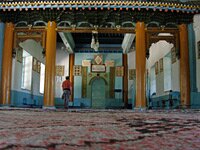
Inside the Dungan Mosque in Karakol
There is the Dungan (Chinese) mosque in Karakol. The foundations of the Mosque are made of stone and the walls are made of fired brick. The roof has a characteristically Chinese architecture. The building has the elements of carved walnut wood and columns around it, decorated in various colours.
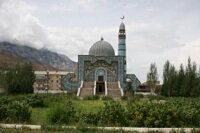
The Mosque in Naryn
The new mosque in Naryn was built, (it was completed in 1993), with donations from Saudi Arabia. It’s a large, highly decorated complex and has a design that combines both arabic and traditional Kyrgyz elements.
In Osh – The Ak-Buura river runs through the city North to South, and to the west is Suleyman Too (“Solomon’s mountain”), which dominates the city. Some Muslims consider it sacred and make a pilgrimage to the site where the Prophet Muhammad is supposed to have once prayed. For some reason (apparently, in profile some people think it resembles a pregnant woman) it is also revered by many women who have been unable to bear children. At the top of a short (30 minute climb) is a flagpole and a mosque which marks the spot where the 14 year old Babur,(who had been recently crowned the King of the Ferghana Valley – and later went on to become the founder of the Mogul dynasty in India), built a shelter for his chilla - a 40 day retreat for meditation on a diet of bread and water, in 1497. Although the mosque has been destroyed and rebuilt twice, (once after an earthquake in 1853 and then in the 1990′s after it had been destroyed in suspicious circumstances by an explosion in 1961), it is another centre for pilgrimage.
At the foot of Suleiman Too, not far from the North-Eastern corner of the mountain, is the Rabat Abdullakhan Mosque, built by Abdullakhan II, the last of the Uzbek Shaibanid dynasty which ruled much of Central Asia in the latter half of the 16th century, as one of a series of mosques throughout his fiefdom.
Osh is also home to what was, until recently, the largest mosque in Kyrgyzstan – The Shaid Tepa Mosque. The original wooden building was constructed between 1908 and 1910, but was closed by the Soviets, when it served as stables and blacksmiths. It was reopened in 1943 in a surprising act of religious tolerance by the then Soviet government. Recently it has been renovated with financial support from Saudi Arabia and has space for some 5000 worshippers.
As it happens, last year Osh also saw the opening of a large mosque, occupying 2.5 acres and with a capacity of 20,000 worshipers, as part of ceremonies commemorating the second anniversary of the ethnic violence which erupted in June 2010.
Also, last year it was reported that Kyrgyzstan’s Spiritual Board of Muslims, (SMMC), has plans to construct Central Asia’s largest mosque in the town of Kara-Suu, in the Osh oblast, on the Kyrgyz-Uzbek border. If construction actually goes ahead. the mosque is planned to be six storeys tall, housing a madrassah and a department of theology. The plan is for construction will be financed by expatriate Kyrgyz citizens living in Moscow and several of the Arab states.
Although, as I understand it, technically mosques are closed to women and non-Muslim men – many, such as the Dungan Mosque in Karakol, will invite visitors to enter.


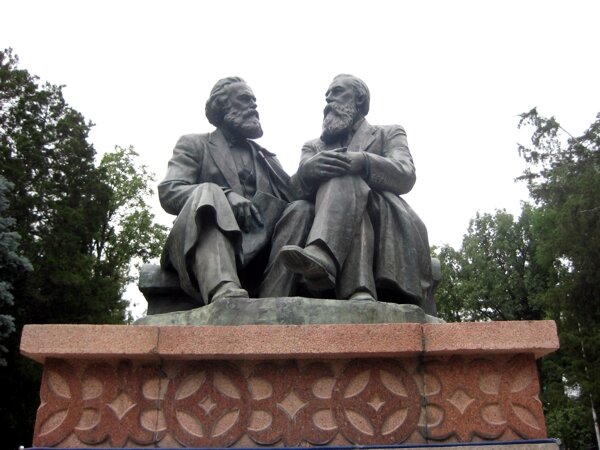


 Bishkek