Sulaiman Too – World Heritage Site
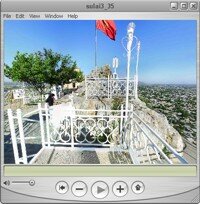
Sulaiman Too Panorama
I have mentioned in a previous postcard the phenomenon of #TTOT - Travel Talk on Twitter.
The organisers decide on a subject for the week and then on Tuesday, (at 9:30 – am and pm, in order to cover all the world’s time zones), they pose a series of questions on that theme, inviting others to submit answers, and thus they hold an on-line conversation in real time. Actually, in many ways it is more like “brainstorming” as the comments flood in, without comment but providing food for thought.
Well, this week, the theme was World Heritage Sites. These are places, (such as a forest, mountain, lake, desert, monument, building, complex, or city) which are deemed by UNESCO to be of special cultural or physical significance.
In preparation for the event, on Monday someone posted a helpful tweet:
The #TTOT chat tomorrow will be about World Heritage Sites. Wondering if you’ve ever been to one? See the list here:http://whc.unesco.org/en/list
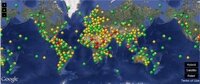
Map showing the distribution of World Heritage Sites
That got me wondering and so I went to have a look. There are some 936 properties currently inscribed in the list, (725 “cultural” sites, 183 “natural” ones and 28 “mixed”), which is a lot more than Seven Wonders of the World – Ancient or Modern. I was pleasantly surprised to discover that I had visited a creditable 38 of them, ranging from the Statue of Liberty in New York and Chichen Itza in Mexico, to the Kremlin and Red Square in Moscow and the fjords of Western Norway … and not forgetting, of course, Sulaiman Too in Kyrgyzstan – Kyrgyzstan’s only entry in the list.
 There were an awful lot, of course, in the many of the 153 different states that I haven’t visited, but I was surprised how many, even in the United Kingdom that I hadn’t visited. I had, at least heard of Stonhenge even if I had never visited it. On the other hand, there were many sites on the list that I have never heard of … and I am not so sure why some of them made it into the list – the modern housing developments in Berlin, for example. As it happens, the UNESCO website has a page describing each of the entries in the list and why they were selected, so it is possible to go and have a look to see why each one was deemed worthy of inclusion.
So, all in all, I felt that a period of geographical and historical research is called for.
.
The idea of creating an international movement for protecting heritage emerged after World War I, but it was only 1972 that the Convention concerning the Protection of the World Cultural and Natural Heritage was signed, merging two separate movements: the first focusing on the preservation of cultural sites, and the other dealing with the conservation of nature. The Convention has since been ratified by 186 countries.
Part of the inspiration behind the convention was the project to build the Aswan High Dam on 1954. The construction would result in flooding a valley containing treasures of ancient Egypt, such as the Abu Simbel temples. UNESCO launched a worldwide campaign to safeguard and preserve these treasures and as a result, (and at a cost of USD80 million – a considerable sum in those days and I hate to think what such a project would cost these days), the Abu Simbel and Philae temples were taken apart, moved to a higher location, and put back together piece by piece, thus preserving them for prosperity.
.
It was in 2009 that Sulaiman Too was inscribed into the list, giving it status as an important historical and cultural site, and giving the Kyrgyz authorities certain responsibilities concerning the upkeep and preservation of the site..
The “sacred mountain” of Sulaiman-Too dominates the Fergana Valley and forms the backdrop to the city of Osh, which stands on the crossroads of several important routes on the ancient Silk Road. It rises 175 metres from the floor of the valley of the Ak Buura River in which Osh is located to an altitude of 1175m. It is surrounded by the busstle of the busy city center surrounds.
The hill lies in an East-West orientation and is 1140m long and 560m wide (or 2000m long and 250m wide – depending on where you consider the foot of the hill to lie).
The hill has five “peaks” which give it a distinctive profile which is said by some to resemble the profile of a pregnant woman lying down. The peaks are called:
- Sulaiman-Too : Sulaiman’s Peak
- Shor Too : Salt peak
- Rushan Too : High Peak
- Eer-Too : Sadle Peak (but the Kyrgyz call it Kelinchek nevestka or “sister in law”)
- Keklik uchar : where the keklik flies, or Keklik’s house.
Made of limestone, the hill has many caves and grottos.
.
The earliest mention of the mountain is in a thirteenth-century Chinese writing, which refers to a “city within a very revered mountain” and one of the cities Davan, (which probably means it was a city from which the Chinese obtained the famous “Celestial horses”).
Sulaiman Too is sometimes referred to as Solomon’s Throne – and the name refers to a legend that the city of Osh was established by the Biblical king. It is said that he visited the area and prayed at the spot where Babur, the first of the Mogul emperors of India who was born in Andijan not far away in the Ferghana valley, built a hurja – or “rest house” and has become a major destination for pilgrims. Some people believe that Solomon was actually buried here. Having founded the city, he is said to have spiritual beings then cut a narrow canyon and thus re-divert the flow of the river Ak Buura through the city. When they reached the mountain he is said to have cried “Hosh!”, (“Enough!”), and hence the city received its name. However, there is no actual evidence that Solomon ever visited the area.
The name Sulaiman Too may, in fact, be a fairly recent acquisition – its first recorded use was in the early 18th century. Babur refers to the mountain as Bara Kukh. It is not clear what Bara Kukh means – although Kukh means “hill” in Persian and various suggestions have been made about possible interpretations of Bara … referring to it’s size and distance from the nearest hills, for example “the mountain that stands in isolation” or, perhaps, “beautiful mountain“. We do know that Babur doesn’t mention anything about Solomon which seems an odd omission if it had been an already established tradition.
It has a long history as a holy site, possibly back to the Bronze Age. Some scholars think it was the site of an ancient Zoroastrian temple. There are suggestions that there was once a Fire Temple here, (some indentations in the rock which have been suggested by some to be the marks made by the hands, knees and forehead made by Solomon whilst praying but which other scholars claim were places where lamps were lit as part of Zoroastrian fire worship). One theory is that the most visited spot on the hill (Babur’s House) was once the spot where the bodies of the dead were left for the dogs and birds to pick at, before the boners were then taken away to be buried – a typical Zoroastrian practice.
It was only during the 19th century, however, that it came to known to the outside world as a place of pilgrimage, as a result of the writings of scholars and explorers describing what they saw and experienced. It was only towards the end of the century that the healing properties of the site were described, and these were catalogued and analysed by scholars during the Soviet period.
During the Soviet period, when religious practice was frowned upon, there was a tendency to deliberately neglect sites that might have religious significance. Since Independence, however, there has been a significant effort to improve the appearance of the mountain: trees have been planted, and a walkway was laid around the base of the mountain with pathways to the museum and the main holy site of Ok Ui.
Although there are a number of Holy Sites on Sulaiman Too which are visited by pilgrims, the whole mountain is venerated as Holy. The two most commonly visited sites are Chake Tamar and Ok Ui. Most of the sites are caves – in fact all the caves on Sulaiman Too are considered sacred. One of the large caves is virtually inaccessible – needing special equipment – and is relatively unexplored.
Bash Koyo Turgan Jer: A depression in a rock near to Ok Ui is known as the “Head Hole” because it thought that it gives relief from headaches if the head is placed in it.
Bel Orik or Bel Tash: a sloping rock with a small gully cut into it, over 2 meters long, located just behind Ok Ui. Pilgrims come to pray at the rock and slide down it. It is said that someone with an infirmity slides down it three times, then they will be healed – and there are several stories of such healing.
Chake Tamar and Beshik Tash: Chake Tamar is a small cave about 100 to the west of Ok Ui, by the side of the newly constructed walkway. In fact there are two entrances to the cave, separated from each other by about 6m. It is very small and to explore it, it is necessary to crawl around on all fours. Apparently there is supposed to be water dripping from the ceiling which has healing properties which is especially effective for healing eye problems. It is also visited by childless couples wishing to have children. Legend has it that Solomon, nearing his death asked the angel of death for time to pray one more time. He visited the various holy sites on the mountain and went to the cave to pray. The Angel of death came to fetch him, but as was in in the cave could not find him – and he turned to stone in the cave and the drops of water which seep from the ceiling are said to be his tears. There is another version of the legend that simply says that he slept in the cave.
Chiltan Gor: A small cave high up on the mountain is known as Chltan Gor. According to legend there are forty entities of superhuman strength who live amongst humans without being seen, called chilten. This cave is known as “the place of 41 chilten”). There are three entrances to the cave and the passages from them meet a fourth, closed, passage. Near the entrances are some petroglyphs and stone implements found here suggest that it was used as a form of habitation.
Eagle’s Cave: The largest and most frequented cave in the side of the mountain is known as the Eagle’s Cave and is now the site of a large museum. The conversion was controversial as some of the arches were filled with cement and a glass and metal shell was constructed over the entrance of the cave. It is linked with another cave, Ishen Unkur, in which there are examples of petroglyphs depicting the sun and various animals. Legend has it that a devout shoemaker of the prophet Suleiman lived here.
Hur Kyz: Near the museum is a small cave (6m tall, 10m wide and 12m deep) called Hur Kyz. In Kyrgyz, kyz means girl and the cave is associated with both women and purity. There was a tradition that if someone who is pure calls to Hur Kyz in the cave, then she will answer … not just as an echo. However, because she saw unclean happenings in the cave, she has hidden herself but will return when piety returns to the population. There is another tradition concerning the name which suggests that it means Forty Girls – and links to the legend of the forty girls from which the Kyrgyz claim descent. Some people claim that is the home of beings – (close to “fairies” in Western cultural terms). One feature of the cave is an arch which is said by some to resemble “stone lace”.
Kol Orik: a rock by the side of the path just below Bel Orik has a hole in it, at about knee level, just about the right size in which to fit an arm bent at the elbow, up to the armpit and it is claimed that putting the arm into it will cure a pain in the arm.
Kyl Kuprik: In some Islamic traditions there is a “bridge of hair” over which people must pass after death … those who have not sinned (or whose sins are balanced by the prayers during their lifetime) pass over the bridge to heaven, whilst the other fall into the fires below. Kyl Kuprik is the Uzbek name for this bridge -and is ascribed to a narrow ledge on the southern face of Suleyman Too, about a hundred meters west of Ok Ui.
Ok Ui: In his memoirs, Babur describes how he built a hurja (or “rest house”) on the mountain – saying that although another hurja, built by a Sultan, was located higher, the one that he built had a better location – with the whole city and surrounding towns spread out beneath it. Ok Ui means “White House” in Uzbek and is the site of the hurja built by Babur in the thirteenth century. The present structure is not the original. The structure had two rooms but was destroyed by the Soviet authorities in 1963. It was claimed that the building was unsound and dangerous – and the mountain was cordoned off one evening, and explosions were heard during the night – and by the next morning the building was gone. The present, (one roomed structure), was built in 1989, with a reported 25000 volunteers passing the bricks up the mountain by hand. The materials they used were apparently those from the original building, which had been kept in storage.
Tepenukur: An almost vertical cave found near the summit of the hill, close to Chiltan Gor. Archaeologists have discovered many stone-age implements in the cave.
.
The largest mosque in Osh, (the Jauza Mosque), used to stand at the base of the mountain to the Southeast. It is mentioned by Babur in his memoirs. Having survived for over 700 years, it was destroyed in the Soviet period and the site changed hands several times … at one being a dormitory for the Teacher Training Institute, another serving as part of a food processing plant, and as a school for photographers.
Near to the site of the mosque was a stream known as Jannat Orik, or “the stream of Paradise”. The waters of the stream were held to have healing properties – especially for throat disorders. Although Babur mentions such a stream, he makes no mention of its healing qualities. Another sacred stream was the Jupas Orik - and until quite recently, water wheels were still being used on it to pump water in the channel.
Not far from Suleyman Too is the Rabat Abdullakhan Mosque. It was built by Abdullakhan II, the last of the Uzbek Shaibanid dynasty which ruled much of Central Asia in the latter half of the 16th century, as one of a series of mosques throughout his fiefdom. In the 1930′s it served as a dormitory, but as had always been the city’s main mosque it was returned to the faithful for prayer by the Soviet authorities in 1944. However, in 1963 it was turned into a museum – thus escaping demolition to make way for a sports stadium for the local Teacher Training Institute. Renovations started in 1988, and the mosque was returned to the faithful once more – and is now in active use and a center for orthodox Islam in the city.
Near to the South-eastern foot of the mountain is the mausoleum of Asaf ibn-Burkhia. According to tradition he was either the vizier of Solomon – or his uncle, (on his mother’s side). When Soviet archaeologists excavated the tomb in 1983, no bones were found, only stones marked like dominoes. In fact there was a common custom in ancient times of burying someone near to where they died, but burying objects associated with the person in their mausoleum – wherever it was located. In fact, the structure is described by scholars as being fairly recent in style, similar to structures built between the 18th and 20th centuries. As with Ok Ui, however, this does not preclude a second structure having been built on the site of an earlier one – and there is some evidence of this. Renovation work was undertaken on the mausoleum in the 1980′s.
There are three cemeteries located on Suleyman Too: a large one at the base of the mountain on the southern side, and two smaller ones to the north.
Also, to the east of the foot of the mountain, archaeologists have excavated a medieval bathhouse., dating from somewhere between the 11th and 14th centuries.
.
Petroglyphs: The mountain is endowed with a number of early rock paintings, 101 individual locations have been indexed so far, according to UNESCO. The earliest examples are circular in format – with spirals contained inside the circles. There is some suggestion that these are connected with sun worship. Others are clearly representations of animals – such as snakes. There also appears to be depictions of “houses” – square motifs divided into four parts.
.
In justification for its inclusion as a World Heritage Site, UNESCO points out that for more than one and a half millennia, Sulaiman Too was a beacon for travellers and revered as a sacred mountain. Its five peaks and slopes contain numerous ancient places of worship and caves with petroglyphs as well as two largely reconstructed 16th century mosques. In all, there are 17 places of worship which are still in use, and many that are not, which are distributed around the mountain peaks and are connected by footpaths. The cult sites are believed to provide cures for barrenness, headaches, and back pain and give the blessing of longevity. Veneration for the mountain blends pre-Islamic and Islamic beliefs. The site is believed to represent the most complete example of a sacred mountain anywhere in Central Asia, worshipped over several millennia.
This rich concentration of material evidence for cult practices, from both pre- and post-Islamic times, is preserved and present the most complete picture of a sacred mountain anywhere in Central Asia. Sulaiman-Too presents vivid evidence for the exceptionally strong tradition of “mountain worship” which spans several Millennia and which has been successfully absorbed by Islam.
However, UNESCO also points out that it is at risk arising from development., both on the mountain itself, and in the surrounding plain and the local authorities are required to have a master development plan which would include measures for the preservation of the site.
.
Incidentally, the first of the five TTOT questions this week was “Suggest your top 3 Unmissable World Heritage Sites.” I am sorry to say that with answers like:
- Angkor Wat (Cambodia), Machu Picchu (Peru) & Uluru – Kata Tjutas (Australia);
- Teide National Park (#tenerife), Tongariro National Park (#NewZealand), and Angkor Wat (#Cambodia) ;
- Macchu Picchu in Peru, Karnak in Egypt and Hagia Sophia in Istanbul;
- Iguazu Falls, Plitvice Jazeera, and Carcassone;
- Machu Picchu (Peru), Persepolis (Iran), Chichen itza (Mexico);
- Canaima national park, summer palace & great barrier reef;
- Angkor, Great Wall, and Upper Middle Rhine Valley;
- Bukhara (Uzbekistan), Petra (Jordan) and Cappadocia (Turkey);
- Borobudur (Indonesia) Petra (Jordan) Abu Simbel (Egypt);
- Table Mountain in Cape Town , Florida Keys, The Pyramids;
- Rice terraces Philippines, Taj Mahal, India & Ellora caves;
- Machu Picchu (Peru); old Havana (Cuba); Pyramids (Egypt);
- Libya: Leptis Magna, old town of Ghadames and ancient rock art sites
… Sulaiman Too didn’t get a look in. Those suggestions represents quite an interesting and eclectic mix of different sites – and I am pleased to say that I have actually been to some of them – but what was really annoying was that I am not sure that all of those are actually on the official list.
The good news is, however, that it didn’t feature in the answers to question 4 either: “Is there a World Heritage Site you think doesn’t deserve its status?”
.







 Bishkek
Apparently, #TTOT regularly gets about a million particpants … with about 25 million “impressions”.
For a brief summary of this week’s discussion, see: http://connvoyage.blogspot.com/2011/08/ttot-round-up-world-heritage-sites.html