Mohammed Kyrgyz – Tagai Bai
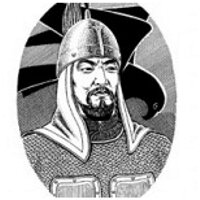
Mohammed Kyrgyz - Tagai Bai
I was going through some old newspapers the other day when an article caught my attention. It featured a line drawing portrait which is one of a series of important characters from Kyrgyz History, and the article seemed to be about this person – Mohammed Kyrgyz, who is also known as Tagai Bai.
Now, I had heard the name of Mohammed Kyrgyz before, but didn’t really know anything about him, hence my interest was aroused.
In itself that’s not surprising when you remember that the Kyrgyz basically had no written language before the Russians settled here and much of our knowledge about their early history comes from wither the epics were handed down from generation to generation as part of an oral tradition, or from external sources – from example, from China or Russia. Indeed one of the first references to him in print seems to come only in 1913, in a book entitled “A Short History of Kirghiz” by one of the first national historians, Osmonaaly Sydyk uulu.
So, who was this Mohammed Kyrgyz?
It’s not certain when Tagai was born, but it was probably around 1469 – a time when Henry VII sat on the English throne in the Sary-Bel Alai Valley in Southern Kyrgyzstan into a family that we would probably now call part of the Kyrgyz aristocracy. His father, Aguls, was one of the twins (the second was called Kubul or Kabyl) and the “wings” of the Kyrgyz tribal system are supposed to be the descendants Aguls, (the “right wing”), and Kubula, (the “left wing”). Their father, Tagai’s grandfather, was Dolon-bai, after whom the Dolon pass on the the Bishkek-Naryn-Torugart road is named.
Tagai had an older brother, Adigine. At some point at the beginning of the fifteenth century, when Adigine has assumed authority as the tribal chieftain, (or Bai), for some reason, (we don’t know why), Tagai had moved to the Ketmen Tube valley, (which was then a part of the Chui province), and settled in the Kochkor region near to the mazar, (mausoleum), of Kochkor Ata.
There he quickly established himself as an authoritative figure, and seems to have been able to gain the respect of the local population, gathering troops to resist the Muhgal invaders that were descending on the country. Then, in 1508 he received news that his brother was seriously ill and he hastened to his side. Adigine died in his arms.
According to his will, Adigine decided not to be buried in his motherland, but in Arslan Bob instead. Arslan Bob was already considered a sacred place amongst the Muslims of Central Asia, and although Islam had not yet been extensively adopted amongst the Kyrgyz, this might have been one of the reasons he chose it. Apparently Tagai led the funeral proceedings and followed Muslim custom and practices. Indeed, it is said that it was from this time that he was give the name “Mohammed Kyrgyz”. It is sometimes claimed that he was one of the leading characters in the adoption of Islam amongst the Kyrgyz.
Another reason why Arslan Bob may have been chosen was that it was considered to be between the two two regions of Kyrgyzstan – the North and the South, although these days it is clearly identified as a part of Southern Kyrgyzstan.
Whatever the reason, from that point onwards many Kyrgyz nobles have been buried there.
Later that year, at Barskoon, on the shores of Lake Issyk Kul, at an assembly of all the the Kyrgyz tribes, (a Kurultai), he was raised on a white carpet and elected as the ruler of all the Kyrgyz – it was reportedly the first time that the Kyrgyz had elected someone as a supreme ruler, (but, to be frank, I have that claim about several others – Barsbek and Orman Khan for example), As a sign of his authority he adopted a flag, (the “golden” flag), and established a special residence, (a “white” yurt), and was given the name Kyrgyzstani uluu.
He knew that to deal with the Mughal soldiers he would need well trained and disciplined troops and so adopted stringent laws and formed an army to defend and create a separate state for the Kyrgyz. As a result, according to some historians all the Mughals were ousted from the territory of Kyrgyzstan by 1510. The rise of a new nation state, however, posed a threat against the Mughals which they felt that had to address and several campaigns were directed against him. For a while, however, with careful planning, courageous fighting and skilful negotiations of alliances he managed to maintain his independence until, in 1524, a force of 12,000 descended upon him at his base at Barskoon. The odds were against him, the forces unequal. The Kyrgyz were defeated and he was taken captive to Kashgar.
His captors withheld from executing him, in fear of sparking a rebellion, but they, also, could not release him for fear that he would lead a revolt, so the cast him into a dungeon where they left him for five years.
On his release, he did indeed gather a force, (comprising, at first, mainly of Kyrgyz, but later these were joined by Kazakhs and members of other Turkic tribes), around himself at his base in Kochkor. There were meetings with other local leaders including the Kazakh Khan, Muhammed Tahir, and discussions centered on the expulsion of the Mughals from the territories where their people lived. Sultan Said Khan could not have missed the warning signs and in 1526 he set out to deal with Mohammed Kyrgyz who was by now in open rebellion against his Mughal overlords. In battle Mohammed Kyrgyz was once more captures and carted off to Kashgar where he remained until his eventual death in 1533.
The Kyrgyz still considered him their leader and, even though he was held in captivity, no-one sought to take the throne from him.
The Chinese claim that he was buried in the Kyzyl- Suu region of what is now the Kyrgyz Autonomous County of Xinjiang, just over the border with China.
Tagai Bai is also connected in some accounts with the construction of the caravanserai at Tash Rabat.
In the Barskoon valley, there are a couple of landmarks that are associated with Mohammed Khan. One is a waterfall where he used to sit and think, (or dream), and the other is a stone which is not far from the monument to Yuri Gagarin, which has now been fenced in to help preserve as a monument to this son of the Alai, (in the South), who lived near Kochkor and untied the Kyrgyz people at Barskoon, (in the North)




 Bishkek