Babur, the “Tiger”
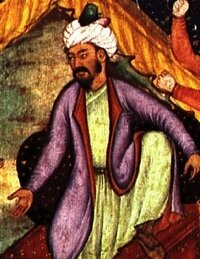
Yesterday, I commented on the fact that it was Saint Valentine’s Day. I could just have easily chosen to mark an anniversary which has slightly more relevance to Kyrgyzstan, but the day passed by without anyone really noticing it.
It was February 14th, 1483 when Babur, (the “Tiger”), the first of the Mogul Emperors, of India was born.
Hang on … I said that the event had relevance to Kyrgyzstan, but he was the founder of an Indian Dynasty. What’s going on?
.
Babur, (Baber, or Barbar – the name is Turkish and means either “lion” or “tiger” depending on the authority), lived between 1483 and 1530, and is best known as the founder of the Mogul empire of India which ruled until 1857. The word Mogul is a corruption of “Mongol”.
He was born in Andijan, (in modern-day Uzbekistan), and his full name was Zahir ud-Din Muhammad. He was a descendant, (a great-great-great grandson), of Timur, (Tamerlane), on his father’s side and of Genghis Khan on his mother’s. He saw his royal lineage as the key to future greatness. Genghiz Khan’s empire was the largest the world had ever known and Timur had planted the Savvid dynasty onto the throne in Delhi.
In 1494, at the age of 12, he succeeded his father, Sheikh Mirzo Zahiruddin to the principality of Ferghana in central Asia. His early life was spent in an ultimately unsuccessful struggle to retain his inheritance and to recover Samarkand (Timur’s capital) from the Uzbeks. He made three attempts to lay siege to the city – but his efforts proved futile, because each time he captured the city, he was unable to hold onto it for long.
Being ousted by the Uzbeks, he turned his attention to the South and in 1504 he captured Kabul, establishing a kingdom in Afghanistan which he ruled for two decades. After the failure of his third and final attempt (in 1512) on Samarkand, Babur began raids southward into India. In 1525, responding to an invitation from the governor of the Punjab to overthrow the Sultan of Delhi, Babur launched an invasion. Although his force was small (12,000), he defeated the Sultan at Panipat in 1526 and captured Agra and Delhi. This may have been due to the fact that he had access to artillery and gunpowder which, even though they were somewhat primitive, they were more than a match for the other side. He finally conquered nearly all of Northern India.
Babur, unfortunately, never got the chance to take full advantage of his fledgling empire. He died suddenly in 1530, and was succeeded by his son, Humayun.
Incidentally, Humayun’s career was somewhat chequered. He inherited one of the largest empires in the world, and between 1530 and 1540, he managed to lose all of it to various rebellions. He went into exile in Persia, and slowly put together an army to recover the lost territories and by 1555, he had almost completely succeeded. Just as he was on the verge of complete re-conquest, he fell down a flight of stairs and broke his neck. Despite this tremendous success, both Islamic and Western historians have marked him down as one of history’s major losers.
Humayun’s defeat, however, had a profound influence on Mogul culture. In his years of exile in the Persian court, he developed a deep understanding and love for Persian culture which he instilled in his son, Akbar (“the Great”, in Persian). After they had re-conquered India, the culture that they built around themselves was based heavily on Persian influence.
Babur left behind a set of handwritten memoirs, written in his native Chaghatay Turkish that recounted almost 40 years of his adventures, ideas and opinions. This document, the Baburnama, is one of the earliest known autobiographical works in the Islamic world, and is perhaps the most detailed account of central Asian life of that period. In it, he nostalgically writes of his former life and home in Osh.
In it describes the Ferghana region as small, surrounded on three sides and with only the western approaches, from Samarkand, for enemies to approach it, and as ”abounding in grain and fruits” … the melons from Andijan are particularly praised as “excellent and plentiful”.
His description of Osh in Southern Kyrgyzstan mentions the Suleyman mount (and his building projects on it); the river, overlooked from both banks by gardens and a red and white stone which was used as handles for knives. He also tells of a mosque built by a meadow with a wide stream flowing through it, and apparently it was a standing joke to carry people who fell asleep in the meadow across three streams to the other side.
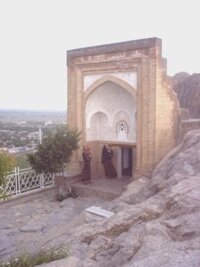
On the Suleyman Mountain in the center of Osh, is “Babur’s house”, built when he was 14 as a shelter for his “chilla” – a 40 day retreat for prayer and meditation. It has been rebuilt twice – once after it was damaged in an earthquake in 1853, and then after a bomb exploded destroyed it in 1961 – the newly independent country arranged for its renovation in the 1990s.
.
An English translation of Babur’s memoirs can be found on the internet at: http://persian.packhum.org/persian/.


 Bishkek