One in the eye
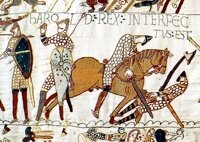
The crucial turning point in the battle – when Harold gets an arrow in the eye!
On a hilltop in the Kent countryside, an arrow found it’s target and was to change the course of history.
It was 14th October, 1966, and legend has it that the English King, Harold, was struck in the eye by an arrow shot by one of the archers in Duke William of Normandy’s army that was trying to storm his position. That battle had lasted all day and the English were holding out and if they could survive to the end of the day, then reinforcements might have arrived and saved the day. Then a feint retreat drew many of the inexperienced English troops to charge down the hill surrendering the advantage that the heights had given them … and the fatal shot shattering the confidence of the were to rob the English of victory … ending the Anglo Saxon monarchy and ushering in the Norman dynasty.
For the record: In fact, there is some doubt about whether the arrow actually pierced the eye … that detail may be based on the interpretation of the depiction of the battle in the Bayeux Tapestry – which, itself, is not quite conclusive. It did, however, prove to be a fatal shot.
There have been other famous arrows in history and legend … William Tell shooting the apple on his son’d head, Robin Hood’s appearance at the archery contests at Nottingham Castle, the English archers at Agincourt that helped Henry V defeat a far superior French Army … and so on. Then there were the Mongol archers, part of the army of Genghis Khan that helped him to sweep across Asia and create the world’s largest empire.
It wasn’t just the Mongols that employed mounted archers, (which, actually, has a long history, first appearing during the Iron Age – the earliest depictions of mounted archers are found in artwork of the Neo-Assyrian Empire of about the 9th century BC), but they were particularly renowned for their skill.
The Kyrgyz, as one of the Turkic peoples, were also skilled warriors adept at archery and this tradition has been kept alive as one of their traditional horse games, Jumby Atmai, which involves shooting at a target while galloping on horseback; a large bar of precious metal (the “jumby”) is tied to a pole by a thread and contestants attempt to break the thread by shooting at it, while at a gallop.
It is sometimes performed at local festivals but, to be fair, I have only ever seen it once. In one festival, an archery contest was organized, but standing and shooting at a wooden board with a mountain goat painted on it.
The festival of traditional horse games usually feature Skatchi (races), Kok Buro, Kyz Kumai, Oodarysh, and Tyiyn Enmai.
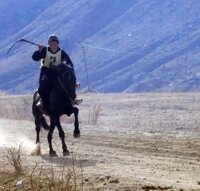
Coming into the finish
Races: To prove the value of their animals they enjoy arranging races – especially at some for of celebration, (festival or toi), so that the riders anc show off their skills and the horses their speed or their stamina.
There are several different types of races:
- Long-Distance Races – “At Chabysh” – these were long-distance races. Experienced trainers prepare yearlings for a race called “tai chabysh” and one-and-a-half year old foals run in the “kunan chabysh” race. When the animals become three years old they are entered into the competitions proper.Previously “At-chabysh” races were held on different occasions, usually in connection with some holiday or commemorative festival. The winner (or its owner) was given some jewellery and cattle as a reward. Horses of various breeds and ages took part in the races. Each trainer had his own methods of preparing the racer for the competition. The distance raced was 53 versts, later on 100 kilometres. Moreover the riders were quite often boys of 10-13 years of age, sometimes riding without a saddle. According to current rules, however, only horses three years old and older of any breed are admitted to the races. And no-one under 13 is allowed to participate. The distance raced ranges from 4 to 50 kilometres.
- Pacer’s Races – “Dzorgosalysh” - These races are run over shorter distances where speed is and not stamina is the crucial element. Experts consider “dzorgo” to be a great merit of a horse. The horses demonstrate not only speed but also gracefulness. (The Kyrgyz people have many proverbs and sayings related to the pacer, such as: “Don’t let your horse run beside a pacer.”)
- Girls and Young women’s Races – “Kyz dzharysh” - It is not only Kyrgyz menfolk that ride horses. Kyrgyz women also learn to ride horses in their childhood in the highlands, where there are severe winters and deep snows; where sheep are driven up and down steep mountain slopes, or across turbulent rushing rivers; and where one cannot do without a horse. Kyz Dzharysh are races for girls and young women. The riders can be distinguished by their headdresses. Girls tend to wear hats with a wide marten and young women wear pretty kerchiefs. The races can be as competitive as any of the men’s races.
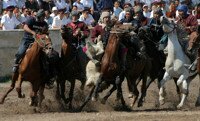
Kok Buro
Kok Buro is sometimes referred to as “goat polo” It is a form od wrestling on Horseback for a Goat’s Carcass – “Ulak tartysh” or “kok-boru” mean “grey wolf”.
There are several legends about the origin of the game: According to one version, young horse riders chased and caught a wolf and beat it with large sticks so that the animal was close to death and then they threw the wolf to each other. Another story tells of a herdsman who invented the game and was inspired one day when hr saw how young wolves played with each other and took goat meat from each other – so, it is said, wolves were the first kok-boru players. There is also a description of the game in the Epic Semetei – the second part of the Manas Epic.
Apparently, the game originally developed in antiquity when herds of cattle grazed in the steppes and mountains all year round – exposed to possible attacks by wolves. Having no firearms, the shepherds could not deal with wolves. Brave djigits (horse riders) chased after the wolves until the beasts of prey fell, and then they began beating them with sticks and lashes, trying to snatch them away from each other.
It is also said that the game was devised to train skilled horsemen – helping warriors to learn the secrets of horsemanship and combat on horseback.
Over the course of time, the place of the wolf was taken by the carcass of of a goat. The skin endures the heat of battle well, and their long hair is easy to grab hold of.
Later on when the people led a more settled life the more informal version of “kok-boru” was replaced by an organized sport. It transformed from being a game for the participants into more of a spectator sport. In the original version of the game, the field of play was not fixed and it was possible for the players to gallop away for over a kilometer – out of sight of those watching. Also the “gates”, or goals, were not well defined leading to numerous disputes.
There are two teams, consisting of an equal number of riders – in formal competitions it is four. The playing ground is 300 by 150 meters. The opposite sides of this area, marked with flags, present symbolically “the gates” – or “goals”. In the center of the playing ground a carcass of a goat, weighing on an average of 30-40 kilograms, is placed. Typically, a game lasts 15 minutes – although competition games are divided into three parts of 20 minutes each . The objective of the game is to seize the goat’s carcass and deliver it into the gates of the contesting team.
The players are allowed to pick up the carcass from any place within the limits of the field, take it from their rivals, pass or fling it over to the partners, carry it pressed to the horse’s side or suspended between the horse’s legs.
During the course of the game some unlikely, unforeseen and ad hoc alliances may be formed among the participants. These alliances are usually short-lived, dissolving in the rapid fluidity of the competition as quickly as they are established. So one moment brothers may be vying for the honour of becoming the new champion, whilst old rivals can be seen aiding each other. All this fosters fast-thinking teamwork that is absolutely vital under actual combat conditions, (which the game very realistically simulates).
The rules forbid rearing the horse, making your horse collide with a rival’s at a high speed, seizing the rivals horse by the bridle, taking the reins off of it, including blows with a whip, or shouting or entering into conversation with one’s opponent.
Kok-boru tournaments are frequently held. Teams from all areas of the Chui Region and Kyrgyzstan participate in the competitions. Special tournaments are held at in Bishkek at Noorus – March 21st – and on Independence Day – August 31st, when teams compete for the President’s Cup including teams from other countries.
It is said that kok-boru is one of the most popular sports in Kyrgyzstan today. There is a Kok-boru federation based in Bishkek with founder members from all of the Central Asian states. The Federation has joined with other Central Asian bodies to create an International Tournament and there are hopes for it to be included as a sport in the Asian Olympics.
As a sign of the times … there are experiments with a new, lighter, carcass, made of rubber. It is hoped that this will help make the sport even more attractive to European and American audiences and lead an ever widening familiarity and popularity for the sport. If nothing else, the initiative should allow spectators to marvel at the skills exhibited by horse and rider without being upset by the thought of an animal having being slaughtered simply to provide for the entertainment of the audience.
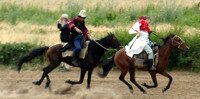
Kyz Kumai
Kyz Kumai - or “Chase the Girl”. In olden days this game was a part of the wedding ritual.
According to the rules the bride was given the best racer and she was entitled to a head start on her horse that began the race. The bridegroom set out in pursuit to catch up with her, in this way proving his love and right to marry her. Being at a disadvantage with the slower horse the bridegroom sometimes failed to catch up with his fiancée. Yet, although she might beat him with her Kamchi (or horse-whip) she did not reject him and the wedding would be held all the same.
At present this traditional folk game is usually held during holidays for example in the green meadows of high mountain pastures, (jailoo) or on racecourses.
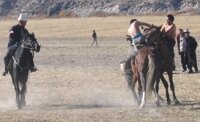
Oodarysh
Oodarysh, or restling on horseback is a popular sport.
Kyrgyzstan has “traditionally been strong in wrestling and boxing”, which may not be surprising given the fact that the Kyrgyz hail from a warrior past and wrestling – including Oodarysh and Er-Enish – wrestling on horseback – is considered a national sport and, practiced in nomadic camps over the centuries.
- In Oodarysh, two riders pit themselves against each other, trying to pull their opponent off his horse. They are allowed to throw their rival, together with his horse, to the ground.
- Er-Enish, on the other hand, is like a team sport where two groups of riders take the field against each other
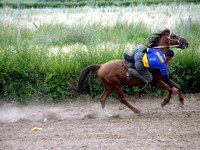
Tyiyn Enmai
Tyiyn enmai is a competition in which young djigits can show off their horsemanship and agility. It used to involve picking up coins from the ground while galloping – but these days the coins have been replaced by flags made from coloured rags. These are placed at measured intervals along a course flags and the riders gallop towards them, bending down over the side of their horse to reach down and grab them as they pass. As the rider grabs one, he throws it high into the air and the audience counts to keep tally. After three passes, the rider with the highest tally is adjudged the winner.




 Bishkek