Islam
I am not sure on what they base this, (bearing in mind that the Muslim calendar is different from that used in the Western, both then – the Julian Calendar – and now – the Gregorian calendar), but according to some traditions, today happens to mark the birthday of the Prophet Mohammed, who was born back in 570AD.
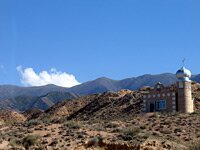
The Mosque at Mazhily Ata
The vast majority of people in Kyrgyzstan would claim to be Muslim, a follower of Islam, the religion based on the teachings of Mohammed.
However, things are not necessarily as straight forward as that statement might suggest.
Tradition has it that Islam was brought to Central Asia by Shah-Fazil, whose mausoleum, (reputedly built by his son around 1050 AD), is in Safed Bulan, however, Islam arrived in the land now known as Kyrgyzstan much earlier, and the Kyrgyz probably first encountered the religion very early on, possibly as early as sometime in the 7th century.
Arab armies had brought their faith eastwards conquering the lands as far as Samarkand and Tashkent. The Battle of Talas in 751 AD is notable for having stopped both the Westward advance of the Chinese Tang dynasty and the Eastward advance of the Arab Caliphate … but not the Eastward advance of Islam as a religion, which continued to be spread by merchants who traveled the Silk Road.
At that time, (and indeed over the centuries since then), the Kyrgyz have practiced a form of Tengriism; a religion which incorporates elements of Shamanism, animism, totemism and ancestor worship, and which focuses on the sky deity, Tengri. Tengriism has helped to shape many beliefs and practices which form part of traditional Kyrgyz culture and which are evident in today’s society, even amongst people who consider themselves to be devout Muslims. Many of the practices of the religion were either adapted and grafted onto the existing shamanistic customs … but others were apparently ignored as they did not seem to have had any relevance to the nomadic lifestyle and culture of the people. As a result, sometimes the Kyrgyz are called “half Moslem” because of the way that they have combined their former traditions with Islam.
Another aspect of Islam is Sufism. The word “Sufi” is derived from the Arab word for wool and was assigned to certain groups because of the woollen robes that they wore. The Sufi tradition tends to emphasise the compassionate nature of God to be found in the Koran, as to the more austere view presented in some of the other traditions, and Sufi “dervishes” sought a mystical union with the Almighty and eventually Sufi orders began to emerge. One of the places which played a prominent role in the development of Sufism was the Ferghana Valley with a number of Sufi saints such as Ali bin Uthman al-Hujwiri and Kwaja Qutbuddin Bakhtiyar Kaki studying here.
The main conversion to Islam amongst the Kyrgyz, however, seems to date from about the eighteenth century and greater success in assimilating Islam into the everyday life of the Kyrgyz, (especially in the South of the country), came in the 19th and early 20th centuries. Despite the prevalence of Orthodox Christianity amongst the Russian colonists, the authorities did not interfere in religious matters and the peoples of Central Asia were free to practice Islam as they had before.
In the Soviet period, however, things were different. Many mosques and religious schools were closed, mullahs arrested and three of the “Five Pillars of Islam” were actually banned by Stalin in his antireligious campaign, and this was one of the root causes of the Basmachi rebellion. Some concessions were made by the authorities during and after the Second World War – but control was still enforced. Perhaps it is surprising that, despite of all disapproval and control, religion remained a force during the 70 years of the Soviet period – to the extent that many Kyrgyz still consider themselves Muslims even if they do not follow all the rites, rituals and practices of the religion.
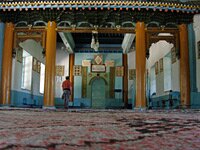
Inside the Dungan Mosque in Karakol
Today, there is an upsurge of interest in religion – once again, especially in the South. New mosques are being built – in the soviet period there were apparently only 33 mosques in the whole of the country, (one source says 25), but in the ten years following independence some 2500 new mosques were established. Not all of them, however, are officially registered (for example, of the 600 mosques established in the Osh oblast up until 1997 – apparently only 60 had been registered with the authorities).
Some of the mosques, such as those in Bishkek, Osh and Naryn, have been financed by Turkish or Saudi Arabian funding – but many which are being established in villages – are built by the local communities themselves. Several thousand Kyrgyz make the Hajj - the pilgrimage to Mecca – each year. Unfortunately, nearly every year the local media carry stories of problems encountered by pilgrims en-route, including occasional injuries and deaths.
The increasing interest in religion seems to have increased an awareness concerning the question of “Muslim militants”. Several organizations have been banned which are thought to be involved in politics or have connections with terrorist organizations, (perhaps most notably Hizb-ut-Tahir), with individuals arrested and printed materials confiscated. This became more marked especially following the incursions of the IMU, (the Islamic Movement for Uzbekistan), into the Batken region in 1999 and 2000, and the events in America on 11th September 2001, and continues to the present.
One of the controversial revivalist movements is the Davaat which encourages groups of young people to travel through the country as “missionaries”, visiting local communities and giving testimonies about their faith. Although the movement has been banned elsewhere in Central Asia, and also in Russia, it is closely monitored and controlled by the office of the local Muftiate.
The office of the Muftiate, however, has itself been the subject of some considerable controversy in recent times, especially over the the question of the organization of pilgrimages to Mecca … but that’s another story.


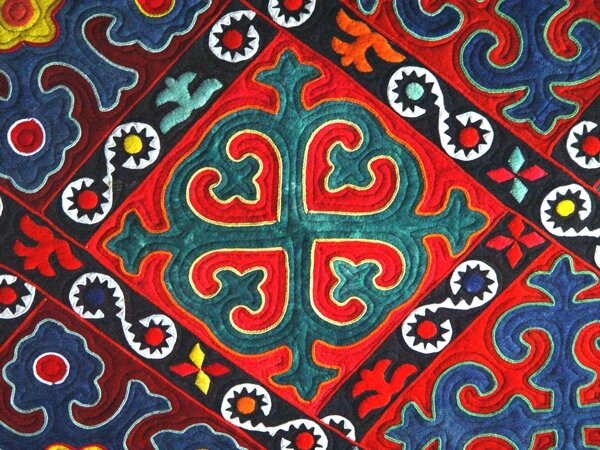

 Bishkek