Itchy hands
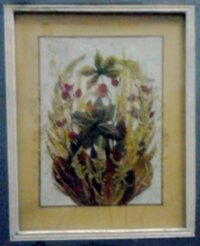
A different way to give flowers for a birthday
A few years ago I was given a picture as a birthday present. It was a picture made from an arrangement of dried and pressed flowers, grasses and leaves.
The idea was that I might hang in my new apartment, into which I had recently moved. It was also an interesting way to present me with the bouquet of flowers that is traditional on such occasions – a permanent reminder of the evening and my friends compared to the bunches of flower stems that would have to be thrown away after just a few days.
These pictures are not to everyone’s taste, but I really liked it … it struck me as the sort of thing that my mother would do … She was a great one for crafts and could turn her hand to sewing, embroidery (saima in Kyrgyz – as in Tush Kiyiz), knitting, macrame, lace making, patchwork (kurak in Kyrgyz), origami, glass engraving, whittling wood … and so on. She wasn’t very keen on drawing and painting, however, but give her some materials and she would love to play with them and see what she could make of them.
Every year she look at what courses were being offered in the local Evening School and if there was a new craft she would rush off to sign up for the class. In fact, she had what I call “itchy fingers”. She would strive to master the skills of a new craft … but once she felt that she had done so, she would transfer her interests onto another, returning occasionally to create something special such as a gift for some special occasion.
She would have loved it here in Kyrgyzstan where there are a great variety of crafts … some of which she had tried but also others which would have been brand new to her … and there are many different ways of looking at even those that she would have been familiar with.
Kyrgyz traditional handicrafts reflect ancient traditions and nomadic lifestyle of the people, and demonstrate a practicality arising out of necessity. For example, musical instruments and other implements were fashioned out of objects found naturally in the environment – were easily crafted and transported as the family from pasture to pasture with their flocks of sheep.
The people lived a subsistence existence – each family group would make items to satisfy their own needs. Occasionally goods were exchanged as presents or barter and sometimes a master, skilled in a particular craft, would emerge whose work was highly prized. Later, goods were also sold in markets and even made to specific orders.
Most of the materials used were natural byproducts of the agricultural lifestyle, (wool, leather, horn) or found in the environment, (wood, chiy grass, plants – roots and leaves for dyes). In particular, felt (made from sheep’s wool or – for the very rich – from camel hair) plays a large role in Kyrgyz crafts.
Some materials (silver, coral, and turquoise) would have been bought in markets.
Most of the work was done manually, using rather primitive tools … it was time consuming and so production levels were low – but it was a cottage industry providing for the domestic needs of the people themselves, so this is understandable. In more recent years, there has arisen the demand for goods by Kyrgyz who no longer live in the countryside, but in high-rise apartment blocks in the cities – and for souvenirs for tourists – so there are now craftsmen, and collectives, that specialize in making goods specifically for sale on the open market. Most of the best quality workmanship is still handmade – although it is possible to find articles manufactured by a more mechanized, industrial method.
The Kyrgyz people like bright, vibrant colours and this is often reflected in their handicrafts. At first, natural colours – such as those produced by dyes extracted from plant roots and leaves produced a limited range of colours, but the introduction of chemical dyes led to increase in the range and vibrancy of colour schemes. It is possible to find colours to suit almost any colour scheme.
Yurt decorations
Designs also tended to be simple, practical and reflect the objects found in the natural environment. . Typical shapes are often based on large various curls, the “muyuz“; with forks and sprouts – the “karga tyrmak” and “ala bakan“; cross-shaped figures – “tort muyuz“; or ovals or diamonds – “tabak oyuu“.
Although there are many traditional designs, elements, motifs on which craftsmen can call upon and utilize – but the nomadic Kyrgyz also have a love for freedom of expression, and both formalized style and free expression is reflected in the styles of craftwork. Shyrdaks, for example may be formal – with regular shapes and/or symmetry – whereas Ala Kiyiz are much more individualistic. This individualism can be seen in many of the items that are available as souvenirs and in the work of Kyrgyz artists such as painters and sculptors.
It is possible to arrange demonstrations and master classes of various national crafts, such as how to make Shyrdaks and Ala kiyiz, at different places around Kyrgyzstan – for example in At Bashi, Naryn, Kochkor, Tamga, Karakol and in Bishkek – either as part of a tour or as a special event.
Traditional crafts play an important role in the daily life and economy of Modern Kyrgyzstan. It is one of the largest sectors of the economy – employing, either formally or as self-employed, part-time, home workers, over 300,000 people. Although many people have suffered hardship in the transition from the central command economy of the former Soviet Union to a Free Market Economy, but the sector is growing from strength to strength – and offers great potential for enriching both financially and culturally (in terms of preserving traditional crafts and lifestyles) those involved.




 Bishkek