Chiy
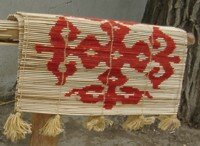
Chiy
Chiy is made from a kind of reed, or grass, which grows on the steppes and for years the long reeds have been harvested – cut and dried.
The grass was long used as winter fodder for animals and stems were gathered from end of summer. Although the livestock would happily munch away at the soft lower parts of the stems, the more mature, thicker upper parts of the stems were left untouched and the nomadic Kyrgyz learned to use them to good effect.
They discovered that the reeds themselves are strong and when braided together they form a mat are provide a sturdy, long lasting mat which can be decorated with wool of various colours or else left plain.
Once they had been collected and the soft parts taken for fodder, children would strip the external shell or casing from the reeds and they would be sorted stored according their length, as this would determine the width of the Chiy mat that could be made from them. The length was technically determined by the number of stems that would be bound together by weaving strands of wool or ribbons.
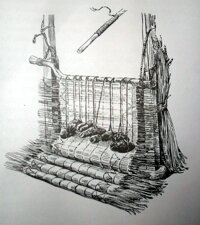
Frame
The mats were made in a wooden frame, between two upright poles. One of them might well be tied to the kerege, the lattice framework that form the walls of a yurt. The second would be positioned a short distance away, the length of the chiy stems that were being used to make that particulr mat – that is, depending on the width of the final mat. The height was usually defined by the height of the woman making the mat.
Long woollen threads, usually made from camel hair were threaded around alternate stems of Chiy grass every 10 to 15 cm along the width of the mat; in front of the first stem, behind the second, in front of the next and so on. A second thread went behind the first stem, in front of the second, behind the next one and so on. These threads kept the stem in place and they were kept taught by stones used as weights. When a new stem was added to the mat, each of the stones was taken and thrown over it … those at the front, thrown over to the back, and vice versa.
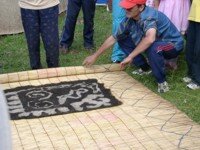
Making Ala Kiyiz on a Chiy mat
The plain mats, without any form of pattern could serve several purposes, as a sort of wall, screen over the door, or windscreen, or as a mat used in the production of felt or an ala kiyiz.
Decorated mats (called Chyrmagan kanat chiy) can be found inside a yurt between the kerege lattice framework and the felt covering, serving as both decoration and an extra layer of insulation. Sometimes it such a chiy mat, maybe six or eight meters long and about one and a half meters tall may be used out of doors as a windbreak.
Another type of mat, (called Ashkana chiy), and may be used to separate areas within the yurt, for example the women’s part from the rest of the yurt.
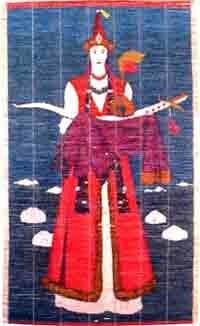
A picture of Kanykei, the wife of the legendary hero, Manas, executed as a decorated chiy mat
The patterns were created by winding coloured threads around each individual stem before they were woven together. TheCherber is the master who designs pattern. Placing a small group of stems together, the Cherber traces the outline of the pattern on the reeds, often with a needle. Each stem of Chiy grass is taken in turn and has different coloured wools wound round it according to the markings on it. Then before they are bound together with the camel hair twine, they are checked to make sure that the colouring and the pattern have been faithfully preserved even though each stem has been treated separately.
It is not always possible to design an exact pattern as with a shyrdak and often designs include angular geometric patterns rather than the more typical swirling curved patterns commonly on felt work - but skilled masters can create intricate designs and patterns. Some quite complex pictures can even be created.
To bind the mats together even more firmly, the edges can be trimmed with ribbons or thick fabric.
Usually the manufacturing process takes place outdoors.
Chiy mats are sometimes laid underneath the thick felt carpets helping preserve them from dampness.
Stems of Chiy grass are sometimes used in the manufacture of various types of household articles such as containers for kitchen utensils.




 Bishkek