Leather
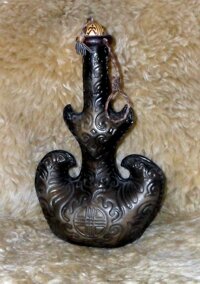
Kookor - leather bottle for Kumyz
The Kyrgyz, being nomads, tended to be self sufficient in most aspects of life and carry with them all that they needed. When it came to crafts, although everyone may have their own specialties, each person tended to be a “jack of all trades”, able to work in several media: wool, wood, ceramics, and leather. A craftsman, (or woman), would use whatever material they had to hand in their own household or in the immediate environment.
Tools were primitive and the work was labour intensive, time consuming, requiring considerable skill and patience.
Animal husbandry being a major aspect of their lives, and provided much of the raw materials for them to work with and although we tend to associate traditional Kyrgyz crafts with feltwork, (especially shydaks and ala kiyiz), it is not surprising that leather work also played an important part in their daily life and culture; belts and horse harnesses, “suit cases”, and containers for plates and other objects and even bottles.
There was a gender difference in that women would be tend to engaged in working with “soft” materials, (felt and other fabrics), whereas the men would work in more “solid” materials, (such as metal, wood, stone, ivory or bone). Most of the time they had no special workshops, nor employed others to help them, except in cases like a blacksmith which needed a special forge and several pairs of hands to work it. It seems, however, that the differences were not always “compulsory” or clear cut. A jeweler’s widow might continue her husband’s trade and in Southern Kyrgyzstan there were apparently men who were considered masters in the production of ala kiyiz. Both men and women were engaged in working leather and tanning hides.
The hides might be from the livestock, (horses, sheep, cattle, yaks, goats or camels), but could also be from wild animals such as foxes, martens, otters, ibex or gazelles, (possibly, although rarely, also from Bears, Argali – Marco Polo Sheep – or Bars – Snow Leopards) . As well as satisfying their own household needs, these skins might also have been traded in the regions markets and found their way further afield, East and West; to China and Russia, (although there is apparently evidence of superior quality leather being imported from Russia).
All the members of the family might be employed in the work, cleaning the pelts, removing the hair from the hides, soaking them, adding compounds to treat the hide to clean and help preserve it as well as possibly dying it with vegetable dyes.
Many hides would be turned into clothes: coats, hats, skirts, trousers, footwear and belts. Whereas lamb skins were most often used for clothing, rich Kyrgyz might wear, for example, hats made from marten or otter firs. Ibex and gazelle hides were especially prized as they were both durable and waterproof. Fur strips would also be used as decoration to edge or trim clothes.
Leather was also turned into horse harness, (saddles, straps, horsewhips, sweatcloths), and various kinds of bags. The carcass of a whole animal might be flayed for tulup bags to hold tea and other foodstuffs, yarns and so on. Leather cases were made to hold household implements. Camel leather was especially prized for sacks, especially for valuables, because of its waterproof qualities. Leather bottles, such as the “anchor shaped” kookor used for Koumiss, and buckets were made from leather.
Pelts were also used for “table cloths”, bedding and floor coverings.
The leather may have been plain, embossed, appliqué with pieces of coloured leather or studded.





 Bishkek