Kurak – Patchwork
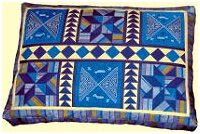
An example of Kurak
The Kyrgyz are an ancient people that have, for many centuries, preserved a traditional, nomadic, pastoral lifestyle in the Tien Shan Mountains of Central Asia. Although most Kyrgyz now live in towns and villages and the number of nomadic shepherd families is not as great as it used to be there is a strong interest in their traditional culture and crafts. To many people this is usually interpreted as “felt work” but the nomadic family, often living alone in isolated mountain pastures for long periods of time, had to be masters of many different crafts. Kurak or patchwork was one such craft.
“Patchwork” is an age-old tradition which has been practiced throughout the centuries by craftswomen from all over the world. There is something satisfying about taking little scraps of material and using them to create something “out of nothing” which is not only useful, but also beautiful.
Kurak is the Kyrgyz name given to the art of and the various articles made from patchwork. The name comes from the word “kura” which means “to piece together to assemble from separate scraps”.
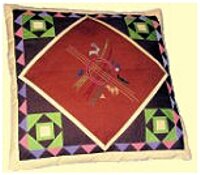
Cushion cover
The art of patchwork may be universal but Kurak is particularly Kyrgyz and has a special place in the culture of this formerly nomadic people, being derived from the practicalities of their traditional lifestyle.
The life of the nomad could be difficult at the best of times. Traveling with flocks pasture to pasture high in the Tien Shan Mountains, there was little sense in transporting things that could be of no practical use. Likewise, it was important to limit waste. So even off-cuts of material would be saved up and put to use combined with others to make something bigger.
The sort of products made out patchwork include everyday articles such as: head-dresses, children clothes, cradle blankets and covers, wedding curtains, mattresses, cushions, saddle cloths and bags – even large, quilted, carpets and blankets as well as purely decorative items such as wall hangings. The only limit to the list is the imagination of the artisan.
However, Kurak represents not just a practical art, economizing and maximizing the usefulness of lengths of material, but also a aesthetic art form allowing for a wide variety of individual expression although many of the designs involve geometric forms and regularity, proportion and symmetry the use of colour, shape and intricacy gave each seamstress the chance to demonstrate their skills.
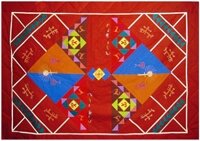
Patchwork patterns
Traditional patterns some of which can be traced back to symbols found in the petroglyphs that litter this part of Central Asia were created and repeated. There are many examples of standard patterns with names such as boto coz “camel’s eye”, turna-kurak “crane”, tumarcha “amulet” and jyldyz “star”. Amongst the most popular, simple, patterns was a black triangle placed on a white background.
An individual item can be appreciated as simply an aesthetically pleasing geometric pattern or, to the knowledgeable and practiced eye, it can tell a story.
Articles of Kurak were also ascribed magical properties bringing luck and prosperity and guarding against evil spirits. There were often special rituals associated with it. For example, the kyrk koinok a shirt for newborn babies to wear after 40 days would be made from 40 pieces of material collected by the mother from neighbouring yurts and sewn together.
A large set of patchwork items was provided in a girl’s dowry. The material patches would be collected at various family functions. Black and white cotton patches were thought to be especially effective. Other colours were also used especially red but the exact combination depended on the available supply
(Based on an article originally written for ”Kurak: Patchwork and Quilts” and featured in Discovery Kyrgyzstan)





 Bishkek