Tush Kiyiz
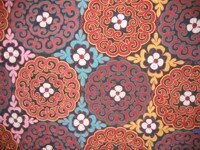
I happened to be in the hotel for a meeting, and was about to leave, when I heard that someone was looking for me. I walked down the corridor and was met by a familiar face, but couldn’t think where I met the lady before. Fortunately, she put me out of my misery with her sentence: “You probably don’t remember me, but me met a few years ago when I photographed a number of Tush Kiyiz in you office … and I was wondering if you still had some more.”
Then the memories came flooding back to me. Yes, I did indeed remember … we had sorted through something like a hundred examples, and she had taken them outside to try and photograph them in a better light. Such is Murphy’s Law, however, that no sooner had we draped several examples over the fence in order to get a better look at them than it started to rain.
Tush Kiyiz, (pronounced “Toosh Keeyiz”), despite the name which means “wall carpets”, are not carpets at all. They are wall hangings, or wall panels. Originally used in yurts, or yourtas, they are to be found all over central Asia where yurts were used – including Kyrgyzstan, Kazakhstan, Mongolia and Upper Xingjiang in China.
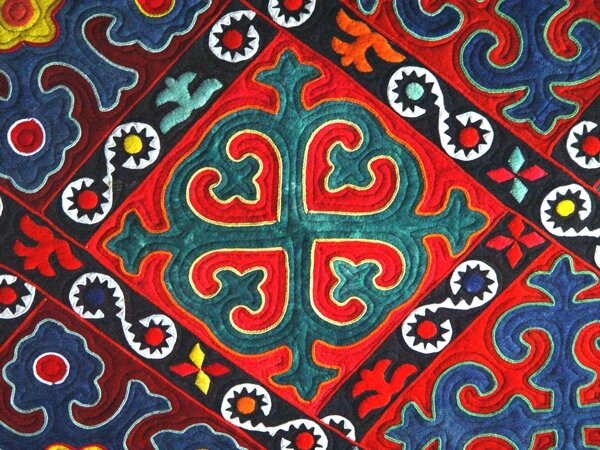
Traditionally, Kyrgyz carpets, such as Shyrdaks and Ala-Kiyiz, are made from felt. Tush kiyiz, however, are different in that they are not made from felt material but consist of a cloth background onto which is sewn a montage of bright embroidery designs.
The outline of a pattern is usually laid out on the piece of cloth to be used – but more experienced (talented) craftswomen preferred to work without laying out the pattern first, which gave a greater freedom for improvisation.
Sometimes the design embroidered onto the material is simply an outline in a form of chain stitch – but in many older tush kiyiz, the elements of the design are completely filled-in by row upon row of fine chain stitching. Also, the colours in the older tush kiyiz tend to be softer than the brighter colours used in more modern examples – because natural dyes were used.
No two tush kiyiz are alike. A grandmother sewed each of them, usually, for a young married couple. Some of them have the names of the couple, or perhaps the maker – sewn into them. A base or background of soft cloth is used, and onto this is sewn in relief, to create a montage, what are apparently abstract designs (but which are often abstract realizations of natural things, such as plants, flowers and even animals or, rarely, people).
Some tush kiyiz are folded and made into containers for clothes and other items – such cloth cupboards being also hung on walls – these are known as “tegche” (though tegche are not only made from tush kiyiz and many different types are found. Some of these tegche lost their functional use as bags and became purely ornamental).
There are actually two main types of tush kiyiz. Some are large and one of this type would cover much of a wall. With this type, the middle of the wall panel is not sewn work but is made only of the original material base. The sewn montage work appears around the edge, like a fringe, although triangular shaped pieces of it will protrude towards the middle of the panel. If you visit a Kyrgyz home, you will still very often see much larger types hanging on the walls.
Other tush kiyiz are smaller and would be used as headboards for beds or (since the bed often served also as a divan) as a divan covering. This type of tush kiyiz is now particularly hard to find, especially ones in good condition. Today, sadly, tush kiyiz are becoming much rarer. Nowadays, very few people live in yurts and although the tush kiyiz survived the transition into fixed houses, the skill is dying out as cheaper, but less interesting, machine made materials are available and as traditions change. A good tush kiyiz might have taken several months to make, although probably the grandmother who made it did not work on the design for more than a few hours a day, given all her other tasks.
It is now rare to find new tush kiyiz (though new shyrdaks are still common) and it is also rare to find any that are older than 40 or 50 years. Some of them will have the date sewn into them. Machine made variants of tush kiyiz are obtainable (made, probably, in Uzbekistan) but these are much less interesting. They can easily be detected by studying their backs because a genuine hand sewn tush kiyiz will have many discontinuities (broken thread ends) where the needle was re-threaded as the work progressed.




 Bishkek