Meanwhile … elsewhere …
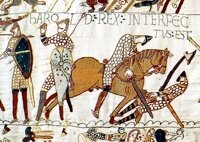
The crucial turning point in the battle - when Harold gets an arrow in the eye!
Although most of the English remember the date 1066 and could tell you that this was the date of one of the most important battles in English History – the Battle of Hastings, where William the Duke of Normandy defeated the Saxon English under King Harold. I am not sure, however, how many would be able to recall the fact that the battle took place on 14th October, 1066.
The nefarious William of Normandy, (William the Bastard, William the Conqueror) … having failed in his “cunning plot” to acquire the throne of England upon the death of King Edward the Confessor, (which even Blackadder’s manservant Baldrick might have found just a little too transparent and embarrassing), cooked up another with Harold’s estranged brother … who landed in Northern England with his Norwegian allies in order to lure the English army away from defending their southern shores. The two brothers met at the Battle of Stamford Bridge – which, no, didn’t have anything to do with Abramovich or Chelsea, but I am sure that a whole generation of English schoolboys find the association makes it easier to remember that particular piece of historical trivia.
Having despatched his treacherous brother, Harold got news of the Norman invasion and had to turn his army of “volunteers” and march them South once more. Most of them weren’t really volunteers, but were ordinary country folk fulfilling their feudal obligations to their overlord – conscripts, if you like; only the elite housecarls would have had much in the way of formal training and be the equivalent of the professional soldiers to be found in most of today’s modern armies.
Accounts of the battle vary, but it seems to have begun at the very respectable hour of nine o’clock in the morning, and lasted most of the day. The two armies were more or less evenly matched, although William’s was probably better equipped and certainly better rested – they hadn’t marched over 200 miles in a week after having already fought a major battle. Harold had the better position, on the top of a hill and the Normans tried to dislodge the Saxon force, but the shield wall held remarkably firm and the invaders had to withdraw several times. Rumours abounded that the Duke was dead and his soldiers looked ready to flee back to their boats, (those, that is, that William hadn’t had destroyed on landing), but he mounted a horse and rallied them once more.
Eventually he employed another “cunning plan” and ordered some of his troops to feign a withdrawal … no, not a withdrawal – a rout. Let the Saxons think they were running away and run down the hill in pursuit thus loosing the advantages of position and cohesion. It worked. Although that marked a pretty disastrous turn in the battle, the crucial moment seems to have come with the death of Harold. The story is that he got hit in the eye by an arrow fired into the air by a Norman archer … but this may be a later invention as there is a story William despatched him with his sword … but not everyone knows that and every schoolboy knows the story of the arrow.
There is a lot more to the story … like the fact that Harold wasn’t the last Saxon King … the teenager Edgar Atheling was declared king the next day, but was never crowned … well he and what remained of the Saxon armies were a bit busy harassing the Norman invader … actually meeting him at Southwark, now a part of London itself, and forcing him to take a more circuitous route to the capital before he could be acclaimed as King and crowned on Christmas Day, over two months after the “decisive” battle.
Now, while all that was happening on a little island just of the coast of Northern Europe, life went on as usual in other parts of the world.
A friend of mine always used to tell students studying to be guides, that knowing the history of Kyrgyzstan was important … but it was also a good idea of what else was going on in the rest of the world. If you are standing in the shadow of the Burana Tower, about 15km south of Tokmok, then when you are telling the group that the city dates from the tenth century, you might try to put that into some sort of context. At the time when William and Harold were fighting over a little Hill trying to decide who would rule over part of the island, (not even the whole of the island), the city of Balasagin of which the tower is all that remains was to become one of the capitals of the much, much larger Karakhanid Empire … one of four capitals: Uzgen, Samarkand, Balasagin and Kashgar.
It’s most famous citizen, Jusup Balasagin, was about to pen the famous Kutadgu Bilig, (“The Wisdom which brings Happiness”, which is usually dated about 1070), which is one of the earliest Turkic books and tells us much of the life and customs of the time and Mahmud al-Kashgari from Barskoon was in about to work on his opus “Di vanu lugati“, (a comparative dictionary of the various Turkic languages and dialects, 1072-1074), in Baghdad.
The Karakhanid empire or Khanate, (also spelt Qarakhanids – which used to cause me all sorts of confusion until I realised they were one and the same), was established in about 940AD by Satuk Bugra Khan … who went on twenty years later to declare Islam as the state religion. It is not clear why the dynasty or empire was given this name, but it means: Black Khan.
It was a confederation of Turkic tribes and marked the change over from Iranian to Turkic influence and dominance in Central Asia. Unfortunately, there are few systematic histories of the Karakhanids that survive and so we have to piece together details from fragments and artefacts discovered by archaeologists such as coins. They seem to have originated in tribal groupings and alliances being formed in the Semirechiye region and the Western Tien Shan – that is in what is now modern day Kyrgyzstan.
For the record: The name Semirechye refers to the seven rivers of the Turkestan administrative region of the Tsarist empire. In Russian, “semirechye” means “seven rivers”. (According to the Odyssey Guide to Kazakhstan, however, the seven rivers were the Ili, Shelek, Tentek, Lepsy, Aksuu, Koksuu Karatal). In modern Kazakhstan, there is still an administrative oblast called Zhetysu, (which means the same, “seven rivers”, in Kazakh), but this is much smaller than the area administered under this name by the Russians, which also incorporated parts of Northern Kyrgyzstan.
This has become an important point in the modern understanding of Kyrgyz history where there is often debate over whether Balasagin or Kashgari can be claimed as Kyrgyz – or as simply belonged to one of the many Turkic groups around at that time. There are also a number of historians who are busy scouring the records of this period to find evidence of the different Kyrgyz tribes.
The confederation owed it’s origins to a rebellion against the Kok-Turks, the local Karluk clans establishing their capital at Suyab, (which was also just outside modern day Tokmak, although nothing of the city remains except the archaeological diggings and what they reveal). They extended their influence and rule across much of the region, (for example to Taraz in modern day Kazakhstan), and eventually Suyab was replaced as the main urban centre by Balasagin.
Before the turn of the millennium, they had expanded their rule to cover most of Transoxiana, establishing the four capitals to see over the four districts of the empire – each ruled by a son of the royal house. In time, however, internal disputes arose and small city states began to secede from the Khanate. The eleventh century saw the rise of the Seljuks who moved into Central Asia having defeated Ghaznavids and entering Iran – and whilst William was ruling over his new domains, ordering the census that resulted in the Doomsday Book, and laying waste the North lands in retribution for a rebellion the Seljuks were establishing their rule over Central Aisa.
The Kara Khitan, a Mongolian people from Northern China, moved into the area and whilst Stephen and Mathilda were busy disputing the succession to Henry I’s throne the Kara Khitai were establishing their sway over Semirechiye from their capital near Balasagin and vassal states in Samarkand and Kashgar. The end of Kara Kitai rule was to come only in 1218 – while John Lackland was on the throne of England having succeeded his brother, Richard the Lionheart.


 Bishkek