Tokmok
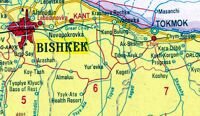
Tokmok - 60km from Bishkek
On Sunday we drove back to Bishkek from Naryn and had to call into the city of Tokmok to deliver some wedding gifts for the daughter of one of our staff.
Now, to be honest, it is some time since I have stopped off in Tokmok … we normally just pass through it on the way to Issyk Kul or Naryn – if we are not taking the by-pass, that is. (To and from Bishkek, there are two roads – one through the villages and the “new road” built in the 1960s, which actually by-passes the town.)
We didn’t really stop in the town this time either, we just delivered the gifts and went on our way. However, we had left the main road and I got to see a part of the town I hadn’t seen before. As we passed the large equestrian statue of Manap Bai, I thought to myself that I must find out who he was. As it happens, I haven’t been able to found out anything about him at all but my research did introduce me to some details that I didn’t know beforehand.
First of there is the name. Tokmok. When I first came here, most people seemed to call it Tokmak, and I got so used to calling it Tokmak, it took a real effort to get change the habit and refer to it by the “new” name. It was explained to me that the one, (Tokmak), was a Russified version of the Kyrgyz name, (Tokmok), to which the city had reverted following independence. I was told that it was the Kyrgyz word for “hammer”, however, it appears that it is not that simple. There seems to have been several other versions of the name over the years, each with their own interpretation. For example:
- Tokmo – is connected with the Hunnish word for a watering place, or tap. The Huns, a Turkic people from Turkic Persia, lived in Central Asia in the first millennium BC. They later went on to cause a certain amount of trouble for the Roman Empire and there have been recent stories connecting the Huns under Attila with the ethnic Kyrgyz.
- Takma – is a Tartar word which means reunion, adjacency or crossing and it is thought that the Tatars may have given this name as place for crossing the river Chu.
- tokmo – which means battle or fight. It’s thought that this version relates to a battle between the Kokand Khanate and the local Kirghiz and Kipchaks.
- Tokmokto – beater, to prick. Over time, the people of the Chui valley began to grow grain and the idea of winnowing by beating the grain with a stick came to be associated with the town.
These days Tokmok is overshadowed somewhat by its neighbour, Bishkek, but that hasn’t always been the case.
The Chinese Buddhist pilgrim Hsuan Tsang visited it in 630AD and left an account of a Kirultai – a gathering of the nomadic hordes under the Khan T’ong. he was struck the many fine horses, the Khan’s retinue had 200 horsemen “all dressed in furs and linen clothes.” His vivid account of the feast, the costumes, food and traditions resembles that given much later of the court of Genghis Khan.
Chinese records tell us that a garrison was placed here and also about an uprising of the locals who were defeated by the troops of Khan Ashina in 714.
Nearby were a number of great Silk Road cities: Nevkat – at Krasnaya Rechka on the the road to Bishkek, (or New City), which flourished for about 600 years between the sixth and twelfth centuries. Archaeologists have found the remains of a Buddhist temple, a fortress, a palace, Buddhist and Nestorian cemeteries and it is still possible to find thousand year old pottery shards here. ; Suyab, a few kilometres outside the modern city at Ak Beshim, where archaeologists have unearthed a Buddhist temple and a Nestorian church. Suyab is mentioned in medieval texts as a large flourishing city which served at one time as the capital of the Western Turkic State; and Balasugin, about 15 kilometres south, where the Burana Tower now stands as the only remains of this once large city.
John of Carpo Carpine and William of Roebuk also passed this way in the thirteenth century – hoping to bring Christianity to the East, but we are told that Tokmak was already the seat of a Nestorian archbishopric.
Tokmok was the site of one of the forts established by the Khokand khanate to protect trade routes, especially with China, and was important as a centre for the collection of taxes. In the middle of the nineteenth century a number of the local Kyrgyz tribes were looking to end the domination of Kokand and sought protection from the expanding Russian Empire. Following skirmishes in the the nearby mountain ranges, a force from Verney, (now Almaty), under General Zimmerman, of some 300 cavalry with three artillery pieces, laid siege to the fortress in August 1860 and with the support of the local local Kyrgyz Sarybugash tribe captured it, razing it to the ground.
A small contingent of 90 Cossaks, supplemented by 150 local Kyrgyz, was left to man the outpost, but by 1861 it seems that Kokand had rebuilt their fort and it fell to the Russians to retake it. This time the established a regional administration and based it in Tokmok.
In the winter of 1878, however, an ice jam formed a natural dam on the river above the town which later burst and the water flooded the city in a matter of a few minutes, destroying many buildings – about a third of the city was inundated. After the floods, military engineers persuaded the bureaucrats to move the administrative centre to nearby Pishpek (another of the Khokand forts) and a major building programme turned a sleepy fort settlement into what is now a bustling capital city.
Between 1909 and 1914, two new dams were constructed by engineers on the River Chui, (some 12 and 16 kilometres from the city), in order to prevent further flooding.
We are told that the river banks were overgrown with reeds and bushes which provided a habitat for wild boars and even tigers – both of which have since disappeared.
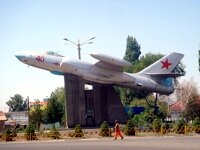
Mig fighter - it has recently undergone a "paint job" and sports camoflague designs
The town, itself is quite small, … there is a small museum with a variety of exhibits, which include some of the architectural finds from the region, and the town boasts a MIG fighter plane mounted as a memorial. Former President Mubarak of Egypt spent some time here training as a pilot.
Just over the border in Kazakhstan are the Chumysh Petroglyphs – mostly small, hand sized, carvings – but nowadays a Kazakh visa is needed to go and see them, and so I have never made it.
To the South are the Kegeti and Samshy valleys. These valleys are less well-known amongst foreign tourists but offer may possibilities for trekking, horse riding and other activities.



 Bishkek