Handwashing Day
Global Handwashing Day logo ... representing water, soap and hands
Today is Global Handwashing Day.
The day take place on October 15 of each year and the first such day was held in 2008, so this is the fifth such day. The theme chosen for this year is appropriately: ”Help More Children Reach Their 5th Birthday“.
The day is part of an international campaign to motivate and mobilize millions around the world to wash their hands with soap and to raising awareness of handwashing with soap as a key approach to disease prevention.
One of the aims is to ensure that everyone knows the Five Fundamental Facts about hand washing with soap:
- Washing hands only with water is not enough!
- Hand washing with soap can prevent children from catching diseases which kill millions every year;T
- he most important times for hand washing with soap are and after using the toilet and before eating food.
- Hand washing with soap is the single and most productive health intervention;
- Social marketing advances that center on the potential “handwasher” and his or her exact motivations are more effective than usual disease-focused approaches.
Now, the cynical amongst us might easily misunderstand or misinterpret the intention behind creating such a day when they discover that among its backers include such soap and detergent manufacturers as Unilever and Proctor & Gamble. However, the Public and Private Partnership for Handwashing with Soap, initiated the day back in 2008 as part of the United Nations designated “International Year of Sanitation”, and it also includes a number of important and influential governmental bodies, such as the Centre for Disease Control, (CDC), and USAID as well as educational and health care institutions, Associations and other NGO’s. Although the day, itself, doesn’t appear to have been sanctioned by the United Nations, UNICEF is one of its founders and its agencies, many of its agencies support activities on the day, around the world.
The day seems to be growing with more and more activities being undertaken each year … but, although events are planned to take place in on all five continent, involving more than 200 million people in over 100 countries … it doesn’t yet reach every country.
As far as I am aware, for example, Kyrgyzstan doesn’t mark the day in any special way.
Most of the activities to commemorate the day seem to based in what we used to call “developing countries”, (Kyrgyzstan is usually described as a “transition country”, one making the transition from a communist/socialist central command economic system to a “free market” one), there are events planned in several “developed” countries including the UK, Germany and the US.
On the other hand, (no pun intended), the people here tend to be very diligent about washing their hands, especially before meals.
I have one friend, for example, who will always excuse himself from the table when we go to a café or restaurant and go in search of the washroom, (toilet, but in this case I think that the Americanism is appropriate), in order to wash his hands. He even apologizes for this apparently compulsive behaviour and says that it is because he was seriously ill a few years ago because he omitted to do it on one occasion.
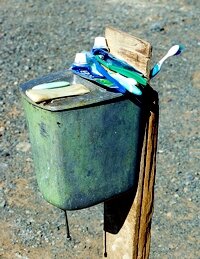
Gravity fed water dispenser on a washstand
It’s not uncommon when attending a traditional function, to be greeted by two young people, one of whom holds a jug of water and a bowl, and the other a towel. You allow the first to pour the water over your hands into the bowl and then the other will give you the towel to dry them. It may be appear to be a symbolic token to tradition but sometimes, (although, to be honest, not always), there is also a bar of soap on hand, (again, no pun intended).
Many villages in Kyrgyzstan do not have access to potable water, and yurt encampments in a high altitude mountain pastures, (jailoo), certainly doesn’t have access to piped water. Instead many homes and yurts have a special washstand with a small basin and a simple gravity fed water dispenser. A container is suspended, usually attached to a post of the washstand, and water is poured in to fill it. There is a hole in the base of the container, with a valve operated by a plunger which the washer pushes up to release a stream of water. Either they are able to wash their rinsing them in the water as it falls, or they can fill the basin. Needless to say, it’s cold water - unless it has been standing in direct sunlight for any considerable period.
One of the things that has surprised me in preparing this postcard was the number of videos that have been prepared by different groups and posted on video sharing sites like youtube and vimeo to mark the day … here is just one:
As an aside: Perhaps the most famous “handwashing” of all time is that recorded in the gospels, where we are told that the Roman Governor, Pilate, declared his unwillingness to take responsibility for or share complicity in the decision, gave in to the demands of the mob and reluctantly sent Jesus to be whipped and then crucified and releasing the “notorious prisoner” and bandit, Barrabbas. The image is also found elsewhere in literature such as in Shakespeare’s Macbeth.




 Bishkek