Living through history
There is a series of school textbooks published in Britain called Living through History. The publishers claim that it brings out “the enjoyable parts of History: the exciting events, the good stories and the real people.” We are all “living though history” – its a truism. As the publishers acknowledge, however, no matter how real it is … it’s not all enjoyable and exciting – at least, not necessarily whilst “living through” it. It’s not always obvious at the time that certain events are going to turn out to be pivotal in the course of history as it unfolds. Sometimes, however, it is only too obvious.
It was on Aug. 18, 1991, four Soviet government officials arrived at Zarya, (Mikhail Gorbachev’s dacha in the Crimean resort of Foros), where the Soviet president was on vacation, and informed him that he was under house arrest. A coup d’état was under way, led by a group of hard-liners in the Soviet leadership who were trying to stop him from signing the Union Treaty that would have ceded more authority to the Soviet Union’s constituent republics and which, the hard-liners were convinced, could only lead to the country’s dissolution. The attempted coup lasted for three days … and failed … eventually resulting in the very thing that the plotters had been trying to avoid.
There are attempts here to remove the present government under way at the moment … at least it is not a revolution or attempted coup but takes the form of a censure motion, (or vote of confidence - or vote of “no confidence” if you prefer), that is to be debated in parliament which was proposed many weeks ago. Each of the political parties are considering their attitude in separate caucus meetings and so far almost everyone has come out in favour of supporting the opposition in having “no confidence” in the government … and that includes the Social Democrats, (who were the President’s party, when he was allowed to be a member of a party, that is), and the largest party in the coalition government.
You might expect the opposition parties to express their support, one of the opposition parties is calling for cases of alleged corruption involving high officers of state to be referred to the Prosecutor’s office for investigation. This in turn led to members of one of the Government parties calling for the Prosecutor to investigate the opposition party leaders for their role in the Bakiev regime. The largest party in the opposition, however – and incidentally, the largest party in the parliament, (Ata Jurt), is reserving it’s position for the time being.
The main issue at the moment seems to involve an intrigue centring on the American airbase, (construction of an air traffic control tower), a Turkish construction company, an English thoroughbred racehorse, and the Prime Minister … was a new control tower needed? and, if so, was the right one commissioned?, who is paying? and was the race horse a bribe?, was it a gift or did the Prime Minister buy it? and if so, for how much?, and what is it really worth anyway?, (there are figures ranging from six thousand to 1.3 million dollars). The strange thing is that the “scandal” has erupted now – but when the censure motion was proposed many weeks ago, there was no word or hint of what is now being hailed as the litmus test which the government has to pass for it to have a future.
The argument has developed a sense of farce as the leader of one political party has offered to buy the horse, but wants to see the original bill of sale … and the Prime Minister saying that he is willing to sell it, but only on condition that the animal is put out to stud and not slaughtered for horsemeat … Kazakhstan’s supposed secret weapon that enabled its athletes to perform so well in London.
Kazakh Kazy, (horsemeat sausage – in Kyrgyzstan it’s called Chuk chuk), may have been in the British news over the last fortnight, having been shipped into the country by the Kazakh Olympic team, but Kazakhstan has also been in the news here in Kyrgyzstan quite a lot this week. That’s partly because there has been a visiting delegation considering a wide range of issues, but also because it was announced that President Nazarbaev is going to make an official state visit next week … his first, although I believe he has been here to attend summits ad so forth, on several occasions since Independence.
Horse meat is popular here as well as in Kazakhstan – but, unlike in the West where it was known as a cheap meat, here it is relatively expensive so it is mainly used for ceremonial repasts; weddings and funerals … oh, and if you take the Prime Minister’s jibes at his opponents at face value, at political rallies. The cost of putting on these grand feasts can be somewhat debilitating and families often go well and truly into debt to provide them. The cost of a horse is about USD1500 and just the cost of a wedding reception in a restaurant for about 400 guests could well exceed USD12,000 … and that’s without Presents … in a country where the average salary is something like USD200 per month. The World Bank estimates the country’s GDP at something like 4.6 billion dollars in 2010 and the Economics Ministry suggests that the population, (about five and a half million people), spend about 2 billion on weddings, funerals and other tois, (celebrations). That’s a little under 400 dollars per person, (man, woman and child), per year … or two months average salary … each!
Over the years there have been several attempts to try and curb what people pay out for them; in some cases this has simply involved exhortations from on high, from the President or some other influential figure, but there have also been attempts to regulate and legislate for the events. A new bill has been drafted which would limit the number of guests, ban alcohol and the slaughter of animals for funerals and place limits on wedding gifts.
Not everyone, of course, pays out so much … they simply can’t afford it. Although birthdays come round every year, most families don’t have to organize weddings and funerals that frequently … and many families spend far less, simply because they can’t afford to spend more. They are still likely to go into debt, even if they don’t spend the thousands upon thousands that these official figures suggest.
People go into debt for all sorts of reason. Recently there has been a lot of coverage of the finance institutions, (Banks, Microfinance companies, Credit Unions and the like), and especially the high level of interest that they charge, (the average rate is approaching 40%). Quite often people take out loans in a fit of optimism but then discover that perhaps it wasn’t as well founded as they had hoped … and they run into financial difficulty … sometimes the institutions having foreclose on the loan, (or as some critics put it “often” foreclosing on the loan). Down South feelings are running particularly high with protesters meeting the Acting Minister for Social Development, (former political columnist Edil Baisalov), to protest. They point out that a number of people have felt driven to suicide because they cannot meet the repayments.
To top it all, the National Bank has decided to revoke the registrations of some 42 MFI’s, (for the Brits, I suppose explain that that is not a reference to a furniture warehouse and saleroom but to Micro Finance Institutions), out of the 90 in the country. In 76 cases the rate of interest was deemed to be far in excess of the market average and they been sent requests for disclosure and substantiation.
Baisalov’s appointment has created a certain amount of controversy in itself … he had to flee the country and seek political asylum in Sweden under the Bakiev regime because he posted an image of a proposed electoral ballot on his blog … which his critics and opponents suggest could have resulted in forged ballot papers. Then, after the revolution he sent a letter in support of a passport application, (admitedly requesting a “Diplomatic Passport”), for Kadyrjan Batyrov, a leader of the Uzbek community in Djalal Abad who has been blamed for inciting the disturbances in the South in June 2010 which cost so many lives.
If the statistics about tois are enough to stun one, then there were that might have a similar effect:
The head of the State Drug Control Service, for example, announced that the service had intercepted and seized drugs to the value of 27 million dollars – but that annually some twenty tons were smuggled through Kyrgyzstan with a total value of 6.6 bullion dollars. Uh… can you remind me, please, what was the estimated GDP for the country? … ?? … ???
Then there was the news about the import of cars into the country. Apparently, in 2010, there were almost 25,000 and in 2011 that had doubled to almost 53,000 and ion the first sixth months of 2012 there were over 32,000 imported suggesting that even if the rate of growth isn’t maintained it may still be substantial. As it happens, is more than twice the number of vehicles imported in the same period last year … so we still might make it! These statistics raise all sorts of questions, for example about whether the road system of Kyrgyzstan can cope with the increase … the streets of Bishkek are already suffering under the weight of traffic. As it happens, many visitors to the country are somewhat surprised, not just by the number of vehicles on the streets, but also by the range of make and model: Lexus and Hummer, Land Cruiser and even Land Rover. I don’t think I have ever seen a Rolls Royce, but I think it can only be a question of time … However, the State Customs Service reported that in the first six months of the year, of the 32,000 vehicles imported into the country, there were only 66 brand new cars.
During the first six months of the year, the state spent almost 99 million som on the apparatus of government. Sixty million som was spent on salaries, just under three million went on travelling expenses, less than two hundred thousand on “equipment and supplies” and the remainder, almost 23 million som, was classified as “Miscellaneous Expenses”.
Indeed, the first half year was not good for Kyrgyzstan … it seems that we are the only country in the CIS, (Commonwealth of Independent States), to have experienced an economic downturn, brought about mainly by a decline in production, not helped by a fall in exports matched by an increase in imports.
There was, however, a whole host of good news in the number of agreements signed with Russia during the week. They have agreed to write off huge sums of Kyrgyzstan’s debt, (almost 500 million dollars worth), there were agreements about going ahead on a number of investment projects. Perhaps the biggest surprise came when it was announced that the lease on the air base in Kant, (about 30 km East of Bishkek), will be extended when it comes up for renewal in 2017, but only for another 15 years. Apparently, the Russians had been looking for 49 years, (the most that is possible under the Kyrgyz Land Code), but for some reason the Kyrgyz seem to have dug their heels in and insisted on just 15.
Another piece of good news, however, came in the health rankings, compiled by Bloomberg, based on data drawn from the World Health Organization, the United Nations and the World Bank, (indicators such as life expectancy, infant mortality, causes of mortality, and mortality in different age groups and life expectancy of men and women aged 65), Kyrgyzstan took 101st place, (out of 145 countries), which actually put them above Kazakhstan and Turkmenistan. Singapore came out at the top of this particular league table, followed by Italy, Australia, Switzerland, and Japan, Israel, Spain, the Netherlands, Sweden and Germany. Bottom of the table were, Mozambique, Chad, Congo, Lesotho and Swaziland. Interestingly, Britain came in 21st place … and the United States 33rd.
Oh, that’s not earth shattering news, but then there is no way to tell which is going item is going to turn out, in the final analysis, to have been the crucial, pivotal moment.
_______________________________________
Postcard from Bishkek: the weekly postcard that I send out as an email also gets posted on the website ianbek.kg each week – and there are other postcards which don’t get sent out. This week, for example, there has been the following postcards:
- Youth Day – or – Youth Quarter - whilst the rest of the world settled down to commemorate the UN Designated International Youth Day on Sunday, here in Kyrgyzstan the day mertely kicked off three months of activities dedicated to the raising the profile of youth affairs and encouraging young people to take a part in public affairs;
- Medal hopes dashed - a review of the Kyrgyzstan’s experience of the Olympic Games;
- Taking the waters - Mineral water is a feature of Kyrgyzstan, althjough some of the bottled varieties are very definitely “an acquired taste”;
- Toktobolot Abdumomunov - The street on which our hotel, The Silk Road Lodge, is located is named after a famous Kyrgyz playwright and Wednesday would have been his 90th birthday;
- Cash is King - It is often said that Kyrgyzstan is basically a cash based society and I have been asked a number of questions recently about carrying cash across borders, I decided to take a brief at the role of cash in Kyrgyzstan today;
- Edelweiss - the Lion’s paw flower that grows in alpine regions throughout Kyrgyzstan and is used as a symbol for for both courage and romance;
It is now possible to follow me on Facebook, (where I have specific pages for Celestial Mountains and ianbek … and also links.kg and Kyrgyz Diary), and on twitter, (@Bishkekpostcard and @celestialMTC ).


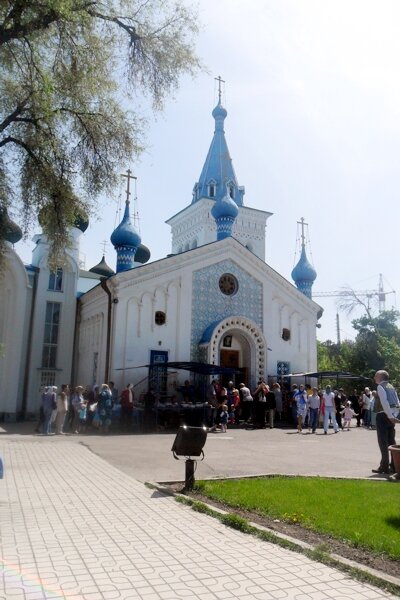

 Bishkek