Youth Day – or – Youth Quarter
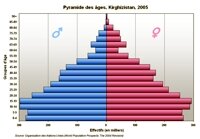
Kyrgyzstan : Age distribution pyramid (2005)
International Youth Day is another one of those special UN designated Observance Days. It has been commemorated on August 12th each year since 2000, the UN General Assembly having adopted it in December the previous year.
As with other similar “awareness days”, (such as Earth Day), the aim was to provide an opportunity for governments and others to draw attention to youth issues worldwide, through concerts, workshops, cultural events, and meetings involving government officials, (from both national and local levels), and youth organizations.
Events are coordinated by the organization’s Department for Economic and Social Affairs and each year a theme is declared and in previous years the themes have included:
- 2002 – Now and for the Future: Youth Action for Sustainable Development
- 2003 – Finding decent and productive work for young people everywhere
- 2004 – Youth in an Intergenerational Society
- 2005 – WPAY+10: Making Commitments Matter
- 2006 – Tackling Poverty Together
- 2007 – Be seen, Be heard: Youth participation for development
- 2008 – Youth and Climate Change: Time for Action
- 2009 – Sustainability: Our Challenge. Our Future
- 2010 – Dialogue and Mutual Understanding
- 2011 – Change Our World
For this year the theme is: ”Building a Better World: Partnering with Youth“, and it is hoped that it will provide a global call to action to develop and engage in partnerships both with and for youth.
As the Young people today face pressing global challenges such as high levels of unemployment, vulnerable working conditions and marginalization from decision making processes. Partnerships — with the United Nations, governments, the private sector, civil society, academia and philanthropists —– can help increase opportunities for success by leveraging comparative advantages, resources and shared interests.
As the General Secretary pointed out in his message to commemorate the day:
Today’s generation of youth — the largest the world has ever known, and the vast majority of whom live in developing countries — has unprecedented potential to advance the well-being of the entire human family. Yet too many young people, including those who are highly educated, suffer from low-wage, dead-end work and record levels of unemployment. The global economic crisis has hit youth the hardest, and many are understandably discouraged by rising inequalities. A large number have no immediate prospects and are disenfranchised from the political, social and development processes in their countries. Without urgent measures, we risk creating a “lost generation” of squandered talent and dreams.
Kyrgyzstan. like many country’s around the world is facing considerable demographic changes. The population grew from 2.1 million to 4.8 million between the official censuses of 1959 and 1999. By 2007, the population was estimated to stand at 5.2 million and not along ago we saw the press reports commemorating the birth of the six millionth citizen.
The ethnic composition of the population has changed since independence. The percentage of ethnic Kyrgyz has increased, (from around 50% in 1979 to nearly 70% in 2007), while the percentage of European ethnic groups (Russians, Ukrainians and Germans) dropped from 35% to about 10%.
The age distribution within the population has also changed considerably over the years. Thanks to improved standards of living and health care there are more people living to greater ages – suggesting potential problems in providing for health care and social services in the future, but the population is also quite a young one … with 10% of people in the first few years of life, and something over 30% of school age. About 70% of the population are under the age of 35.
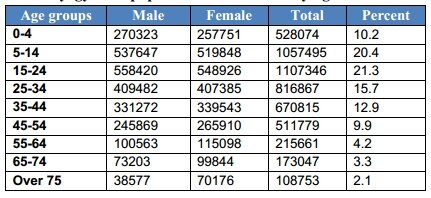
Population age distribution (2007) - (Economic Cooperation Organization)
Following the revolution of 2010, Kyrgyz politicians recognized that young people in the country had a major role to play in shaping the future. In addition to the Ministry of Education a special Ministry of Youth Affairs was created, (although, at the time, some people wondered what it would actually do).
In the government reorganization at the end of last year, it was transformed into the Ministry of Youth, Labour and Employment. The emphasis seems to be clearly on employment – finding jobs for the young people of Kyrgyzstan. Although this is a vitally important issue, as Ban Ki-Moon also said in his statement:
Young men and women are not passive beneficiaries, but equal and effective partners. Their aspirations extend far beyond jobs; youth also want a seat at the table — a real voice in shaping the policies that shape their lives.
In creating the Ministry of Youth Affairs, Kyrgyzstan recognized this and it was also reflected in Prime Minister’s statement at the end of last week when he said that the government was “always open to the youth of the country”. The plans to create new Public Association to unite different youth groups and with a role in monitoring the work of various government bodies have proved to be somewhat controversial, (“Those who haven’t held a job and don’t know how to work will sit in judgement on those who do … )”, but may go some way towards the challenge in the General Secretary’s next observations:
We need to listen to and engage with young people. We need to establish more and stronger mechanisms for youth participation. The time has come to integrate youth voices more meaningfully into decision-making processes at all levels.
It was interesting to note earlier in the year, comparisons which were drawn between Kyrgyzstan, Georgia and the Ukraine, (two of the reforming republics of the former Soviet Union which are frequently held up as examples which Kyrgyzstan would do well to emulate). The portraits of three ministers, from each country were displayed … and it was clear that we were supposed to draw conclusions about the remarkable 10 year difference between the ages of the youthful “reformers” and the Kyrgyzstan’s “duffers”. It may well be that the ministers were typical for their respective countries – or they may have been specially chosen to highlight the difference, I don’t know. As far as I can see, although the oldest minister is 64, the youngest is 41 and the average of the government is just under 49 – compared with 69, 40 and 51 for the United Kingdom.
Even if the emphasis of the Ministry of Youth, Labour and Employment is on the work place, it is also paying attention to involving young people in wider issues. For example. a delegation was sent to the Leaders of the 21st Century conference which was held last week in Rostov on Don in Russia.
As it happens, here in Kyrgyzstan we don’t do things by halves … whilst the rest of the world commemorates the International Day of Youth, today … for us it is the start of three months of activities designed to last until the National Youth Day which is marked in November.




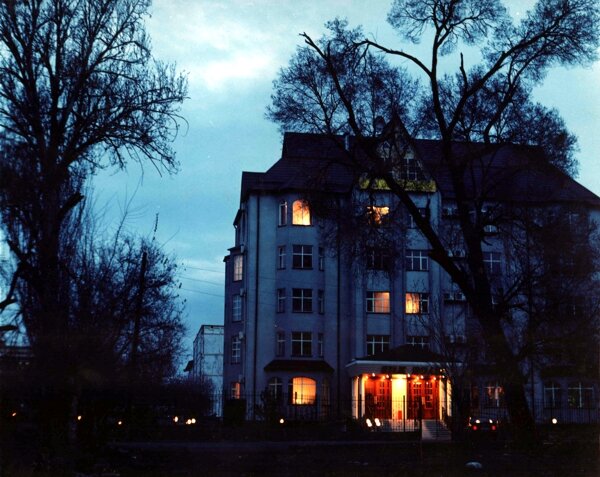
 Bishkek