Edelweiss
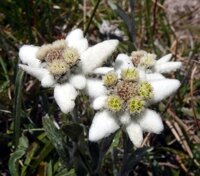
Edelweiss - otherwise known as Leontopodium alpinum
A group of Austrian tourists were on as trip into the Kyrgyz mountains and when these disembarked from their minibus ion one of the jailoo, (high mountain meadows), to have a walk around in order to “stretch their legs”. After a short space of time, a high pitched squeal could be heard from one of the group, “My God! … My God!”, to be repeated three or four times in rapid succession. This was followed by by exclamations such as “Stop, stop, … look where you are walking … don’t step on them … don’t step on them!”
The thing that had captured his attention and zeal to protect was a mass of small white flowers growing in the grass – Edelweiss.
Actually, these white blooms are not exactly what they seem. Although the name, Edelweiss, is derived from the German words edel, (meaning “noble”) and weiss, (meaning “white”), the flowers are actually yellow. The “furry” white petals which give the plant it’s name, are actually leaves covered in a sort of fuzzy fur of fine white hairs. In the centre of these leaves, which form a sort of pointed star, are clusters of blooms, each of which consists of a handful of tiny, (measuring just 5mm across), yellow flowerheads – yellow from the pollen which is spread from plant to plant by flies. A single Edelweiss may consist of anywhere between five hundred and a thousand tiny florets.
In fact, they belong to the same family of plants as the Sunflower and are relatives of the daisy.
The scientific name, leontopodium, is from the latinization of the Greek for Lion’s paw – which I suppose is a figurative way of describing the plant’s appearance. It is also sometimes known as the “flower of the rocks”, the “star of the snows” or “Botanical Star”.
Edelweiss originated in the steppes of Asia and/or the slopes of the Himalayas, migrating West into Europe sometime during the Ice Ages. There are over thirty different varieties altogether.
The plants like rocky limestone outcrops at between 2000 and 3000 meters above sea level, and flowers bloom between July and September. It’s thought that the “furry” hairs on the leaves and fibrous root systems may be natural adaptations for coping with high altitudes; cold weather, arid climate, winds and increased ultraviolet radiation. Since it is generally found at high altitudes and in inaccessible places such as crags and ledges, it is often associated with alpine regions, (hence the name), and mountaineering.
In the wild they normally grow to a height of between 3 and 20cm, although in Kyrgyzstan they are commonly much lower, and cultivated specimens can grow to as much as 40cm.
In Austria and Switzerland, (where they are the national flower) they are specially protected as they are thought to be quite rare and even endangered … hence the shocked surprise to see many of them carpeting a jailoo and the zeal to protect them.
The flower heads are used in folk medicine as a herb and are thought to be efficacious in the treatment of abdominal and respiratory problems, (such as diarrhoea and dysentery, tuberculosis and diphtheria). (These days, oils and extracts derived from the plant are also used in cosmetics and skin care products – sun creams and anti-wrinkle treatments.)
It seems that after several years of picking the plants will die out. The plants are actually classified as short lived perennials – living for between two to seven years – and so if the flowers are harvested several years in a row then the plant does not have tome to reseed itself and may disappear from an area where it was thought to be already well established.
Hence they were harvested and this might have helped lead to their demise.
At the moment the Leontopodium alpinum enjoys protected status in Austria, Bulgaria, Croatia, France, Germany, Iran, Italy, Mongolia, Norway, Poland, Romania, Serbia, and Switzerland (actually, as I understand it, the protection is not national but given in the 14 individual cantons where the plant grows), as well as in in parts of India, Indonesia, Malaysia, Slovakia, Slovenia and Spain.
You will notice that Kyrgyzstan is not on that list. Actually, the Red Data Book of Kyrgyzstan does not include a reference to the common variety of Edeweiss, Leontopodium alpinum, but does carry one to Pyrethrum leontopodium (C. Winkl.) Tzvel. As it happens, even in the West, there are some people who now say that it can be removed from the endangered list because of the success of various programmes for the propogation of the plant.
The plant carries many symbolic interpretations and associations – usually with courage and love, such as in the legend which tells of a bold suitor who put his own life in danger climbing a steep rock face to pluck the white flower as a gift for his beloved. It has been adopted by several military units and even by an anti-fascist youth movement during the Second World War.





 Bishkek