World Photography Day
World Photography Day
I have a “problem” … actually it’s not really a “problem” … more of a predicament.
Some of my staff are really keen on photographs … Please note: “keen on photographs” not necessarily on photography – that is, actually taking photographs. I am constantly being called to to have a look at a computer screen or to look at a “coffee table book” or photograph album and asked to pour over a wide variety of pictures and am expected to “awe and ah” at cute and cuddly kittens, portraits of Marilyn Monroe or some spectacular landscape.
Oh, don’t misunderstand me … we have plenty of keen and able photographers as well … Maxim being one of them … and I am more than happy to cast my eyes over a set of photographs, give an opinion, ask questions etc., but with so many photo websites available … I often feel a sort of “photo fatigue” setting in – it is just that sometimes I am not really sure why I am being shown a picture.
As it happen, today has been designated World Photography Day. To be honest, I don’t know who was responsible for creating the day, but it has apparently been around since 2009. It is not one of the UN designated commemorative days – they have designated August 19th as World Humanitarian Day - but more about that, perhaps, on another occasion.
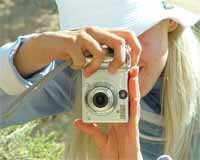
Photographer At Work!
I do know, however, why August 19th was chosen for the day. Back in 1839, Louis Daguerre, invented the photographic technique that took his name. Actually, he refined a technique which had been known for some time, but Daguerre’s innovations proved a reliable, convenient and practical method of producing the images.
He demonstrated the technique to the French Academy of Sciences behind closed doors in January 1839 and instead of applying for a patent for his new technique, Daguerre negotiated with the French government to give up all legal rights to it , but exchange for a lifetime pension from the French Government. It was on August 19th, 1839, that the Daguerreotype went public and the French government announced the arrangement as a “Gift to the World“.
That is generally considered to be the start of modern photography. We have seen lots of other developments: the pinhole camera obscura (which had been around since as long ago as 4BC); the box camera, (the Brownie); the film cartridge; colour film; transparencies; the SLR camera, (Single Lens Reflex camera); the Polaroid “instant” camera and the modern digital camera. As is often the case with new and developing technologies, new advances came slowly at first but it wasn’t long before they were coming thick and fast and with greater acceleration.
I am not surprised that Photography is very popular in Kyrgyzstan. I noticed very early on, seventeen years ago, how local people were very keen to pose for the camera; to “fish out” their photograph album or a cardboard box containing their collection of “snaps”.
At that time, when I first came here, not everyone has a camera so getting one out and pointing it people made it a special occasion. Photographs made, (and still do, for that matter), excellent presents.
If it was a ‘Polaroid’ (instant camera) and they could see the results develop in front of them … it made the event even more special, “magical” one might say … magical as in both, “miraculous” and “awe inspiring”. When digital cameras came along and people could get the instant gratification of seeing the picture on the little LCD screen, it was more instant than a Polaroid, and more “snaps” were possible in a shorter time … giving a sense of gratification … but lacking in some sense of satisfaction as the picture stayed with the camera, (in the camera, even), and so appeared more transitory. Now, of course, these are all too common, especially with the rise of the telephone camera. The sense of “magic” has dissipated … gone, perhaps for ever as digital photographs become more available, more accessible and easier.
Easier … the technology is advancing at such a rate that some camera’s now, not only focus automatically, can zoom and select the appropriate settings for the aperture, time exposure required and whether or not to fire a flash bulb; they can even take several photographs and give the user the chance to select which ones they want “to keep”.
In the days of “film”, the photographer would have to pay, (both in terms of cash and time), to see the results of their work fact that they were much more careful in setting up the pictures they took. Now it is easy to take 100 photographs and discard 95 of them.
There are a couple of points to remember when taking photographs – they are the same all over the world, but here some advice that we give to clients when they ask about photography:
- Salon / Studio – Most of the larger towns will have a photo salon designed to produce passport photos and the like, and which will develop and print films for anyone who still uses film – although not transparencies or slides.
- Restrictions – There are few restrictions about what you can photograph. In China anything that could be considered militarily sensitive (including a soldier in Uniform) is out-of-bounds and in Pakistan, don’t photograph any bridges over the Hunza river. In Kyrgyzstan, it is best to photograph anything that could be militarily sensitive, but fortunately that doesn’t extend to soldiers in uniform, as in China. Bridges seem to be OK – but we have had one incident where photographs of a serpentine on a mountain road was questioned by customs officials (!). It is best NOT to photograph the border installations or the airport facilities.
- Flash : remember to ask if it is alright to use a flash bulb in museums, etc. Some museums, churches and mosques don’t allow any photographs whilst others others charge a supplementary fee and yet others are only too willing;
- Customs: A word of warning, Customs officials have been known to examine films … and photographs – and technically they can ask to see the films, but generally there are no problems. X-Ray machines – at airports are said to be film safe;
- Photographing people: most people will be delighted if you want to photograph them, but as a courtesy it might be wise to ask them.
- Presents: Photographs make an excellent present and will be highly prized and valued so, if you say you will send people copies when you have them printed – please do so.




 Bishkek