Taking the waters
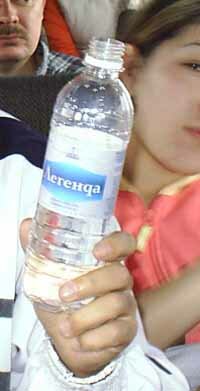
One of Kyrgyzstan's commercially produced Mineral waters
I was born and brought up in the spa town of Malvern in Worcestershire and one of our claims to fame was the Mineral Water that has been bottled since 1622, (it is now bottled by Schweppes out of their factory on the Western side of the hills). There are a number of natural springs and a Victorian rhyme claimed that Malvern water was so pure that it owed its fame to the fact that it contained “nothing at all”.
Although mineral water is often thought of as a drink, The Oxford English Dictionary defines it more generally as: “water found in nature with dissolved salts present”. Some salts, of course, do not make for a very pleasant or refreshing drink.
According to the US Food and Drug administration, mineral water contains at least 250 parts per million of “total dissolved solids” which originate from geological and physically protected underground water sources.
In many places, however, the term “mineral water” is used to mean any bottled water as opposed to tap water.
Sometimes visitors to Kyrgyzstan express concerns about the quality of drinking water. Although “potable” water, (water deemed “safe enough to be consumed by humans with a low risk of immediate or long term harm”), is not available in all parts of the country, especially in some of the rural areas, and although tap water in the cities is generally “safe” when in doubt the advice is to drink bottled mineral water. This is generally available throughout the country – but some local varieties may be an “acquired taste”.
In fact, Kyrgyzstan is rich in the variety of mineral waters available. According to the Encyclopaedia Kyrgyzstana there are over 250 springs in the Kyrgyz Republic which are held to have curative properties and were the basis for establishing spas and sanatoria. Springs of water thought to have medicinal, healing properties are referred to as Arashan in Turkic languages, hence, for example, Altyn Arashan.
There are over 50 thermal springs including Kochkor Ata, Issyk Ata and Tyeplie Kluchi in the Kyrgyz Range to the south of Bishkek and Ak Suu and Djety Orguz near Karakol.
Curative mud (derived from silt and silt-peat) is found mainly in the Issyk Kul region and was the basis of several sanatoria which have been established on the lake shores, although other deposits are to be found in the Chui and Osh oblasts.
Several firms, (such as Shoro and Coca Cola), produce their own brands of bottled water (although, surprisingly, none are currently listed on the website of mineral waters.org) and there were proposals to try and export some brands in the 1990′s which were only partially successful. Commonly available brands include:
- Legenda – still spring water
- Baitik – sparkling
- Artezian – sparkling or spring water
- Bonaqua – still water produced by the Kyrgyz branch of Coca Cola Bottlers
- Issyk Ata – sparkling mineral water
- Djalal Abad – sparkling mineral water


 Bishkek