Cash is King
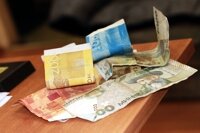
To a large extent, Central Asia is still, basically, a cash based society.
I have recently been asked the same question a number of time, (in slightly different formats and by different people I hasten to add), and so I thought it might be an idea to spend some time considering the issue.
The question was, basically, about the restrictions on carrying cash across borders here in Central Asia.
Although features of the twenty first century like credit cards and debit cards have begin to make an appearance in Central Asia, they are still a relatively recent innovation and people are not that familiar with them once you get outside of the major cities.
Central Asia is still, predominantly, a cash based society. Cash is King!
This means that visitors to the country, (tourists, that is) need to give plenty of thought to the questions like:
- how much money will they need – They should try not to carry more than they need for their immediate needs – but they also need to make sure that they have enough in one form or another
- how to keep it secure - This is a problem – the general advice is not try and avoid carrying all their money in one form – use cash, travellers cheques, and credit cards. However, in Kyrgyzstan Travellers Cheques and Credit cards are not widely accepted … especially outside the larger population centres.
- if they should need to get extra cash, how can they do so? – Of course the standard answer is to have a variety of cards – one card may not be enough, (because they may exceed the available balance, or the card may be retained by an ATM), so they should also consider options such as a money transfer (e.g. by Western Union – they may need passwords).
- Is it possible to get some local currency before you travel – although for Kyrgyzstan this may be difficult or unlikely – so they will probably need to have some small notes in an international currency in order to exchange so that they can pay for taxis, tips etc., … not too many, however, as small notes attract a lower rate of exchange.
We always advise clients that, of course, it is NOT a good idea to carry large sums of money at anytime … street crime does exist here, just as it does elsewhere in the world. To minimise the risk of being involved then, just as they would at home, they should keep to well lit streets, avoiding short cuts, dark alleys etc. and try not to travel alone at night. It is important to “keep one’s wit’s about” them, to try and be aware at all times for people who might be “distractions” for bag snatching and pickpockets.
They should try to avoid being seen as “rich” – where possible using local currency and not having large sums. They should keep money, credit cards etc. distributed between several pockets.
In terms of foreign currency, the US dollar is generally preferred, although the Euro is also easy to change and is generally acceptable. It may be possible to exchange other currencies, such as Pounds Sterling, but the rates offered will not be particularly attractive. In terms of US dollars – Small notes, (less than USD50), old notes, marked or damaged notes all tend to attract a lower rate … and may even be refused.
In the unfortunate and unlikely event of being involved in a theft, then they report it to the local police as soon as possible … not only might they get their belongings back – but without an official police report, they are unlikely to be covered by their insurance policy.
It might seem defeatist but our advice is always, “If confronted or threatened: give up your valuables … Your money and passport can be replaced – you can’t”
There are twenty two different banks licensed to operate in the country, each with a network of branches which can be quite small – with just one or two branches, or reasonably large with up to about 50 branches throughout the country. Some are local, (that is owned by local citizens), whilst others have foreign shareholders and yet other are subsidiaries of foreign banks. The range of services offered by the different banks varies, with some simply serving as part of a transaction system, whilst others offer a portfolio with a wide range of financial products, (for example credit cards or ATMs).
Credit cards be used in several of the banks for cash advances in Bishkek – at a fee. VISA cards are the most commonly accepted brand. It is possible to make purchases with a credit card in some outlets, (hotels, restaurants, and some of the bigger shops), in Bishkek. A few of the hotels on Lake Issyk Kul also accept them – but otherwise cards are of limited use in the rest of the country. Although there are a few ATM’s which accept foreign cards in the Republic – don’t expect to find any outside the larger population centres.
Visitors should carry a list of contact numbers for reporting lost and stolen cards etc.; making a note of any credit limits and being sure not to exceed them. It may be wise to have at least two credit cards – and keep them separate. But, they shouldn’t bring all their cards with them – if they should be lost, then at least their would still be one waiting for them on their return, which they could use whilst waiting for replacements.
Travellers Cheques on the other hand have never really been popular and although several of the banks in Bishkek will cash them, especially those from American Express, but at a fee. It is usually not possible to use travellers’ cheques when making purchases and there is often some confusion about how the traveller’s cheque system works.
Travellers should keep a note of any travellers cheques, (number, denomination, when and where cashed), and keep it up to date and separate from the cheques themselves.
Money Transfer, as operated by, for example, Western Union is offered by most of the banks.
ATMs, operated by local banks are available in the larger population centers. Some issue only local currency, whereas others give a choice of different currencies. Unfortunately, communications with the processing center can be difficult and it may be necessary to try several machines before you find one that will accept the card. There is usually a fee associated with using the machines.
Exchange offices - There is no “black market” in currency in Kyrgyzstan – so their is nop “benefit” to be gained by changing “on the street”. It is best to avoid unofficial exchange offices.
Most branches of bank will offer exchange facilities, and in Bishkek and Osh there are a number of Exchange Offices (Obmen). It is best to avoid using exchange offices that operate from a window directly onto the street – if possible use an office in a bank or shop. There is no commission charge – just a differential between the buying and selling price. Check the sums involved – don’t worry about the time taken to count a pack of 20 som notes … most exchange offices are honest – but, unfortunately, not all of them.
You don’t need to get a receipt – unlike in some countries, you won’t be asked to produce them when you leave the country, but exchange offices are supposed to provide one.
TAKING CASH ACROSS BORDERS (INTO AND OUT OF CENTRAL ASIA COUNTRIES)
The rules change from time to time. Usually there is no problem brining money into a country – there may, however, be problems taking it out.
On one occasion a tourist who was simply in transit through Kazakhstan, (there are more flights to a wider range of destinations through Almaty airport), had five thousand dollars with them when they entered Kazakhstan but when they tried to leave the country with it a couple of hours later, they were told that they had exceeded the limit that Kazakh regulations allowed them to take out the country.
That tourist was travelling alone but on another occasion, a group of three tourists travelling as a “family” group included all of their cash on the “group leader’s” customs declaration form … to be told exactly the same – he had exceeded the limit he was permitted to take our of the country. As it happens, in this particular case, once the circumstances had been explained to the customs official, he allowed them to rewrite their forms dividing their cash among the three group members.
Border crossings can be stressful situations at the best of times … and a recent report on the “woes” associated with international borders borders in Central Asia, suggests that corruption of officials is commonplace, (or at least: “alive and well at all border crossings in the region”). Fortunately, however, problems such as these are more notable for their rarity … the fact that they are the exception rather than the rule when it comes to affecting tourists.
This is the situation as I understand it at the moment, (please note that “Cash” includes Travelers’ Cheques):
In Kyrgyzstan
There is no restriction on the amount you can bring in or take out of the country. However,
- for sums up to USD3000 it is not necessary to complete a customs declaration form – but it might be safer to do so anyway,
- it is necessary to declare sums over USD3000, and
- if someone is carrying more than USD10000 then they are supposed to have documentary proof of the source of the money.
- Receipts for currency exchanges are not required. If a Customs declaration form is completed on entry to the country – then a copy is not retained by the traveller to be presented together with receipts for currency exchange when leaving the country.
In Kazakhstan
In Kazakhstan, for example, you are only supposed to be able to take USD500 out of the country and you could not export local currency (Tenge) … but in 2004 it was reported that Kazakhstan had introduced new currency regulations. Apparently the new limit is USD3000 in foreign currency, and it is possible to take Tenge “without restrictions and written declarations submitted to Kazakhstan custom authorities”, (i.e. without having to fill in a declaration form). In fact, it can be difficult to get the necessary stamp on the custom’s form.
In Uzbekistan
The import of cash foreign currency is freely allowed although travellers, although it is obligatory to complete customs declaration forms.
The export of cash in foreign currency is allowed:
- for residents – up to the equivalent of $1500, for sums over $1500 up to $ 5000, (including traveller’s cheques) require an authority from the National Bank of Uzbekistan (NBU).
- for non-residents – i.e tourists – within the limits of the imported currency, according to the completed customs declaration (i.e. you can only take out less than you brought into the country – you should keep copies of any receipts from exchange offices or banks where you have exchanged foreign currency).
The export of cash in foreign currency, irrespective of the sum, should be indicated in the customs declaration.



 Bishkek