Sir Janyl
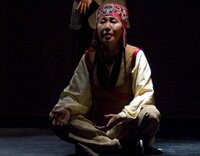
From the stage play "Janyl Myrza"
As well as the epic saga Manas, the Kyrgyz have about 40 other “minor epics” such as Kojojash, Kurmanbek Baatyr, Tolubai and Er Toshtuk.
Most of these have never been translated from the Kyrgyz into other languages – not even Russian. One of the more interesting epics is that of Janyl Myrza – which roughly translates as “Sir Janyl”. Like many of the Kyrgyz epics is centers on the the struggle to overcome aggressors which threaten and maintain their independence.
This case is slightly different, however, because
- the central character is a woman and
- it is apparently grounded in actual history.
In 2008, the President was urged b some groups of citizens to take a French journalist to court for portraying a negative image of the Kyrgyz attitude towards women. They pointed out that, although traditional Kyrgyz culture is often thought of as a patriarchal society, there have been notable exceptions where women have risen to positions of power and responsibility in their own right.
Dating back into antiquity, for example, there was the Amazon queen Tomris, and Zarina, (who led a rebellion by Scythians and Parthians against Cyaxares, King of the Medes). In more recent times, (and more specifically Kyrgyz examples), there were Saykal, Kurmandjan Datka and Janyl Myrza.
The epic of Janyl Mirza is preserved in at least three different versions: that collected by Togolok Moldo, another by Chorobaeva and a third by Abdrakmanov. Apparently there are also a number of poems about her, including one by Kasym Tynystanov.
It describes events that appear to have taken place in the seventeenth century. Janyl Mirza was born and grew up in the mountainous regions of the southern part of Naryn oblast, in the region of the Arpa valley. Born into a family where there was no son she was raised in the same was as a boy, and taught many of the warrior skills such as archery and the traditional art of the Berkutchi - hunting with eagles - although she retained her girlish beauty.
As a result of her training, she developed remarkable skills as a marksman, as a natural archer who honed her abilities so that she never missed her target, obtaining quite a reputation for herself.
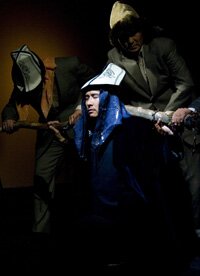
From the stage play "Janyl Myrza"
News of her beauty and courage spread far and wide beyond the borders of her tribal homeland. She was subjected to verbal abuse and insult, and some Kyrgyz nobles from other tribes challenge her, but they all received their comeuppance, many dying at her hand.
Eventually, however, she is defeated; not by playing fairly, however, but by subterfuge and trickery, and she is forced into accepting the traditional role of a wife. Even so she is still someone to be reckoned with, and deserving of respect, although she has to maintain her balance whilst walking a social tightrope.
In one dispute, she is urged to don her armour once more and take part in battle in defence of her husband’s people and land, which she does. After victory is achieved, she returns to her own home to look after her own people.
Between 2005 and 2008, Vitlana Tkacz worked with theater groups from America and Kyrgyzstan to bring a version of the epic to the stage. There were performances in Bishkek, Naryn, At Bashi and Janyl Myrza’s homeland in the Ak Suu valley, as well as in New York. Combining acting, with a script in English and Kyrgyz), traditional Kyrgyz music, (some by Asylbek Nasirdinov and including traditional laments), dance and mime, it was well received both here in Kyrgyzstan and the States, (although one review suggested that it tried to do too much and thus was a little confusing).
Whilst they were doing the research and rehearsing for the play, the theater group went to the homeland of Janyl Myrza, visited many of the valleys and sites in the story and actually met some of the people who claim to be descended from characters in the epic.
Janyl Mirza has become something of an icon for women of power in Kyrgyzstan in the same way as, (but to a lesser extent than), Kurmandjan Datka, and there is a Women’s Refuge Center in Batken named after her.



 Bishkek