Togolok Moldo
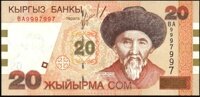
Togolok Moldo on the 20 som banknote
Back in January I posted a postcard about one of the main streets in downtown Bishkek, Togolok Moldo. There I gave a short paragraph intruding him:
This street is named after the bard Togolok Moldo, (his real name was Bayymbet Abdyrakhmanov), who lived between 1860 and 1942 He was a poet and one of the better known twentieth century manaschi – a special class of itinerant minstrel (akyn) who give recitals of the Manas epic. Unlike the other great akyn, Toktogul, Togolok Moldo could write and so many of his verses were written down. He recorded and wrote down many national folk songs as well as his own verses, and many of the texts are now kept in the Manuscript Library of the National Academy of Sciences. He appears on the 20 some banknote.
Interesting though that is, this brief description raises a number of questions … for example, if his real was Bayymbet Abdyrakhmanov uluu, why is he known as Togolok Moldo? Well, apparently, he was given the name Togolok Moldo by his audiences – “togolok” means round-faced and “moldo” means an educated person.
Then there is the question, “Why is held in such high regard that a street was named after him and his portrait was placed on one of the country’s banknotes?” There were many performers of the Manas epic, so just why was Togolok Moldo deemed particularly special? To answer that question we need to consider the story of his life.
As one source puts it, however, Togolok Moldo had two lives; the one which is represented by the time on earth, between his birth and death, and the other represented by his legacy, moulded by his creative force. As he himself put it: “When I die, I will remain in my words”.
His earthly life was one of hardship and hard work.
Born on 17th June,1860, at Kurtka, in the Ak Talaa district in the Naryn region, (the pass from At Tallaa to Lake Son Kul is called the Kurtka Pass). He was born into a poor peasant family but a musical one; his father, Abdrakhman, was a renowned performer of traditional folk songs and his great uncle – his father’s uncle, Muzooke, a Komuzist.
He began to learn to read at the age of 9, taught by the local mullah at the Muslim school. At the age of 14, however, his father died and he was brought up by his grandfather’s brother. Four years late, Muzooke also died and the family found themselves in dire straights and forced to move to Djumgal, (the other side of Lake Son Kul), to work as labourers for a local manap. Life continued to be difficult and so they moved once more, this time to some of his mother’s relatives in the village of Kara Dobe, near Tokmok in the Chui valley where he worked hard as a labourer for the local bais, (rich peasants).
He didn’t, however, neglect his education. Passionate in his pursuit for knowledge he sought out the local mullah in order to study. Unfortunately, however, the mullah was disinterested. They quarreled and the student left his teacher. He began to work as a healer and teaching some of the local children, in his spare reading the masters of the day and learning the Manas epic.
At the age of twenty seven he finally returned to his home village and began the creative period of his life. It was at this time that he was given the nickname that was to stick with him and become the name by which he is known today.
On a visit to Ketmen Tebe in 1880 he met with the other great Kyrgyz bard of the period, Satylganov Toktogul, and the two established a friendship which continued over many years. The two of them represented a particular tradition, not just in terms of their art and the Manas epic, but as Democrats and commentators on the social conditions of the time – reflecting on the “slavery” of the common people, expressing their aspirations, hopes and dreams. In his satirical verses “Kermchontoy” and “Babykhany”, (both written in 1900), he exposed the greediness of the rich and “The Tale of Aquatic and Terrestrial Birds”, (written in 1908), provides an allegorical commentary on contemporary social conditions. This didn’t make him popular with the rich manaps and beys and he had to leave home and seek refuge in a village in another region.
He enthusiastically welcomed the October Revolution of 1917, writing poems such as Revolution, (1918), and Freedom, (1919-1923), to celebrate the new order, effectively becoming the mouthpiece for the revolution and the establishment of Soviet power.
This created new enemies for him. There were attempts on his life and the Basmachi raided his home, twice, and kidnapped his wife. Eventually, however, he returned once more to his home village of Kurthka and was one of the first to join the collective farm there.
He died in Naryn on 4th January, 1942, at the ripe old age of 81 … and is buried in the village that bears his name near Ak Talaa in the Naryn oblast.
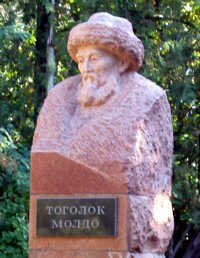
Bust of Togolok Moldo outside the Philharmonia
His legacy, on the other hand, lives on.
He is considered a “candle”, (light”), and pride of the Kyrgyz people, one of the founders of Kyrgyz Soviet literature whose works are filled with prophetic and deep philosophical meanings and educational importance.
He began writing verses when he was just 14. Although a manashi, his work spanned several different genres not just the famous epic; folklore and fables, laments songs and satire. He drew inspiration from a wide variety of sources, not just from the Manas epic and traditional Kyrgyz folklore, the “progressive” works written in Tartar and Kazakh and Russian literature. He was one of the Kyrgyz literati of the time who actually welcomed the advent of Russian influence and he wrote in Russian as well as in Kyrgyz.
As well as social commentary he wrote what could be counted as love poems, but people say that the lamentation takes a special pride of place in his work.
Unlike the other great akyn of the time and his friend, Toktogul, Togolok Moldo could write and so many of his verses were written down. He recorded and wrote down many national folk songs as well as his own verses, and his publications ran into well over a million copies and were translated into many of the languages of the former Soviet Union. Many of the texts are now kept in the Manuscript Library of the National Academy of Sciences.
He has one of the main streets in Bishkek, (and in other cities around the country), a park with a bust of him in Bishkek, as villages, schools and farms named after him … and, of course, he appears on the 20 som banknote.


 Bishkek