Tomris – Amazon Queen
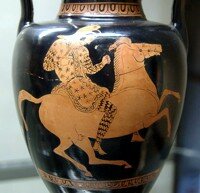
An Amazon warrior on a Greek Amphora
The ancient Greek Historian tells of a mythical race of warrior women called the Amazons. His account said that they came from an area bordering Sycthia in Sarmatia, in modern day Ukraine, but Sycthia covered a much larger area, stretching across the Kazakh steppes, and deep into Central Asia, including contemporary Kyrgyzstan.
The mythical accounts suggest that they were a race of women and men were forbidden to reside in Amazonian territory, but in order to prevent their race dying out, once they would visit their neighbours and indulge in sexual relations. The children born as a result of these encounters would either be raised by the Amazons, (if they were girls), or killed, sent back to their fathers or abandoned in the wilderness to fend for themselves, (if they were boys). Thus the girls were raised in an all female environment, trained by their mothers in agriculture, hunting and fighting.
It seems that the all-female society, however, was not to be perpetuated and the intermarriage of Amazons and their neighbours was often to used to explain the origins of different tribes. Herodotus tells us, for example, that the Sarmatians of his time were descendants of the Amazons and the Sychtians, athough the mothers tended to retain many of the traditions of their maternal forebears – riding into battle alongside their menfolk, dressed in an identical manner. The ancient historian Diordorus commented that Scythian women ‘fight like the men and are nowise inferior to them in bravery’.
Some versions, (for example, that of Hippocrates), suggest that they cut off their right breasts, although ancient depictions of Amazon warriors don’t show this. (Indeed some sources suggest that the very name “Amazon” derives from a phrase meaning “without breasts” although some scholars prefer the interpretation “not to suckle”). Perhaps more telling is the fact that Herodotus tells us that, “no girl shall wed till she has killed a man in battle” and apparently some scholars have suggested that Scythian women had to kill three enemies in battle before they could marry.
So, perhaps it is not surprising that they were said to be formidable warriors.
Although basically a feature of Greek Mythology, (Amazons appear in both the stories of the Trojan Wars, where Homer records how they came to the defense of Troy, and the Labours of Hercules), and some of the more fanciful aspects of the ancient records, it seems as if the Amazons are actually based in historical fact.
There is evidence to suggest that there were women warriors who did indeed ride into battle and archaeologists have excavated several tombs of such “warrior women” across the steppes of Russia and Kazakhstan and even, possibly, across the Tien Shan mountains in the Chinese province of Xingjian. According to the archaeological evidence some of these women appear to have been buried with armour and weapons, and although there is a question as to whether these artifacts were belongings of the women which they had used or simply prized possessions like “family heirlooms”, but the presence of injuries would suggest that these women had indeed been involved in combat. Some of the corpses seem to have sported tattoos and worn clothing similar to their male counterparts, and which show a close resemblance to the depictions of the Amazons on Greek plates and urns.
In the first century BC, the Scythians occupied the vast expanses from Dunay up to Enisey (in Siberia) and East Turkistan were settled by a nomadic people with their herds – they were also known as the Saks. The word “Sak” literally meant “mighty man”, (or warrior).
The Saks of Kyrgyzstan consisted of two tribes: the Tigrahaud-saks, who lived in northern part of the country and the Haumavarg-saks, who lived in the southern part. They spoke a language akin to Iranian and had a European appearance.
Although they were basically nomads – cattle breeders and herders – they were also aware of settled agriculture and could smelt both bronze and iron. Historians think that they are ancestors of modern Turkic-language peoples (including the Kyrgyz).
The Saks worshipped Tengri – God of the heavens. They also worshipped the Sun, the Earth, the Moon, and Rivers. They named the Ele-ana River, (literally mother Lena) and Enisei river (Ene say – “mother river”).
They were a bellicose and brave nation, and adept cavalrymen. It is thought that they were the first people to invent the battle chariot.
There is evidence in the historical records that, unlike many of the other ancient civilizations, there were several Scythian women who were elevated to the rank of a tribal ruler. Such a Central Asian “queen” is said to have approached Alexander the Great and proposed that they should have a son together – “With such parents as us he would, surely, rule the world.”
Between 570-520 BC, one group of the Saks were ruled by by a queen, Tomiris, (who is also known as Tumar). She had a son – Spargapis. By all accounts, she was very beautiful, had blue big eyes and a slim figure.
She is renowned for her struggle against the Persian king, Kir II, in what should have been an unequal fight – as his forces were far superior to hers. He had already captured such powers as Lidiya, Margiana, Vavilona, Finiky, Horezm and Sogdiana and he then proposed to marry Tomiris in order to gain supremacy over her land and people. She, however, realizing the nature of his motives rejected his proposal. Surprised by her pride, her unbending will and nobleness, he sent his army into battle against her people. A bloody and vicious battle took place in the Talas valley – the most bloody and cruel battle in the history of the Saks. They won, however, and according to tradition, the decisive impact came from the attack led by Tomiris, together with her 5000 amazons.
In true Amazon tradition, she is said to have died having received a mortal wound in one of her battles.






 Bishkek