High Rise
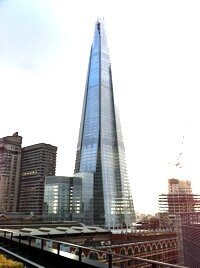
The Shard
I see that London has a new addition to the skyline – the Shard, a 95-storey building which reaches almost 310 meters above the ground. It,s become not only London’s tallest building, but also the UK’s and even Europe’s.
(Actually, it is only the second-tallest free-standing structure in the United Kingdom, the concrete tower at the Emley Moor transmitting station measures some 330 meters.)
The London skyline has changed quite a lot in the seventeen years I have been here, what with the Gherkin and the London Eye … and the Olympic Tower … that I wonder if I will recognize the place if I do ever go back.
The Bishkek skyline has also changed quite a lot in that time …
I wrote a postcard a couple of years ago about Housing and construction in Kyrgyzstan, outlining some of the major developments in the transformation from Yurt to High Rise.

Dom Druzhba
Up until the end of the nineteenth century, Bishkek was clearly a single storey community. Apparently, Terentiev, the first Mayor of Bishkek, built the first two storey houses in the city, and two of his houses still stand – one on the Old Square and the other, which is in a perilous state of repair, just off Sovietskaya, North of Jibek Jolu. Daniel Prior, in his Bishkek Handbook, about Dom Druzhba, (just off the main Ala Too Square). He tells of a nomad visiting the city from his high mountain pastures, (jailoo), shortly after it had been built. When he went back home, he told all his family and acquaintances what a wonderful city Frunze was, (as Bishkek was called in those days), with such a tall building that if you bent over backwards looking upwards – with the top of your head on the ground behind you – then you still could not see the top of the building. Apparently, the building he was describing is now known as Dom Druzhba.
For the record, the first three storey building was erected for the Kyrgyz National University at the intersection of Prospect Manas and Frunze Street. As new materials and construction techniques were adopted, cottage design gave way to a classical, monumental and then a functional minimalist style, before a period when marble edifices became prevalent. In the period since Independence, the stress has been on “Individualist design”.
In Bishkek, we are unlikely to rival the shard in terms of height, the tallest buildings at the moment being about 18 storeys, and there is some considerable concern about exceeding this limit. Apart from the fact that Bishkek is in an earthquake zone, the emergency services, (for example the Fire Brigade), don’t have the sort of equipment necessary for dealing with such tall structures.

Ruby Park
Having said that, opposite my office, there is a construction site where they are erecting a building which will have over 20 floors as well as some which will extend below ground, the Ruby Park complex – you can see some details including architect’s drawings of how they envisage the completed project will appear.

One of the scale models on display
In fact this is just one of a whole range of projects planned by the city’s Chief Architectural Department. Last Summer they prepared a demonstration with models of most of the major intersections in the city center. It was quite a strange experience looking at them, in that some existing landmarks, (such as the White House, Historical Museum and Circus), were still evident, but there were many new seemed to have been replaced by edifices which might, in Britain, have earned a critical remark about carbuncles from a member of the Royal Family.
Prince Charles may have strong views about the merits or otherwise of different architectural edifices, but the Shard managed to emerge from a public enquiry set up by John Prescott, the Deputy Prime Minister at the time, as a exemplary design. That would have helped it a lot here in Bishkek, even if we might not rival it in terms of height, there are several that might be able to do so in terms of design. Most new building projects here, cor example, have to exhibit some form of individual design, so we have curved walls, circular buildings, buildings that resemble fairy tale castles and an elongated pyramid reaching for the skies would probably fit in very well.
Personally, I am not sure about this tendency towards favouring High Rise projects. For a start, although I am happy to entertain that argument from town planners, I am not sure that Bishkek is under the same sort of pressure for land usage as other major cities. Then, I have to say that there is something comforting and “human” about the low rise environment.





 Bishkek