Hunting with Eagles
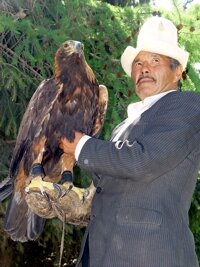
Hunting with the golden eagle is an ancient tradition that dates back to the Mongol conquest of Central Asia around the 12th and 13th centuries, when a fine eagle and good horse cost the same price and both lent prestige to their owner.
Although the practice is gradually disappearing in this area, hunting with birds (especially with eagles) is still practiced in certain regions of Kyrgyzstan and Kazakhstan. Westerners tend to think of this as falconry – and although hunting with hawks and falcons does take place, it is looked down upon by those who hunt with eagles as a pastime for children and dilettantes.
It is one of the aspects of Kyrgyzstan’s traditional nomadic culture which attracts a lot of attention in the press in the West and on travel blogs … along with Kok Buro (“Goat polo”)… mainly, perhaps, because of the dramatic photographic opportunities it offers, (although a number are “negative” as a result of the raw “tooth and claw” nature of the activity).
Hunting takes place riding a specially trained horse, (called a “bercut”). To allow a rider to carry an eagle a special device (a “baldak”) is fitted onto the saddle to support the rider’s arm.
In many demonstrations and displays, however, the berkutchi launches their eagle from a standing position on a hillside rather than from horseback.
Sent out to hunt fawns, foxes, or other small animals, the eagle dives down on them and kills them. But often it is also capable of killing young wolves when they cannot negotiate the deep snow. Sometimes the eagles hunt in pairs, just as they would in the wild.
A skilled pair, berkutchi (hunter) and bird, can typically catch 50 or 60 foxes a dozen badgers, a couple of lynx and 4 or 5 wolves in a normal 4 month season, which starts in the late autumn. Eagles rarely fail to catch their prey, which it quickly kills, usually by breaking the neck in its powerful claws.
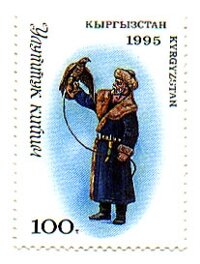
The capture, training and keeping of eagles is a highly ritualised activity, and both the Kazakhs and the Kyrgyz are experts. They even manage to get the bird to kill the prey while scarcely leaving a mark on its fur.
Training eagles takes a lot of time, (3-4 years), must be done by one person, and requires constant daily attention.
Most of the birds, which can have a life expectancy of 40 years, are caught young, hooded and placed in a cage with a perch that constantly sways while the berkutchi sings and chants to it, to imprint the sound of his voice and impress his personality on the bird. (Later on, the eagle is able to distinguish human voices and will obey only that of his master).
The berkutchi feeds the bird himself.
When the eagle is almost an adult, the trainer shows it the hides and furs of the animals it must hunt so that it becomes used to the smell and characteristics of the prey. All of this is done with special commands. Training continues by dragging a fox fur behind a galloping horse.

Not all eagles can be so trained, but those that do show intense loyalty. Although never tethered they always return after killing their prey.
Although there are several people who keep birds and fly them, perhaps the most famous is Tenti, the “Bird Man of Jele Debe”, although now he has retired from active working with Eagles. Jele Debe is a small village near to Djety Oguz in Issyk Kul oblast. Tenti has been hunting with eagles since he was 12 years old, and is one of the master practitioners of the art. He has been featured in newspaper articles all over the world – notably in the US.
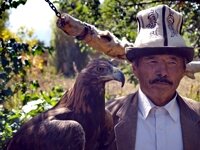
Another famous berkutchik lived on the southern shore of Lake Issyk Kul, at Bokonbaeva: Saganbai. He had four eagles which he cared for. As well as collecting and training his own birds, in the past, he was presented with eagles by both Askar Akaev and Boris Yeltsin for training. His birds were all working birds … in the season they hunted and have been known to catch all sorts of prey including foxes and even wolves. In the closed season he gave demonstrations of this ancient craft. He has been featured in a number of articles in the foreign press – but fame and glory has not “gone to his head”. Justifiably, proud of his skills and the heritage of which he is a living example, Saganbai wrote a book about hunting with eagles as a handbook for training younger berkutchi. His son continues the family tradition offering a glimpse into a world and a lifestyle that is almost lost in the modern world.
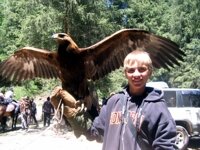
Demonstrations often include the eagle swooping down on a live rabbit, but most berkutchi are aware of Western sensibilities and so intervene before the live bait is actually killed. The eagle is does not go unrewarded for its efforts however, as they offer it a morsel of meat they have brought along for the purpose.
Holding an eagle offers a popular photo opportunity. Most of the eagles are fortunately used to people, (at least in small numbers), and take the experience in their stride, although some the same cannot be said for all the tourists surprised by the size and weight of the birds.
The season for hunting with eagles is from October to February. The larger eagles malt during the summer months and do not fly. So during the tourist season demonstrations of the art are limited to showing the magnificent birds and flying smaller falcons.

.
A blog well worth following is Keen on Kyrgyzstan, written by Dennis Keen, an American who is currently in Kyrgyzstan studying eagle hunting on a Fulbright Fellowship … and contains plenty of photographs whilst he describes both his work and some of his other experiences here in Kyrgyzstan:
http://keenonkyrgyzstan.wordpress.com/
..
.
..




 Bishkek