Free Lunches
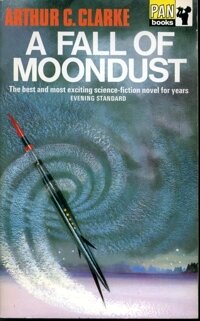
"The best and most exciting science fiction novel for years", at least, according to The Evening Standard
When I was the tender age of thirteen, my English class had a problem … we had the usual task of studying and writing a book report but unfortunately there weren’t enough copies of the chosen book for us all to have one. I can’t remember what the book was but I got selected for special treatment … Mr. Walker, my teacher who was a very prim and proper English country gentleman, doled out the books and when the last one had been given to the boy who sat at the next to me, he gave me a copy of Arthur C. Clarke’s, “A Fall of Moondust“, and told me to do my book report on that instead.
This was basically a submarine rescue story set on the moon, although because the “sea” concerned wasn’t water but sand, (moondust), and moon rock, there was also an element of a mine rescue; all spiced up by the exotic location, (the moon), and all that that involved.
It was my first real introduction to Science Fiction, and I was hooked – at least for a while. Over the years I have read a lot of Arthur C. Clarke and a number of other other famous authors of the genre, but there are some that I must admit to never having read, such as Frank Herbert, (author of the Dune books), or Robert Heinlein.
Robert Heinlein was born on 07/07/07, (1907, that is), and was one of the most influential and controversial authors in the genre, and is usually identified, (along with Arthur C. Clarke and Isaac Asimov – whom I have read), as one of the three masters of science fiction of the so-called “Golden Age of science fiction“. Heinlein was known as the “Dean of Science Fiction” as a result of his insistence on scientific and engineering plausibility in his stories. He is also famous for having coined a number of words that are supposed to have adopted into the English language such as gork, (“to understand intuitively or by empathy; to establish rapport with … to empathise or communicate sympathetically (with); also, to experience enjoyment”), waldo, (a remote manipulator or robot), and Tanstaafl, (There ain’t no such thing as a free lunch).
Recently, I have been reading Atlas Shrugged by Ayn Rand, who would have agreed with Robert Heinlein about there being no such thing as a free lunch. Actually, her point seemed to have been that there were people who not only thought that there was such a thing but that also many who expected one.
There are many people who think that we have become a dependent society, depending on the generosity of donors (whether in the the form of grants or loans), or on the remissions of earnings from Kyrgyz citizens working abroad and sending money back home to their families. Some time ago I saw a breakdown of how much Kyrgyzstan had received over the years, but unfortunately I can’t find it again. I see, however, it was announced that since independence, (1991), Japan has given some five hundred million dollars of assistance to Kyrgyzstan – in programs implemented through the embassy, through the Japanese aid organization, JICA, or channeled through international organizations. There were also comments comments this week about the support offered by Russia and China.
The Finance Minister made some controversial comments on this subject in an interview about the social welfare budget when he said “Kyrgyzstan turns into a country of dependents and welfare recipients”. This is the guy who caused more than a few eyebrows to be raised a few weeks ago with the claim that it was possible to live on about USD100 a month -about 4700 som. Some students tried it … and failed … miserably. They, of course, are still single and don’t have the expense of trying to raise a family … which adds – considerably, as I keep trying to tell the kids – to the cost of living. Perhaps, (at least in that respect), informally “adopting” a family of ten wasn’t the wisest decision I have ever made.
According to him the number of people in need rises every year – I am not sure if he was saying this to simply emphasize the point or if he was actually surprised by it … it doesn’t surprise me as expectations are constantly rising, an increasing number of people reaching retirement and an increasing proportion of the population being children and young people not old enough to enter the workforce, the definitions of need and designation of people in need is constantly refined, (becoming more inclusive – there’s pressure groups, for example, pushing for the rights and need to support children with autism and invalids), and society is getting poorer as the economy seems to struggle from one crisis to another. The 550,000 people receiving pensions, for example, are supported by just 500,000 receiving salaries. That’s quite a burden even if the pensions are ridiculously small. Also, those figures account for just over a million of the over five million population of Kyrgyzstan – so there seems to be a fairly big gap in there somewhere.
I think, however, that he was right in couple of things … “Welfare should be allocated only to those who really need it” and “The whole system of social welfare and support of Kyrgyzstan needs to be reformed” – but then … that’s true everywhere, isn’t it?
One aspect of the dependent society is illustrated by the story surrounding the uncertainty of the future of Kumtor. In many ways the country has been reliant on the performance of one company which has contributed a large share of the budget, and the lions share of the country’s exports. One set of statistics that I saw this week said that in the twenty years since Independence the company has contributed over 30% of the country’s exports, whereas last year it accounted for over 50%.
Although the question of nationalization may have been shelved, that of whether or not to revoke their operating license is still under consideration. I said last week that the share price would need watching and, sure enough, it plummeted wiping millions off the value of Kyrgyzstan’s own holding in the company. At least one director has resigned, and another has stressed that they think the decision to review the license as “unwise”. It was interesting to note that one of the deputies has taken the stand that the issues at stake, (especially that of environmental protection protection) was far more important than and long term that of the value of Centerra’s share. It’s “unforgivable” he said, to destroy in 15-20 years what has been passed down by generations over thousands of years.
The government have also rescinded a grant of 16300 hectares of land granted to Kumtor just before the 2010 revolution, (signed off by the then Prime Minister, Daniar Usenov).
One of the concerns seems to be that the contribution that the company is going to make to the budget – USD10 million – through dividends is considerably less than the government had planned for – USD50 million – and which, at least according to one report, the company had apparently promised. There’s been a commission set up to consider environmental questions and Babanov, the Prime Minister, has made some very critical comments during a visit to the mine. He has also said that we have to sort this out – conduct an international audit, review the situation and draft a new agreement – and he has set a deadline for doing so by October 1st.
If environmental issues are to the fore, it was also interesting to see that parliament is to consider a ban on the import, production and sale of plastic bags. They may be convenient and cheap but they and are not biodegradable and pollute villages and cities. What’s more they are made of non-renewable resources and, the proponents of the measure propose that alternatives, (string, paper and “reusable” bags - which I take to mean, but I could be wrong, biodegradable plastic bags).
Incidentally, talking of gold … and plastic bags … a security guard at the airport found a plastic bag in a recess which contained over four kilograms of a yellow metal, supposedly gold … Hmmm … interesting. It’s all been handed over to the security services along with a suspect thought of having placed it there.
A lack of understanding of environmental issues and a distinct lack of concern for your neighbours was highlighted in one story where some residents in a village in Southern Kyrgyzstan have been taking advantage of good weather to go swimming in a local lake, (Toguz Bulak, or Nine Springs). Unfortunately, it’s not a lake, but a reservoir which provides drinking water to villages downstream.
The parliament has also been busy in the war on Corruption … passing a package of bills which define “corruption” as a crime and lays down a number of measures to address the problem. Sentences, for example, have been increasing between 3 and 5 years to between 12 and 15 years. Anyone applying for a government post is going to have declare their incomes – and those of their close relatives – as part of the application.
There was an interesting story dutring the week where the Prosecutor’s Office accused the head of a local district council in Naryn of making illegal land sales. Needless to say, he denies it, and points the finger at the State Registration Service which, he claims, authorized the sale.
Land and property are a hot issue here. After all, some people say that the disturbances that eventually led to the 2005 revolution ousting the Akaev regime began with protests over a border demarcation deal with China which ended up with Kyrgyzstan handing stretches of land over to their large neighbours. It was als0 a central issue behind the 1990 Osh riots which were a precursor to the 2010 troubles in the city. There are also people who indicate that it plays a role in the troubles experienced by the mining companies. So, another story that broke during the week also proved to be a little worrying. A group of local citizenry in the Issyk Kul trgion have evicted a family from their home, shop and allotment as the result of a local dispute – even though the authorities had warned them that their actions would be illegal.
There was another story involving the arrest of the head of the criminal investigation service and his deputy over the sale of drugs.
The shock of the week, however, (eliciting tweets of “Lightning” and “Who next?”), came with the arrest and detention of the Minister of Social Development on a charge of accepting a bride. The day before, one of his assistants had been arrested, allegedly caught red-handed accepting 10,000 dollars. The story is that he told the authorities that the Minister it was intended for the Minister and should have 20,000 (!) it. As a result they searched his house and when he appeared fro questioning, (voluntarily), the next day, they arrested him and remanded him in solitary confinement. He’s obviously been relieved of his post, for the time being.
The story seems to be that the bribe was connected with an international adoption agency, so we can probably expect some more trouble on that front. The issue was already in the news because the controversial deputy, Jyldyz Djoldosheva, had hit the headlines again with a suggestion that that Kyrgyzstan should impose a moratorium on international adoption – again. There was a moratorium for two years from 2009 until 2011, which was the cause for considerable criticism and heartbreak. In a related story it was reported that in an attempt to balance the books and find a more efficient use of its limited resources, the state is going to close some 29 boarding schools, with the funding being redirected to financing children’s homes and placing children in with foster parents.
Talking of stewardship of limited financial resources, the Finance Minster, (yes, him again!), is under a certain amount of criticism for “refusing” assistance from the European Union for Welfare Support for children in poor families. What intrigued me about the report is that particular report was that there was no indication of exactly what was meant by “refusal” or why he decided to do so.
Talking of finance and education, the construction of 11 new schools in the south of the country has been suspended due to a lack of funding. On the other hand, an agreement has been reached with Kazakhstan to build a large school which would cater for 1000 pupils. In British terms that’s not a particularly large school, but in Kyrgyz terms it is.
Oddly enough, however, it’s being reported that tax revenues for the first half of the year are up – 25% more than last year. That seems pretty impressive to me, if we take the figures at face value, and suggests that something must have happened, (but please don’t ask me what), to bring businesses out of the shadow … because other statistics suggest that economic activity is down on last year. It’s estimated that something between 50-70% of business in Kyrgyzstan is in the shadow economy, and 85% of the budget comes from taxes paid by just 550 enterprises – out of 300,000 that are officially registered.
The budget should soon be about 50,000 som better off after this week, (that’s just over a thousand dollars), because that was the fine imposed on the Russian blogger Vladimir Farafonov for the posts which the authorities said incited ethnic hatred. Both sides have thw possibility to appeal the court’s decision so there is still the possibility for this story to rumble on – not to mention the “threat” from Vladimir Zhirinovsky to take some form of retaliatory measures.
Perhaps the oddest story of the week came in reports on Tuesday that Kurmanbek Bakiev would to return to Osh and announce that he had seized the country. Camps of people preparing to participate in the “invasion” of the country. Most of the international attention, however, is not on Bakiev, but on possible Islamic militants, with claims that Kyrgyzstan is not well prepared to deal with them, and that the Haqqani network seems to be active in the region. If that is true, it could be worrying because they apparently are not averse to working with less religious groups like those of organized crime. At least one commentator I have seen, however, suggests that this could simply be a case of the security services to emphasize a potentialo threat and the need for the resources to counter it.
The Olympics are approaching and I have deliberately been trying to avoid the topic because I think it will get more than enough exposure in about a month’s time … BUT … I felt that I had to draw attention to the fact that Ilya Ignatieff has qualified to participate in the forthcoming games … but he won’t be competing in London … he’ll be making his way to Weymouth and Portland as he is a yachtsman and that’s where the sailing events are being held. It’s the first time Kyrgyzstan has been represented in this sport at the Olympics – which strikes me as quite an achievement for someone from a small landlocked country.
There has been more news in that the flight Istanbul-Bishkek-Ulan Bator has finally started and Turkish Airlines are currently looking at flying to a number of South East Asian destinations via Bishkek.
Oh … and a couple of items of breaking news …
It seems that the US are looking at Tajikistan as an alternative for placing a base in Central Asia after 2014 … Hmmm … now that raises a lot questions.
Having talked so much this week about the Kyrgyz budget, I just had to mention how the news report that Stonehenge is about to undergo a twenty seven million pound “upgrade” brought a smile to my face. The government here has allocated seven million som to the developmetn of tourism in the whole of the country … that’s about GBP100,000.
During the week I have been asked by several people the standard questions including why I came to Kyrgyzstan?, why I have stayed?, do I regret it? and would I do it again? When I live in such interesting times, full of surprises, when nothing is predictable … how can I regret it?
.
.
.
_______________________________________
Postcard from Bishkek: the weekly postcard that I send out as an email also gets posted on the website ianbek.kg each week – and there are other postcards which don’t get sent out. This week, for example, there were postcards about:
- Tax: Evasion, Avoidance, Mitigation, Protest, Resistance … - on Tax Inspectors’ Day I take a look at some concepts relating to people’s attitudes to this unpopular, (but necessary), subject;
- Chiy - a traditional Kyrgyz craft involving decorative art created from winding coloured threads around stems of grass;
- some advice for dealing with the summer heat on what has been designated as Stay out of the Sun Day
- Kongur Ulan - a valley on the Southern shore of Lake Issyk Kul;
- Jogorku Kenesh - on Tynwald Day, (commemorating the world’s oldest parliament), I take a look at the Kyrgyz parliament;
- Rhubarb, rhubarb … - grows naturally in the mountain jailoo but, surprisngly, little is made of it in Kyrgyz cuisine.
It is now possible to follow me on Facebook, (where I have specific pages for Celestial Mountains and ianbek … and also links.kg and Kyrgyz Diary), and on twitter, (@Bishkekpostcard and @celestialMTC ).





 Bishkek
Another EXCELLENT letter………and a lovely typo, charming to think that brides are still employed a bribes