Kongur Ulan
The southern shore of Lake Issyk Kul has a number of interesting sites, (or should that be sights), which are off the beaten track, (that is, off the routes of most tourist itineraries), and yet have something to offer and are worth a detour.
That doesn’t mean to say, however, that they will be deserted; Myortvoye Ozero, (Kyrgyzstan’s own Salt Lake or Dead Sea), for example, or Manzhily Ata are rarely ever deserted.
Kungor Ulan
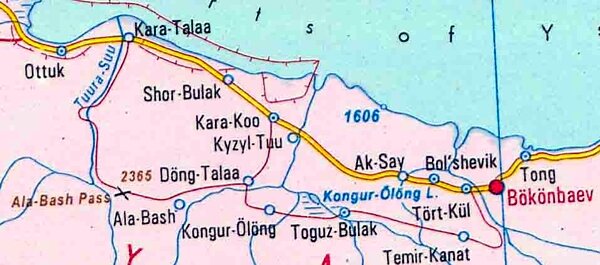
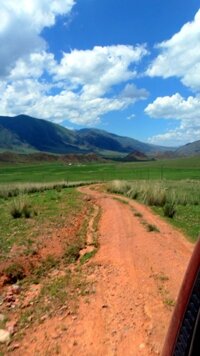
At the Western end of the lake, near to Bokonbaeva there are a number of such sites, including Myortvoye Ozera and Manzhyly Ata). Behind the Terskey Ala Too Range of mountains is the forty kilometer long Kongur Ulan valley, (also known as Kongur Ulen or Kongur Olan). This wide valley of meadows and swamps, runs parallel to the main road, the other side of the mountains, and lies at an altitude of about 2200 meters above sea level, offering scope for walking.
The Western Tuura Suu Valley
Just above the village of Bokonbaeva, (near the village of Tuura Suu), by the side if the River Ton there are a cluster of archaeological sites, monuments and remains; for example: huge stones with petroglyphs and ancient Arabic inscriptions; grindstones that once worked in ancient mills and numerous tumulii or burial mounds. In Tuura Suu itself, archaeologists discovered tombs with stone sarcophagi, covered with huge stone slabs.
(Actually, there are two villages called Tuura Suu in the Kongur Ulan valley – this one at the Eastern end of the valley, a little to the south of Bokonbaeva, which is the larger of the two – and the other at the Western end of the valley.)
Nearby are the ruins of an ancient citadel that dates back to the sixth century, its defensive wall now immersed in the waters of the Tort Kul water reservoir, but with its top still visible above the surface. (For the record: Tort Kul means Four Lakes). There is also evidence that sacrificial altars were once found on the surrounding hilltops.
There is a legend that an 18th century baatyr, (a local Khan or hero, ) called Charota Bulde won the valley with a band of 40 warriors – for each of which was built an elaborate gumbez (mausoleum) when they died. Some of these can still be seen in the village of Kongur Olun.
At the Western end of the Kongur Ulan valley archaeologists have discovered a complex of ancient ruins dating from the 10th, 11th and 12th centuries.
To the West, the valley of Kongur Ulan glides into the valley of Ala Bash, (“mottled head” in Turkic), named for a small mountain capped with red and black rocks which dominates the valley’s center. At the foot of the slopes of Ala Bash there used to be a settlement here and it is said that it is possible to make out the delimitation of the ruins. There are also many petroglyphs depicting hunting scenes and wild goats.
The award wining Kyrgyz film “Beshkempir” (= “Five Old Women”), was shot in the region, in the village of Bar Bulak.
There is a track from here over the mountains to Ece Naryn, but it’s not suitable for vehicles.


 Bishkek