Rhubarb, rhubarb …
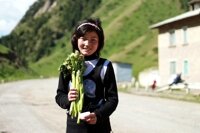
No, she's not saying, "Rhubarb, rhubarb ...": she's offering a bunch of kistleetchka for sale.
There are a couple of places on the road to Naryn where I stop at least once every summer to buy some reven, (known locally as kistleetchka), which grows wild in the high mountain meadows. Children are seen at certain points holding a bunch in their outstretched hands. People stop their cars and buy some which they munch away at on their journey as a sort of travel snack.
It was first introduced to me, (here), as Kyrgyz Pineapple – but that was basically a joke: most people who are introduced to it as such, bite into the green stems and their face then takes on a grimace of surprise because it is not at all sweet like pineapple … but rather sour, or tart.
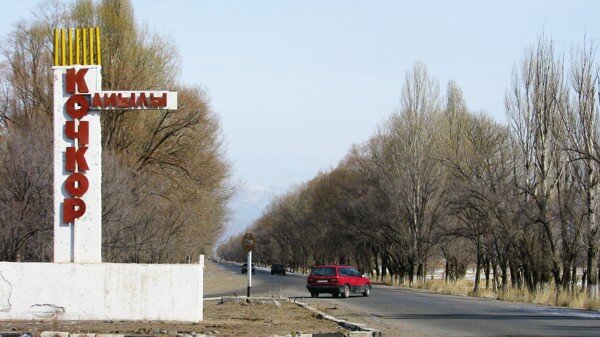
I have searched for it several times in various markets, but have only found it once; in a bazaar in Kochkor, and I once saw a pack of frozen rhubarb in the Turkish supermarket, Beta Stores, in downtown Bishkek. It seems as if all the rhubarb on sale is collected and brought down from the mountains to be sold fresh as bunches of stems … and I can understand that because it goes limp and unattractive very quickly. Nobody seems to cultivate it here, which strikes me as a great pity – but then again, perhaps there wouldn’t be the demand for it to make it worthwhile. However, I would quite like to grow some for my own personal use … but, try as I might, I can’t find a root anywhere and as I am not keen on the thought of digging some up in a jailoo and then transplanting it, (which might well be illegal), so I suppose it will have to remain a pipe dream.
Most of the locals don’t understand what I see in it so, last year, I tried to show them, and in the process made somebody’s day … I am not sure that any of the roadside sellers have every sold 20 bunches in one sale – even so, it was precious little. It went as far as a large(ish) rhubarb crumble and some stewed rhubarb. If I had had some more then rhubarb and apple pie and, (who knows), rhubarb wine may have been on the menu.
Because you add sugar, quite a lot of it, it proved quite a hit with the locals, many of who have a distinct ”sweet tooth”. Despite this, (which I would have thought would be an attraction), the locals tend to eat it raw, cleaning the stem and nibbling.
Rhubarb is quite an interesting plant. It is now cultivated in areas all over the globe. Although it is basically a seasonal plant, in warm climates it will grow all year round. In more temperate or cold climates, then the part of the plant above ground may wither away during the cold winter only to reassert itself the following the spring. In fact because of “greenhouse cultivation” it tends to be available all year round in parts of the West. In Britain it is one of the earliest “crops”, especially where it is “forced” by covering it to encourage upward growth, which has the advantage of producing sweeter and more succulent stems.
It is a perennial herbacious plant where a number of stems rise from a central crown, or root, each topped by a triangular leaf. Many of the cultivated varieties have bright crimson red or light pink stems, which vary from slender to quite thick, but the wild variety found in Kyrgyzstan tend to sport long, thin, green stems. As the plant matures, a flower stem emerges from the root.
It is found in quite a number of uses. From ancient times the Chinese used it as a herb, a laxative. It’s introduction to the West seems to have come as it and other valuable herbs and spices were traded along the Great Silk Road. At one point on history it was known as Turkish Rhubarb, due to its transport through this hub of the great trade route, and the transportation costs made it a expensive commodity. So expensive in fact that in his report of his mission to the court of Timur, (Tamerlane), in Samarkand in 1403-5, the ambassador of Henry III of Castile, Ruy Gonzáles de Clavijo, commented that, “The best of all merchandise coming to Samarkand was from China: especially silks, satins, musk, rubies, diamonds, pearls, and rhubarb…”.
As the plant thrived along the banks of the Volga it later became known as Russian Rhubarb – indeed, the name seems to come from the Greek rha barbarum and it seems that this may be a reference to the River Volga.
Although, in the West, we tend to use it as a fruit, (there is even an American court ruling declaring it to be a Fruit), technically, (botanically), it is a vegetable in that the edible part we eat is the stem and not the seed, (or the seed pouch).
One of the things about the plant that often surprises people is that although the stems are edible, the leaves are toxic.



 Bishkek