Jogorku Kenesh
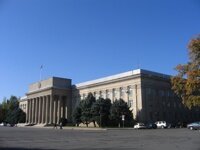
The Jogorku Kenesh (actually ... this used to be the Parliament building - it is now Government House and the parliament now meets in the White House)
Today is Tynwald Day.
The Tynwald is the legislature, (parliament), of the Isle of Man, a self governing Crown Dependency of the United Kingdom, which is located in the Irish Sea between the mainland of Great Britain and Ireland. Although Queen Elizabeth is the Head of State, with the quaint title Lord of Mann, and the British government is responsible for its foreign affairs and defence, it is not actually a part of the United Kingdom.
It is claimed that the Tynwald, (or more properly, the High Court of Tynwald), is the oldest continuous parliamentary body in the world, havingexisted for over 1000 years and consists of the House of Keys, whose members and elected, and the indirectly chosen Legislative Council.
It normally sits in the capital, Douglas, but once a year, (normally on 5th July), holds an open air ceremony at Tynwald Hill at St John’s. Hence the designation of Tynwald Day.
Given that today is Tynwald Day it seemed an appropriate moment to take a look at Kyrgyzstan’s parliament, the Jogorku Kenesh.
The Jogorku Kenesh is the name given to the Supreme Council of Kyrgyzstan. Although it is a modern institution, it is rooted in the distant past.
A Kurultai was a gathering of the people for an important event – an assembly or congress. It was at a Kurultai when a Khan, or tribal leader, would have been elected. The epic saga of Manas describes such a meeting where is elected the Supreme Khan of the Kyrgyz and over the course of history there were several notable examples: such as the one at which Orman Khan was elected supreme Khan, or the one that commissioned Atake Baatyr to travel as ambassador to the Tsar’s court in St. Petersburg, in order to seek Russian assistance against Kokand.
There have been several Kurultai of the Kyrgyz diaspora held since Independence:
- In the summer of 1994 the first Kyrgyz Kurultai, (or “gathering”), took place in Bishkek, and representatives of Kyrgyz communities from various parts of the world (including Australia Saudi Arabia, Canada, Germany, Turkey, China, Afghanistan and the US) attended.
- The second such gathering took place in 1996
- A third meeting was held in 2003.
The term has also been used by political groups wanting to organize protests or opposition to the government. Kurmanbek Bakiev, when he was President, tried to institute a similar sort of consultative council independent of the parliament, and there have also been suggestions that such a structure should be enshrined in the constitution.
The origins of the present institution can probably be traced back to 1924 with the decision to divide the Central Asian nation states and the subsequent creation of the Kara Kyrgyz Autonomous Region, thus unitiing the various tribes and regions of what is now the Kyrgyz Republic into a single unified body. The Presidium of the Central Executive Committee of the RSFSR, (he Russian Soviet Federative Socialist Republic), established a Kyrgyz Revolutionary Committee, with 17 members under the leadership of Imanaliev Aydarbekov.
Over the next few years the governance of the area underwent several reorganizations, each with their own supreme governing body and executive committee. The first proper constitution of the Kyrgyz Autonomous Socialist Soviet Republic created the Congress of Soviets which was the supreme legislative and supervisory body in the republic. This was later restyled as the Supreme Soviet of the Republic.
The current institution is a unicameral, (single chamber), Parliament which has 120 members who are called Deputies.
It has been subject to several reforms in the short history of Independent Kyrgyzstan. At first, there was just one chamber – with 305 members. It was then changed to a two-chamber body with a combined membership of 105 deputies – 60 in the Upper House called the Legislative Assembly, (45 were elected in constituencies and 15 from party-lists,) and 45 in the Lower House called the People’s Representative Assembly. In 2003, a constitional amendment changed this back to a single chamber (of 105 deputies) and under changes introduced in 2007, it consisted of 90 deputies elected on the basis of a “party slate” with a threshold of votes which parties must achieve in order to have a deputy elected.
Deputies are elected for five years and enjoy a certain number of privileges, (for example: immunity from prosecution, they cannot be detained, arrested, or searched except for cases when they are caught “red handed” and criminal proceedings cannot be instituted against a deputy without the permission of the Jorgorku Kenesh … all of these were important considerations in the curious case of the Matroshka Doll). However, there as also some restrictions on their activities, for example: they cannot be involved in entrepreneurial activities or be employed in public service; they must be Kyrgyz citizens over the age of 25 and have lived in the Republic for five years; they cannot be a member of a local Kenesh (council) at the same time and they cannot have a criminal record.
At the first meeting following the election, which must take place within days of the results being announced, the eldest deputy convenes the meeting and an oath of office is administered. The deputies elect one of their number as Toraga, or Speaker, or Chairman, to preside over their proceedings, and one or more deputies.
The parliament has committees for the consideration of legislation, although it can establish further commissions for specific purposes.
The powers allocated to the parliament are extensive and include:
- introduction of constitutional amendments;
- the adoption of laws;
- official interpretation of the Constitution and law;
- alteration of the borders of the Kyrgyz Republic;
- deciding matters of administrative and territorial structure of the Kyrgyz Republic;
- arrangement of presidential elections;
- approval of the republican budget and the report on its implementation; nation-wide programs for social and economic development; the structure of the Government recommended by the President
- giving consent to the appointment of the Prime Minister; members of the Government; judges; the General Prosecutor; the Chairman of the National Bank; Chairman of the Central Electoral Commission; the Chairman of the Auditing Chamber
- expression of a vote of no confidence in the Government;
- election and dismissal of the Chairman, deputy, and judges of both the Constitutional Court and the Supreme Court; half of the members of the Central Electoral Commission and the Ombudsman (Akyikatchi) of the Kyrgyz Republic and his deputies;
- appointment of half of the auditors of the Accounts Chamber;
- ratification and denunciation of international treaties, except for the certain specific cases envisaged in the constitution;
- introduction of states of emergency, including the authorization or annulment of decrees of the President of the Kyrgyz Republic concerning this issue;
- deciding matters of war and peace; including the possibility of using the Armed Forces beyond its borders when necessary to fulfill international treaty obligations in support of peace and security;
- establishing military ranks, diplomatic ranks, class categories and other special titles; state awards and honorary titles ;
- issuing acts of amnesty;
- hearing addresses and statements by the President of the Kyrgyz Republic; speeches of the leaders and other representatives of foreign countries and/or international organizations; annual reports of the Constitutional court, the Ombudsman, the Prime Minister, General Prosecutor of the Kyrgyz Republic, Chair of the National Bank and Chair of the Accounting Chamber;
- dismissal of the President of the Kyrgyz Republic from office.
Elections to the Jogorku Kenesh have been controversial, and judged by observers to be flawed. For example, in the two rounds of elections held in February/March 2005, more than 400 candidates ran for the new 75-member unicameral legislative assembly, most of whom were officially independent. Only six seats were won by “opposition” politicians and international observers said the elections “fell short of international standards for democratic elections “in several important areas. Widespread protests over the alleged rigging of the election by the government culminated in the Tulip Revolution and the downfall of President Askar Akaev who fled the country and later resigned.
Although elected for five years the President can dismiss the parliament early and call for new elections. This was done in 2008. Candidates of the newly established presidential political party, Ak Zhol, stood for election for the first time, but took virtually all the seats. This was also the first time new rules for the elections which required that successful candidates were to be selected from party lists - and for a candidate to be successfully elected, the party had to achieve a threshold of votes both within the particular constituency and across the country. The threshold was set quite high and Ak Zhol was the only party to achieve this level of votes. The threshold was overturned following an appeal to the courts – by the Ak Zhol party.
Following the revolution of 2010, the new government decided to move the country away from the Presidential form of government, (which they saw as leading to the excesses of the Akaev and Bakiev regimes which resulted from the domination of the country by one person, family or faction), to a system of Parliamentary Democracy. This approach was approved in a referendum in late June, 2010, but many commentators consider that this was more a result of the shock and repulsion to the events in Southern Kyrgyzstan earlier in the month rather than a positive expression of support for the new system.
Indeed, there have been many calls for a return to a Presidential system of government, especially as the parliament has, (according to some critics), failed to prove itself as an effective form of government.
In the elections following the referendum, a total of 57 parties contested for seats allocated on a part list system. Parties had to pass a threshold of votes, and only five managed to achieve this, (although a sixth party came perilously close and some say were actually deprived of representation in the parliament by some manipulation of the voting statistics).
Like many parliaments around the world, the Jogorku Kenesh has been prone to its own share of scandal and controversy ranging from arguments on the floor of the house to allegations of corruption; from fisticuffs between members to the assassination of deputies.
The Parliament building in the Old Square, (or Central Square – behind the Historical Museum), was built in 1936 and served as the Government House – until the current Government House (The White House) was built in 1984. In 1964 it underwent a considerable renovation following a visit by the then General Secretary, Nikita Khrushchev, who declared that the building was in a bad state of repair and did not a suitable building to house the government of one of the republics of the Soviet Union. It has undergone further renovation also in recent years.




 Bishkek