The legends of Cholpon Ata
It’s that time of year again. Time for a trip up to Lake Issyk Kul.
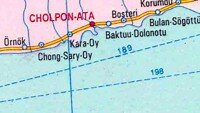
The kids have been nagging me for two years now, that they want to visit the Aqua Park at the Zolotoi Peskiy (Golden Sands) resort in the village of Bosteri, just a little bit further up the coast from Cholpon Ata.
Two years ago, for our first visit to the lake, we went a little to early, before the park opened for the season. Then, last year, we just didn’t have the time or a vehicle to take us there from the resort where we were staying.
This year, however, we have arranged to stay with some friends who have a house just beyond Cholpon Ata, on the way to Bosteri, so they are full of hope and expectation that, this time, we will finally make it.
Cholpon Ata holds a special place in the affection of the locals. It’s the largest settlement on the northern shore and is the centre of the resort zone. But apart from these practical points it also has a particular romantic appeal as a result of the legends about how it got its name.
For example, I remember that, once, when I was on the panel examining a number of students on a Guide’s course, one of the questions they were asked was: “What is your favourite traditional Kyrgyz legend?” We decided to adapt the question after the third candidate, and ask each student to tell a specific legend in turn, because the first three had all chosen the legend of Cholpon Ata and we began to wonder if they had learned any other legends on the course.
In fact, yes, they had, and the others told the legends we asked them to recount quite adequately, but for a while we were concerned.
So what is the legend of Cholpon Ata?
.
Once upon a time, a long time ago … so long ago that the people have forgotten exactly when it was, under a high mountain there was a city and above the city towered the fortress of powerful khan. The khan was famous for his riches – but more than that, for his cruelty. Each day, some citizen was killed and his body thrown into the ground.
The old khan was lecherous and he heard that one poor peasant had daughter of inexpressible beauty. The Khan decided that he must have this beautiful girl.
The girl and her father lived in small village, in a valley in the mountains, on a coast of the river. A lot of the young men from all around (Dzhigits) tried to win her hear, but she did not pay any of them any attention. To offers of love and marriage, from even the most courageous Dzhigits, she always answered, that she loved another.
Who was this beloved? – nobody knew, and she did not know either …
It came to pass – one day, when the sun peeped over the top of mountains, a Dzhigit on white steed came and together they rode off into the sky. A whirlwind blew-up and took them to mountain top covered with eternal snow. The strong Dzhigit embraced her, kissed her, then removed from his hand a ring and gave it to her. Placing it on her finger, he said: “I will soon return! Never remove this ring, and unhappiness will not touch you!”
Many days have passed, but the Dzhigit did not come back.
When the Khan’s matchmakers arrived to the girl’s village with gifts and offers – she rejected them all saying: “I love another and I shall not be another’s wife!”
The girl went up into the mountains, hoping to find once more the Dzhigit. In vain she called his name, only the echo of her own voice returned to her. The girl began to cry and started to make her way back home. She had not reached her village, when she was surrounded, seized, tied up and blindfolded by a gang of youths. When she was released and the blindfold removed she realized what had happened, that she was held prisoner in the Khan’s fortress, from which it was impossible to escape. It is better to die, she decided, than to become the wife of the Khan.
Her beauty and youth surprised the old Khan. He showered gifts upon her. But no gifts could win her over and make her change her mind. “I love another and I shall never be yours!”, was always her answer.
This ‘stubbornness’ displeased the Khan, and he decided to take by force what he could not win with gifts. He again came to the girl, promising her love, everything, … even freedom.
“I love another!” – she repeated. The Khan rushed at her like a wild animal and she ran to a window. “I shall not be yours!”, she cried and threw herself from the window onto the ground below.
From where she fell at the foot of the high and might walls of the fortress, opened up caves and water gushed from them. From them flowed the waters light-blue, pure, clean, crystal clear, and as hot as the maiden heart, which formed the mountain lake, which the people called Issyk Kul.
It is said that if you stand on the shore at Cholpon Ata (“Cholpon’s Father”) you can see in the mountains opposite the face of the girl’s father who’s tears flow down the mountainside to add to the salt waters of the lake as he weeps for his beautiful daughter who threw herself from the window high in the Khan’s citadel, rather than succumb to his evil advances and betray her true beloved. And, on quiet summer evenings, when the sun sets, the ruins of a fortress appear under the water and the voice of the girl can be heard.
Adapted from : Kyrgyz National Fairy Tales – Bishkek – 1977 .
.
As I said, this is often quoted as their favourite legend by many Kyrgyz – and the story of the sunken citadel may well refer to one of the sunken cities that archaeologists have discovered under the waters of the salt water mountain lake – Issyk Kul.
There is, however, another legend about Cholpon Ata … that refers back to original homeland of the Kyrgyz, on the banks of the Yenesei River in Siberia:
.
At the time the Khan of the Khankass tribe were living on the banks of the Yenesei, there was a kind and prosperous man who had two children: a son called Atabek and a daughter called Cholpon. One day he bacame very ill and read in a holy book that only the water from the “hot lake” could cure him, that only his children could get the water for him and that their way would be difficult. The lake was very distant, in the mountains, and was guarded by two batyrs: Kungei and Terskey.
The Khan summoned his children and asked them for advice. They loved their very much and so gathered together a band of djigits, (young men or warriors), to travel with them in search of the curative lake. After a difficult journey they eventually found it. When they arrived at the shore of the lake, Kungei Baatyr was sleeping and they managed to collect a bowl of lake water. As they were about to leave, however, Kungei woke up, captured them and chained them up by the lake shore.
When he saw Cholpon, however, he fell n love with her. He took the precious bowl of water from out of her hands and threw it with such strength that it flew all the way to the Khan’s palace on the banks of the Yenesei. The Khan took the bowl of water and washed himself in it and was cured.
Concerned about his children he once more consulted the Holy Book form which he had first learned about the lake. There it said that the Khan should take his kingdom and move to the hot lake. So he packed up his belongings, collected his people and they all moved together to their new home by the side of the beautiful lake and the place where Atabek and Cholpon had been kept chained was given the name Cholpon Ata – Cholpon’s Father – in his honour.




 Bishkek